

Chapter 5
Supersonic Wind Tunnels
5.1 Convergent-Divergent Nozzle
To begin with, the generation of a supersonic flow requires a convergent duct and
an upstream/downstream pressure ratio sufficient to achieve sonic velocity at the
duct minimum section or throat. Downstream, the velocity of the flow continues
to increase and becomes supersonic if the section of the duct increases (Hugoniot’s
relationship) and if a low enough pressure is maintained. Such a convergent-divergent
nozzle is sometimes called a de Laval nozzle named after its inventor, the Swedish
engineer Gustaf de Laval. The laws of thermodynamics and fluid dynamics make it
possible to establish the following relation, usually referred as the isentropic relation
for flow in converging-diverging (CD) nozzles, which provides a critical area relation
between the cross section A of the duct and the Mach number, M:
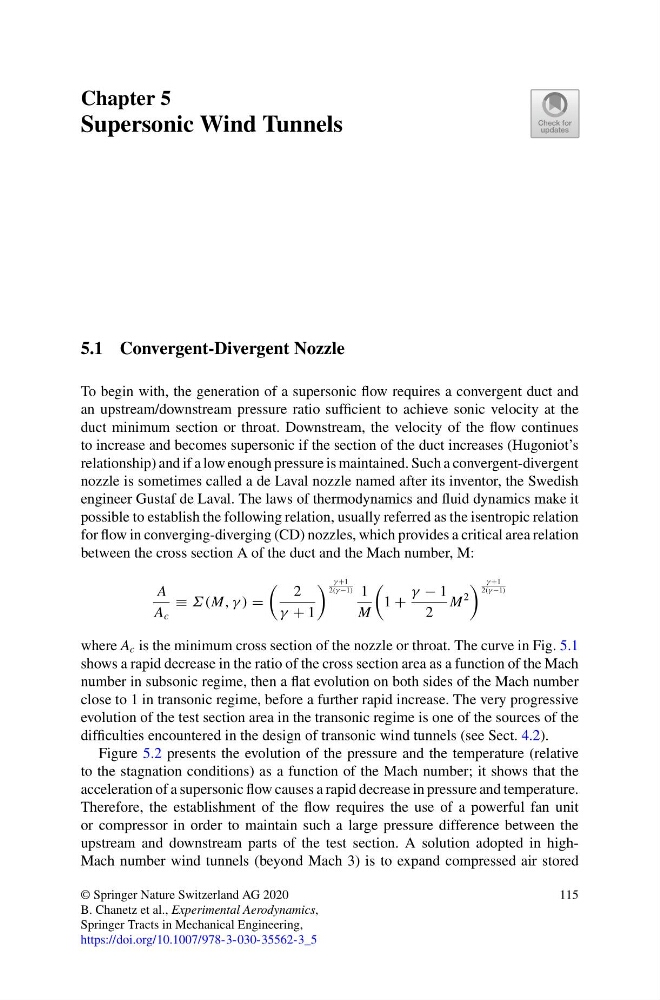
A
A c
≡ Σ(M, γ ) =
2
γ + 1
γ +1
2(γ −1) 1
M
1 +
γ − 1
2
M
2
γ +1
2(γ −1)
where A c is the minimum cross section of the nozzle or throat. The curve in Fig. 5.1
shows a rapid decrease in the ratio of the cross section area as a function of the Mach
number in subsonic regime, then a flat evolution on both sides of the Mach number
close to 1 in transonic regime, before a further rapid increase. The very progressive
evolution of the test section area in the transonic regime is one of the sources of the
difficulties encountered in the design of transonic wind tunnels (see Sect. 4.2).
Figure 5.2 presents the evolution of the pressure and the temperature (relative
to the stagnation conditions) as a function of the Mach number; it shows that the
acceleration of a supersonic flow causes a rapid decrease in pressure and temperature.
Therefore, the establishment of the flow requires the use of a powerful fan unit
or compressor in order to maintain such a large pressure difference between the
upstream and downstream parts of the test section. A solution adopted in highMach number wind tunnels (beyond Mach 3) is to expand compressed air stored
© Springer Nature Switzerland AG 2020
B. Chanetz et al., Experimental Aerodynamics,
Springer Tracts in Mechanical Engineering,
https://doi.org/10.1007/978-3-030-35562-3_5
115
Supersonic Wind Tunnels
5.1 Convergent-Divergent Nozzle
To begin with, the generation of a supersonic flow requires a convergent duct and
an upstream/downstream pressure ratio sufficient to achieve sonic velocity at the
duct minimum section or throat. Downstream, the velocity of the flow continues
to increase and becomes supersonic if the section of the duct increases (Hugoniot’s
relationship) and if a low enough pressure is maintained. Such a convergent-divergent
nozzle is sometimes called a de Laval nozzle named after its inventor, the Swedish
engineer Gustaf de Laval. The laws of thermodynamics and fluid dynamics make it
possible to establish the following relation, usually referred as the isentropic relation
for flow in converging-diverging (CD) nozzles, which provides a critical area relation
between the cross section A of the duct and the Mach number, M:
A
A c
≡ Σ(M, γ ) =
2
γ + 1
γ +1
2(γ −1) 1
M
1 +
γ − 1
2
M
2
γ +1
2(γ −1)
where A c is the minimum cross section of the nozzle or throat. The curve in Fig. 5.1
shows a rapid decrease in the ratio of the cross section area as a function of the Mach
number in subsonic regime, then a flat evolution on both sides of the Mach number
close to 1 in transonic regime, before a further rapid increase. The very progressive
evolution of the test section area in the transonic regime is one of the sources of the
difficulties encountered in the design of transonic wind tunnels (see Sect. 4.2).
Figure 5.2 presents the evolution of the pressure and the temperature (relative
to the stagnation conditions) as a function of the Mach number; it shows that the
acceleration of a supersonic flow causes a rapid decrease in pressure and temperature.
Therefore, the establishment of the flow requires the use of a powerful fan unit
or compressor in order to maintain such a large pressure difference between the
upstream and downstream parts of the test section. A solution adopted in highMach number wind tunnels (beyond Mach 3) is to expand compressed air stored
© Springer Nature Switzerland AG 2020
B. Chanetz et al., Experimental Aerodynamics,
Springer Tracts in Mechanical Engineering,
https://doi.org/10.1007/978-3-030-35562-3_5
115