

4.3 Typical Transonic Wind Tunnels
109
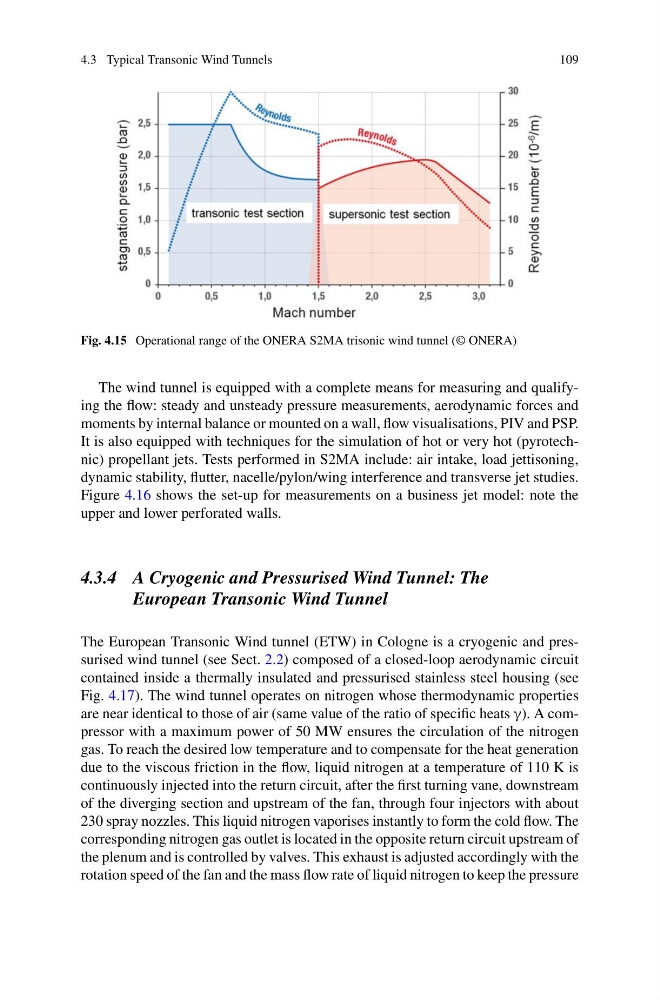
Fig. 4.15 Operational range of the ONERA S2MA trisonic wind tunnel (© ONERA)
The wind tunnel is equipped with a complete means for measuring and qualifying the flow: steady and unsteady pressure measurements, aerodynamic forces and
moments by internal balance or mounted on a wall, flow visualisations, PIV and PSP.
It is also equipped with techniques for the simulation of hot or very hot (pyrotechnic) propellant jets. Tests performed in S2MA include: air intake, load jettisoning,
dynamic stability, flutter, nacelle/pylon/wing interference and transverse jet studies.
Figure 4.16 shows the set-up for measurements on a business jet model: note the
upper and lower perforated walls.
4.3.4 A Cryogenic and Pressurised Wind Tunnel: The
European Transonic Wind Tunnel
The European Transonic Wind tunnel (ETW) in Cologne is a cryogenic and pressurised wind tunnel (see Sect. 2.2) composed of a closed-loop aerodynamic circuit
contained inside a thermally insulated and pressurised stainless steel housing (see
Fig. 4.17). The wind tunnel operates on nitrogen whose thermodynamic properties
are near identical to those of air (same value of the ratio of specific heats γ). A compressor with a maximum power of 50 MW ensures the circulation of the nitrogen
gas. To reach the desired low temperature and to compensate for the heat generation
due to the viscous friction in the flow, liquid nitrogen at a temperature of 110 K is
continuously injected into the return circuit, after the first turning vane, downstream
of the diverging section and upstream of the fan, through four injectors with about
230 spray nozzles. This liquid nitrogen vaporises instantly to form the cold flow. The
corresponding nitrogen gas outlet is located in the opposite return circuit upstream of
the plenum and is controlled by valves. This exhaust is adjusted accordingly with the
rotation speed of the fan and the mass flow rate of liquid nitrogen to keep the pressure
109
Fig. 4.15 Operational range of the ONERA S2MA trisonic wind tunnel (© ONERA)
The wind tunnel is equipped with a complete means for measuring and qualifying the flow: steady and unsteady pressure measurements, aerodynamic forces and
moments by internal balance or mounted on a wall, flow visualisations, PIV and PSP.
It is also equipped with techniques for the simulation of hot or very hot (pyrotechnic) propellant jets. Tests performed in S2MA include: air intake, load jettisoning,
dynamic stability, flutter, nacelle/pylon/wing interference and transverse jet studies.
Figure 4.16 shows the set-up for measurements on a business jet model: note the
upper and lower perforated walls.
4.3.4 A Cryogenic and Pressurised Wind Tunnel: The
European Transonic Wind Tunnel
The European Transonic Wind tunnel (ETW) in Cologne is a cryogenic and pressurised wind tunnel (see Sect. 2.2) composed of a closed-loop aerodynamic circuit
contained inside a thermally insulated and pressurised stainless steel housing (see
Fig. 4.17). The wind tunnel operates on nitrogen whose thermodynamic properties
are near identical to those of air (same value of the ratio of specific heats γ). A compressor with a maximum power of 50 MW ensures the circulation of the nitrogen
gas. To reach the desired low temperature and to compensate for the heat generation
due to the viscous friction in the flow, liquid nitrogen at a temperature of 110 K is
continuously injected into the return circuit, after the first turning vane, downstream
of the diverging section and upstream of the fan, through four injectors with about
230 spray nozzles. This liquid nitrogen vaporises instantly to form the cold flow. The
corresponding nitrogen gas outlet is located in the opposite return circuit upstream of
the plenum and is controlled by valves. This exhaust is adjusted accordingly with the
rotation speed of the fan and the mass flow rate of liquid nitrogen to keep the pressure