

4.3 Typical Transonic Wind Tunnels
105
and 333 K. Depending on the Mach number and the external temperature a Reynolds
number of about 10
7 /m can be attained at Mach 1.
The wind tunnel has a very complete set of means to quantity the flows including
measurement of forces, steady and unsteady pressures (by PSP in particular), and
for qualitative measurements, infrared thermography for heat fluxes, visualisations
by smoke or viscous coating and the detection of the transition by naphthalene
sublimation. A diverse range of rigs are available for testing propulsive jets, helicopter
rotors, propellers or air intakes.
The wind tunnel also allows for icing tests and probing the flow around the model.
Among the tests carried out in S1MA, are tests on a complete airplane model with
aerodynamic forces measurement by 6-component balance and also measurements
on helicopter rotors, on full-scale missiles, on interferences nacelle/pylon/wing (with
nacelle equipped with TPS, see Sect. 2.7), on load jettisoning, on the control of the
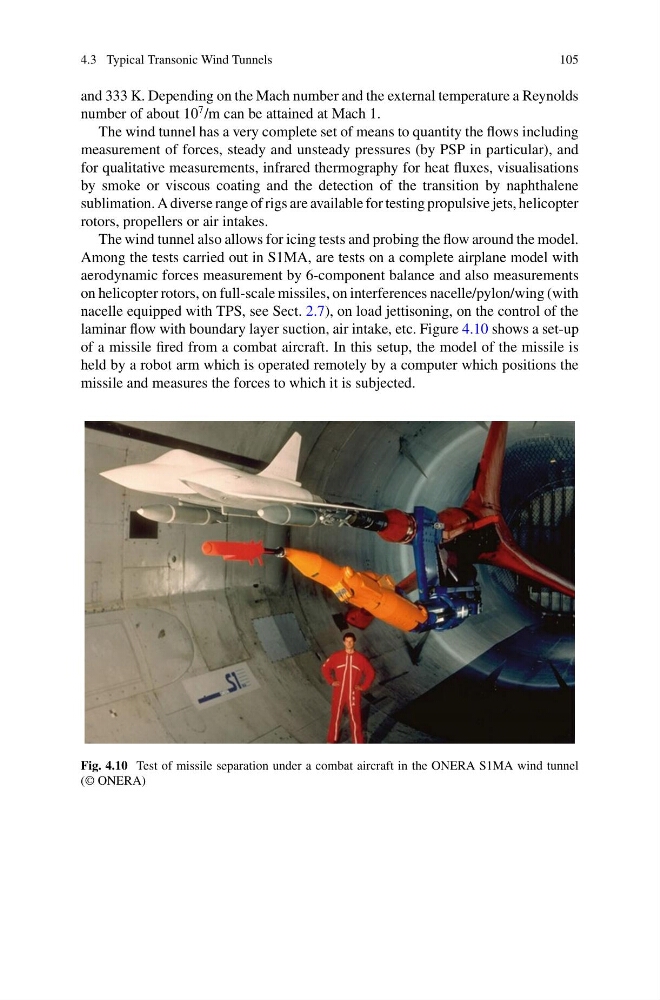
laminar flow with boundary layer suction, air intake, etc. Figure 4.10 shows a set-up
of a missile fired from a combat aircraft. In this setup, the model of the missile is
held by a robot arm which is operated remotely by a computer which positions the
missile and measures the forces to which it is subjected.
Fig. 4.10 Test of missile separation under a combat aircraft in the ONERA S1MA wind tunnel
(© ONERA)
105
and 333 K. Depending on the Mach number and the external temperature a Reynolds
number of about 10
7 /m can be attained at Mach 1.
The wind tunnel has a very complete set of means to quantity the flows including
measurement of forces, steady and unsteady pressures (by PSP in particular), and
for qualitative measurements, infrared thermography for heat fluxes, visualisations
by smoke or viscous coating and the detection of the transition by naphthalene
sublimation. A diverse range of rigs are available for testing propulsive jets, helicopter
rotors, propellers or air intakes.
The wind tunnel also allows for icing tests and probing the flow around the model.
Among the tests carried out in S1MA, are tests on a complete airplane model with
aerodynamic forces measurement by 6-component balance and also measurements
on helicopter rotors, on full-scale missiles, on interferences nacelle/pylon/wing (with
nacelle equipped with TPS, see Sect. 2.7), on load jettisoning, on the control of the
laminar flow with boundary layer suction, air intake, etc. Figure 4.10 shows a set-up
of a missile fired from a combat aircraft. In this setup, the model of the missile is
held by a robot arm which is operated remotely by a computer which positions the
missile and measures the forces to which it is subjected.
Fig. 4.10 Test of missile separation under a combat aircraft in the ONERA S1MA wind tunnel
(© ONERA)