

62
S. Kerbstadt et al.
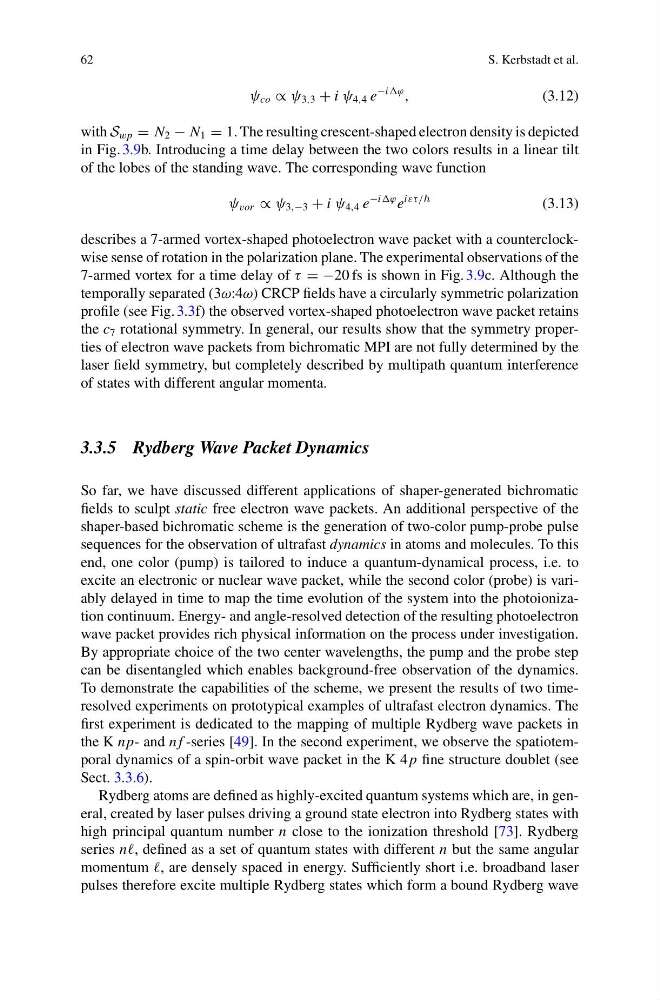
ψ co ∝ ψ 3,3 + i ψ 4,4 e
−iϕ
,
(3.12)
with S wp = N 2 − N 1 = 1. The resulting crescent-shaped electron density is depicted
in Fig. 3.9b. Introducing a time delay between the two colors results in a linear tilt
of the lobes of the standing wave. The corresponding wave function
ψ vor ∝ ψ 3,−3 + i ψ 4,4 e
−iϕ e
iετ/
(3.13)
describes a 7-armed vortex-shaped photoelectron wave packet with a counterclockwise sense of rotation in the polarization plane. The experimental observations of the
7-armed vortex for a time delay of τ = −20 fs is shown in Fig. 3.9c. Although the
temporally separated (3ω:4ω) CRCP fields have a circularly symmetric polarization
profile (see Fig. 3.3f) the observed vortex-shaped photoelectron wave packet retains
the c 7 rotational symmetry. In general, our results show that the symmetry properties of electron wave packets from bichromatic MPI are not fully determined by the
laser field symmetry, but completely described by multipath quantum interference
of states with different angular momenta.
3.3.5 Rydberg Wave Packet Dynamics
So far, we have discussed different applications of shaper-generated bichromatic
fields to sculpt static free electron wave packets. An additional perspective of the
shaper-based bichromatic scheme is the generation of two-color pump-probe pulse
sequences for the observation of ultrafast dynamics in atoms and molecules. To this
end, one color (pump) is tailored to induce a quantum-dynamical process, i.e. to
excite an electronic or nuclear wave packet, while the second color (probe) is variably delayed in time to map the time evolution of the system into the photoionization continuum. Energy- and angle-resolved detection of the resulting photoelectron
wave packet provides rich physical information on the process under investigation.
By appropriate choice of the two center wavelengths, the pump and the probe step
can be disentangled which enables background-free observation of the dynamics.
To demonstrate the capabilities of the scheme, we present the results of two timeresolved experiments on prototypical examples of ultrafast electron dynamics. The
first experiment is dedicated to the mapping of multiple Rydberg wave packets in
the K np- and n f -series [49]. In the second experiment, we observe the spatiotemporal dynamics of a spin-orbit wave packet in the K 4 p fine structure doublet (see
Sect. 3.3.6).
Rydberg atoms are defined as highly-excited quantum systems which are, in general, created by laser pulses driving a ground state electron into Rydberg states with
high principal quantum number n close to the ionization threshold [73]. Rydberg
series n, defined as a set of quantum states with different n but the same angular
momentum , are densely spaced in energy. Sufficiently short i.e. broadband laser
pulses therefore excite multiple Rydberg states which form a bound Rydberg wave
S. Kerbstadt et al.
ψ co ∝ ψ 3,3 + i ψ 4,4 e
−iϕ
,
(3.12)
with S wp = N 2 − N 1 = 1. The resulting crescent-shaped electron density is depicted
in Fig. 3.9b. Introducing a time delay between the two colors results in a linear tilt
of the lobes of the standing wave. The corresponding wave function
ψ vor ∝ ψ 3,−3 + i ψ 4,4 e
−iϕ e
iετ/
(3.13)
describes a 7-armed vortex-shaped photoelectron wave packet with a counterclockwise sense of rotation in the polarization plane. The experimental observations of the
7-armed vortex for a time delay of τ = −20 fs is shown in Fig. 3.9c. Although the
temporally separated (3ω:4ω) CRCP fields have a circularly symmetric polarization
profile (see Fig. 3.3f) the observed vortex-shaped photoelectron wave packet retains
the c 7 rotational symmetry. In general, our results show that the symmetry properties of electron wave packets from bichromatic MPI are not fully determined by the
laser field symmetry, but completely described by multipath quantum interference
of states with different angular momenta.
3.3.5 Rydberg Wave Packet Dynamics
So far, we have discussed different applications of shaper-generated bichromatic
fields to sculpt static free electron wave packets. An additional perspective of the
shaper-based bichromatic scheme is the generation of two-color pump-probe pulse
sequences for the observation of ultrafast dynamics in atoms and molecules. To this
end, one color (pump) is tailored to induce a quantum-dynamical process, i.e. to
excite an electronic or nuclear wave packet, while the second color (probe) is variably delayed in time to map the time evolution of the system into the photoionization continuum. Energy- and angle-resolved detection of the resulting photoelectron
wave packet provides rich physical information on the process under investigation.
By appropriate choice of the two center wavelengths, the pump and the probe step
can be disentangled which enables background-free observation of the dynamics.
To demonstrate the capabilities of the scheme, we present the results of two timeresolved experiments on prototypical examples of ultrafast electron dynamics. The
first experiment is dedicated to the mapping of multiple Rydberg wave packets in
the K np- and n f -series [49]. In the second experiment, we observe the spatiotemporal dynamics of a spin-orbit wave packet in the K 4 p fine structure doublet (see
Sect. 3.3.6).
Rydberg atoms are defined as highly-excited quantum systems which are, in general, created by laser pulses driving a ground state electron into Rydberg states with
high principal quantum number n close to the ionization threshold [73]. Rydberg
series n, defined as a set of quantum states with different n but the same angular
momentum , are densely spaced in energy. Sufficiently short i.e. broadband laser
pulses therefore excite multiple Rydberg states which form a bound Rydberg wave