

56
S. Kerbstadt et al.
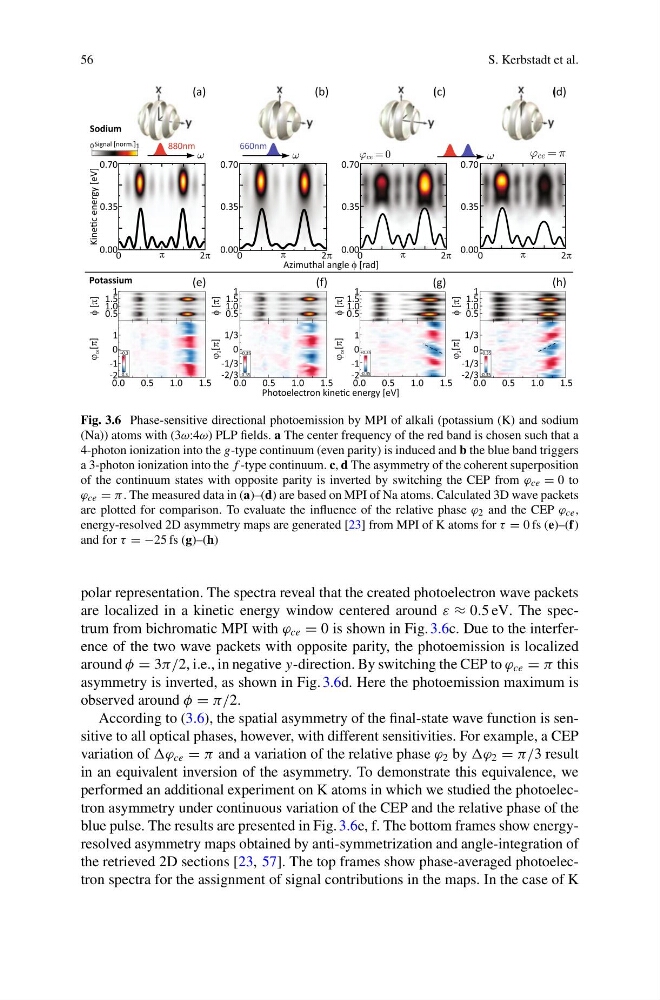
Fig. 3.6 Phase-sensitive directional photoemission by MPI of alkali (potassium (K) and sodium
(Na)) atoms with (3ω:4ω) PLP fields. a The center frequency of the red band is chosen such that a
4-photon ionization into the g-type continuum (even parity) is induced and b the blue band triggers
a 3-photon ionization into the f -type continuum. c, d The asymmetry of the coherent superposition
of the continuum states with opposite parity is inverted by switching the CEP from ϕ ce = 0 to
ϕ ce = π . The measured data in (a)–(d) are based on MPI of Na atoms. Calculated 3D wave packets
are plotted for comparison. To evaluate the influence of the relative phase ϕ 2 and the CEP ϕ ce ,
energy-resolved 2D asymmetry maps are generated [23] from MPI of K atoms for τ = 0 fs (e)–(f)
and for τ = −25 fs (g)–(h)
polar representation. The spectra reveal that the created photoelectron wave packets
are localized in a kinetic energy window centered around ε ≈ 0.5 eV. The spectrum from bichromatic MPI with ϕ ce = 0 is shown in Fig. 3.6c. Due to the interference of the two wave packets with opposite parity, the photoemission is localized
around φ = 3π/2, i.e., in negative y-direction. By switching the CEP to ϕ ce = π this
asymmetry is inverted, as shown in Fig. 3.6d. Here the photoemission maximum is
observed around φ = π/2.
According to (3.6), the spatial asymmetry of the final-state wave function is sensitive to all optical phases, however, with different sensitivities. For example, a CEP
variation of ϕ ce = π and a variation of the relative phase ϕ 2 by 2 = π/3 result
in an equivalent inversion of the asymmetry. To demonstrate this equivalence, we
performed an additional experiment on K atoms in which we studied the photoelectron asymmetry under continuous variation of the CEP and the relative phase of the
blue pulse. The results are presented in Fig. 3.6e, f. The bottom frames show energyresolved asymmetry maps obtained by anti-symmetrization and angle-integration of
the retrieved 2D sections [23, 57]. The top frames show phase-averaged photoelectron spectra for the assignment of signal contributions in the maps. In the case of K
S. Kerbstadt et al.
Fig. 3.6 Phase-sensitive directional photoemission by MPI of alkali (potassium (K) and sodium
(Na)) atoms with (3ω:4ω) PLP fields. a The center frequency of the red band is chosen such that a
4-photon ionization into the g-type continuum (even parity) is induced and b the blue band triggers
a 3-photon ionization into the f -type continuum. c, d The asymmetry of the coherent superposition
of the continuum states with opposite parity is inverted by switching the CEP from ϕ ce = 0 to
ϕ ce = π . The measured data in (a)–(d) are based on MPI of Na atoms. Calculated 3D wave packets
are plotted for comparison. To evaluate the influence of the relative phase ϕ 2 and the CEP ϕ ce ,
energy-resolved 2D asymmetry maps are generated [23] from MPI of K atoms for τ = 0 fs (e)–(f)
and for τ = −25 fs (g)–(h)
polar representation. The spectra reveal that the created photoelectron wave packets
are localized in a kinetic energy window centered around ε ≈ 0.5 eV. The spectrum from bichromatic MPI with ϕ ce = 0 is shown in Fig. 3.6c. Due to the interference of the two wave packets with opposite parity, the photoemission is localized
around φ = 3π/2, i.e., in negative y-direction. By switching the CEP to ϕ ce = π this
asymmetry is inverted, as shown in Fig. 3.6d. Here the photoemission maximum is
observed around φ = π/2.
According to (3.6), the spatial asymmetry of the final-state wave function is sensitive to all optical phases, however, with different sensitivities. For example, a CEP
variation of ϕ ce = π and a variation of the relative phase ϕ 2 by 2 = π/3 result
in an equivalent inversion of the asymmetry. To demonstrate this equivalence, we
performed an additional experiment on K atoms in which we studied the photoelectron asymmetry under continuous variation of the CEP and the relative phase of the
blue pulse. The results are presented in Fig. 3.6e, f. The bottom frames show energyresolved asymmetry maps obtained by anti-symmetrization and angle-integration of
the retrieved 2D sections [23, 57]. The top frames show phase-averaged photoelectron spectra for the assignment of signal contributions in the maps. In the case of K