

52
S. Kerbstadt et al.
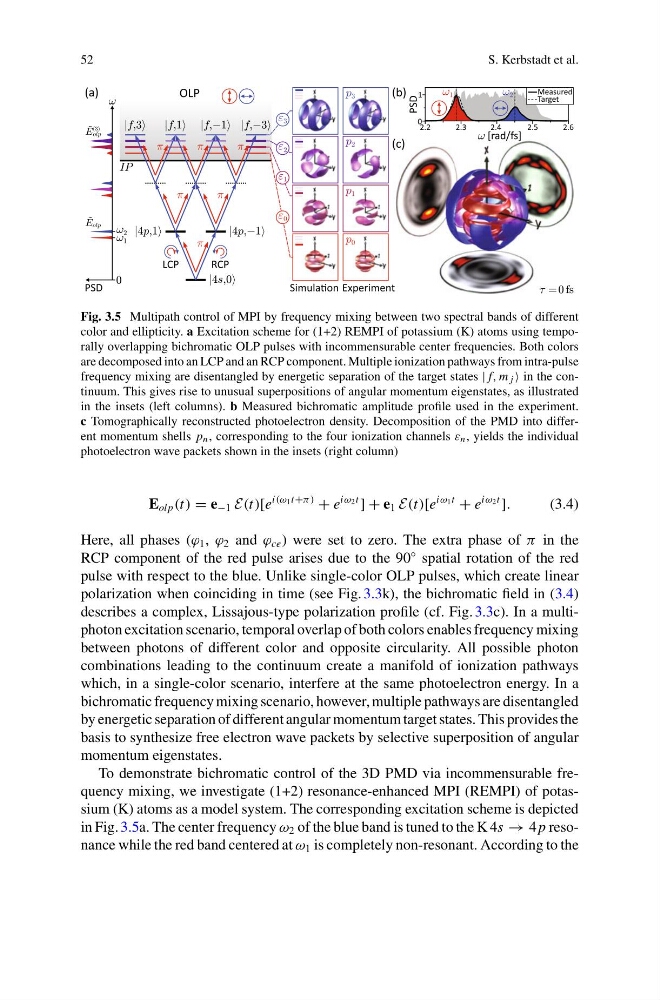
Fig. 3.5 Multipath control of MPI by frequency mixing between two spectral bands of different
color and ellipticity. a Excitation scheme for (1+2) REMPI of potassium (K) atoms using temporally overlapping bichromatic OLP pulses with incommensurable center frequencies. Both colors
are decomposed into an LCP and an RCP component. Multiple ionization pathways from intra-pulse
frequency mixing are disentangled by energetic separation of the target states | f, m j in the continuum. This gives rise to unusual superpositions of angular momentum eigenstates, as illustrated
in the insets (left columns). b Measured bichromatic amplitude profile used in the experiment.
c Tomographically reconstructed photoelectron density. Decomposition of the PMD into different momentum shells p n , corresponding to the four ionization channels ε n , yields the individual
photoelectron wave packets shown in the insets (right column)
E olp (t) = e −1 E(t)[e
i(ω 1 t+π)
+ e
iω 2 t
] + e 1 E(t)[e
iω 1 t
+ e
iω 2 t
].
(3.4)
Here, all phases (ϕ 1 , ϕ 2 and ϕ ce ) were set to zero. The extra phase of π in the
RCP component of the red pulse arises due to the 90
◦ spatial rotation of the red
pulse with respect to the blue. Unlike single-color OLP pulses, which create linear
polarization when coinciding in time (see Fig. 3.3k), the bichromatic field in (3.4)
describes a complex, Lissajous-type polarization profile (cf. Fig. 3.3c). In a multiphoton excitation scenario, temporal overlap of both colors enables frequency mixing
between photons of different color and opposite circularity. All possible photon
combinations leading to the continuum create a manifold of ionization pathways
which, in a single-color scenario, interfere at the same photoelectron energy. In a
bichromatic frequency mixing scenario, however, multiple pathways are disentangled
by energetic separation of different angular momentum target states. This provides the
basis to synthesize free electron wave packets by selective superposition of angular
momentum eigenstates.
To demonstrate bichromatic control of the 3D PMD via incommensurable frequency mixing, we investigate (1+2) resonance-enhanced MPI (REMPI) of potassium (K) atoms as a model system. The corresponding excitation scheme is depicted
in Fig. 3.5a. The center frequency ω 2 of the blue band is tuned to the K 4s → 4 p resonance while the red band centered at ω 1 is completely non-resonant. According to the
S. Kerbstadt et al.
Fig. 3.5 Multipath control of MPI by frequency mixing between two spectral bands of different
color and ellipticity. a Excitation scheme for (1+2) REMPI of potassium (K) atoms using temporally overlapping bichromatic OLP pulses with incommensurable center frequencies. Both colors
are decomposed into an LCP and an RCP component. Multiple ionization pathways from intra-pulse
frequency mixing are disentangled by energetic separation of the target states | f, m j in the continuum. This gives rise to unusual superpositions of angular momentum eigenstates, as illustrated
in the insets (left columns). b Measured bichromatic amplitude profile used in the experiment.
c Tomographically reconstructed photoelectron density. Decomposition of the PMD into different momentum shells p n , corresponding to the four ionization channels ε n , yields the individual
photoelectron wave packets shown in the insets (right column)
E olp (t) = e −1 E(t)[e
i(ω 1 t+π)
+ e
iω 2 t
] + e 1 E(t)[e
iω 1 t
+ e
iω 2 t
].
(3.4)
Here, all phases (ϕ 1 , ϕ 2 and ϕ ce ) were set to zero. The extra phase of π in the
RCP component of the red pulse arises due to the 90
◦ spatial rotation of the red
pulse with respect to the blue. Unlike single-color OLP pulses, which create linear
polarization when coinciding in time (see Fig. 3.3k), the bichromatic field in (3.4)
describes a complex, Lissajous-type polarization profile (cf. Fig. 3.3c). In a multiphoton excitation scenario, temporal overlap of both colors enables frequency mixing
between photons of different color and opposite circularity. All possible photon
combinations leading to the continuum create a manifold of ionization pathways
which, in a single-color scenario, interfere at the same photoelectron energy. In a
bichromatic frequency mixing scenario, however, multiple pathways are disentangled
by energetic separation of different angular momentum target states. This provides the
basis to synthesize free electron wave packets by selective superposition of angular
momentum eigenstates.
To demonstrate bichromatic control of the 3D PMD via incommensurable frequency mixing, we investigate (1+2) resonance-enhanced MPI (REMPI) of potassium (K) atoms as a model system. The corresponding excitation scheme is depicted
in Fig. 3.5a. The center frequency ω 2 of the blue band is tuned to the K 4s → 4 p resonance while the red band centered at ω 1 is completely non-resonant. According to the