

3 Bichromatic Control of Free Electron Wave Packets
45
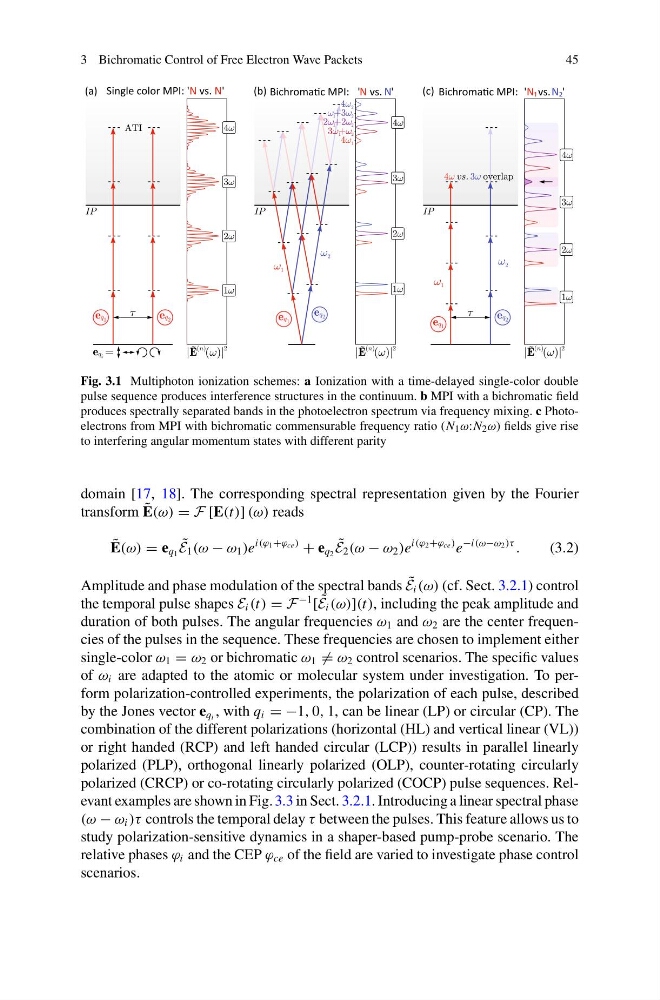
Fig. 3.1 Multiphoton ionization schemes: a Ionization with a time-delayed single-color double
pulse sequence produces interference structures in the continuum. b MPI with a bichromatic field
produces spectrally separated bands in the photoelectron spectrum via frequency mixing. c Photoelectrons from MPI with bichromatic commensurable frequency ratio (N 1 ω:N 2 ω) fields give rise
to interfering angular momentum states with different parity
domain [17, 18]. The corresponding spectral representation given by the Fourier
transform ˜
E(ω) = F [E(t)] (ω) reads
˜
E(ω) = e q 1 ˜
E 1 (ω − ω 1 )e
i(ϕ 1 +ϕ ce )
+ e q 2 ˜
E 2 (ω − ω 2 )e
i(ϕ 2 +ϕ ce ) e
−i(ω−ω 2 )τ
.
(3.2)
Amplitude and phase modulation of the spectral bands ˜
E i (ω) (cf. Sect. 3.2.1) control
the temporal pulse shapes E i (t) = F
−1
[ ˜
E i (ω)](t), including the peak amplitude and
duration of both pulses. The angular frequencies ω 1 and ω 2 are the center frequencies of the pulses in the sequence. These frequencies are chosen to implement either
single-color ω 1 = ω 2 or bichromatic ω 1 = ω 2 control scenarios. The specific values
of ω i are adapted to the atomic or molecular system under investigation. To perform polarization-controlled experiments, the polarization of each pulse, described
by the Jones vector e q i , with q i = −1, 0, 1, can be linear (LP) or circular (CP). The
combination of the different polarizations (horizontal (HL) and vertical linear (VL))
or right handed (RCP) and left handed circular (LCP)) results in parallel linearly
polarized (PLP), orthogonal linearly polarized (OLP), counter-rotating circularly
polarized (CRCP) or co-rotating circularly polarized (COCP) pulse sequences. Relevant examples are shown in Fig. 3.3 in Sect. 3.2.1. Introducing a linear spectral phase
(ω − ω i )τ controls the temporal delay τ between the pulses. This feature allows us to
study polarization-sensitive dynamics in a shaper-based pump-probe scenario. The
relative phases ϕ i and the CEP ϕ ce of the field are varied to investigate phase control
scenarios.
45
Fig. 3.1 Multiphoton ionization schemes: a Ionization with a time-delayed single-color double
pulse sequence produces interference structures in the continuum. b MPI with a bichromatic field
produces spectrally separated bands in the photoelectron spectrum via frequency mixing. c Photoelectrons from MPI with bichromatic commensurable frequency ratio (N 1 ω:N 2 ω) fields give rise
to interfering angular momentum states with different parity
domain [17, 18]. The corresponding spectral representation given by the Fourier
transform ˜
E(ω) = F [E(t)] (ω) reads
˜
E(ω) = e q 1 ˜
E 1 (ω − ω 1 )e
i(ϕ 1 +ϕ ce )
+ e q 2 ˜
E 2 (ω − ω 2 )e
i(ϕ 2 +ϕ ce ) e
−i(ω−ω 2 )τ
.
(3.2)
Amplitude and phase modulation of the spectral bands ˜
E i (ω) (cf. Sect. 3.2.1) control
the temporal pulse shapes E i (t) = F
−1
[ ˜
E i (ω)](t), including the peak amplitude and
duration of both pulses. The angular frequencies ω 1 and ω 2 are the center frequencies of the pulses in the sequence. These frequencies are chosen to implement either
single-color ω 1 = ω 2 or bichromatic ω 1 = ω 2 control scenarios. The specific values
of ω i are adapted to the atomic or molecular system under investigation. To perform polarization-controlled experiments, the polarization of each pulse, described
by the Jones vector e q i , with q i = −1, 0, 1, can be linear (LP) or circular (CP). The
combination of the different polarizations (horizontal (HL) and vertical linear (VL))
or right handed (RCP) and left handed circular (LCP)) results in parallel linearly
polarized (PLP), orthogonal linearly polarized (OLP), counter-rotating circularly
polarized (CRCP) or co-rotating circularly polarized (COCP) pulse sequences. Relevant examples are shown in Fig. 3.3 in Sect. 3.2.1. Introducing a linear spectral phase
(ω − ω i )τ controls the temporal delay τ between the pulses. This feature allows us to
study polarization-sensitive dynamics in a shaper-based pump-probe scenario. The
relative phases ϕ i and the CEP ϕ ce of the field are varied to investigate phase control
scenarios.