

32
Y. Zhang et al.
0
1 0
2 0
3 0
4 0
5 0
Time (fs)
0
0.1
0.2
0.3
0.4
0.5
0.6
0.7
0.8
0.9
1
Population
Laser field
X
A
B
X (v=0)
A (v=0)
B (v=0)
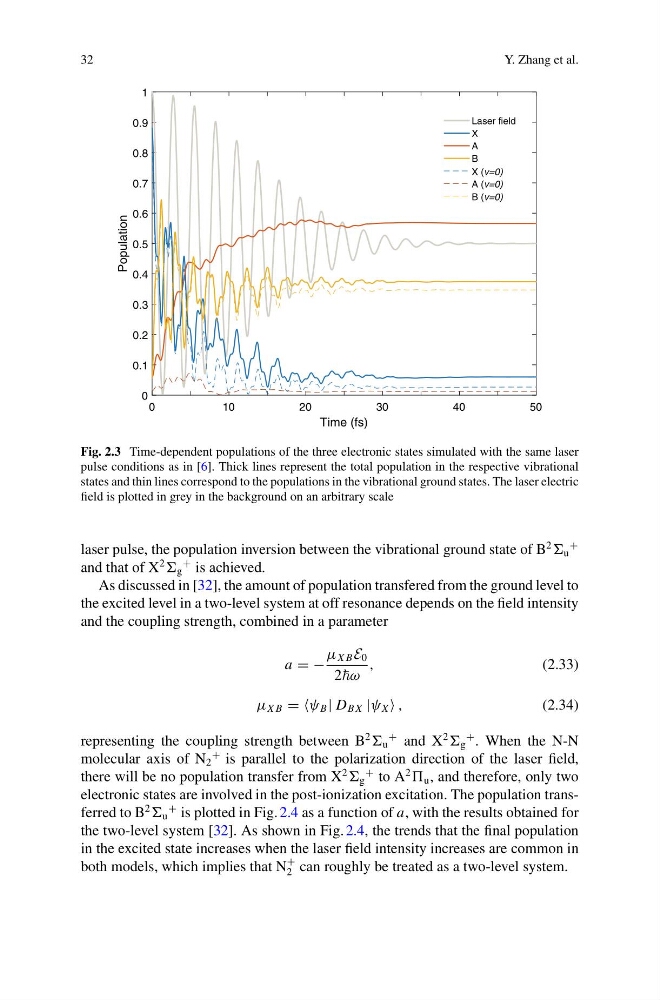
Fig. 2.3 Time-dependent populations of the three electronic states simulated with the same laser
pulse conditions as in [6]. Thick lines represent the total population in the respective vibrational
states and thin lines correspond to the populations in the vibrational ground states. The laser electric
field is plotted in grey in the background on an arbitrary scale
laser pulse, the population inversion between the vibrational ground state of B
2
u
+
and that of X
2
g
+ is achieved.
As discussed in [32], the amount of population transfered from the ground level to
the excited level in a two-level system at off resonance depends on the field intensity
and the coupling strength, combined in a parameter
a = −
μ X B E 0
2
,
(2.33)
μ X B = ψ B | D B X |ψ X ,
(2.34)
representing the coupling strength between B
2
u
+ and X
2
g
+ . When the N-N
molecular axis of N 2
+ is parallel to the polarization direction of the laser field,
there will be no population transfer from X
2
g
+ to A
2
u , and therefore, only two
electronic states are involved in the post-ionization excitation. The population transferred to B
2
u
+ is plotted in Fig. 2.4 as a function of a, with the results obtained for
the two-level system [32]. As shown in Fig. 2.4, the trends that the final population
in the excited state increases when the laser field intensity increases are common in
both models, which implies that N
+
2 can roughly be treated as a two-level system.
Y. Zhang et al.
0
1 0
2 0
3 0
4 0
5 0
Time (fs)
0
0.1
0.2
0.3
0.4
0.5
0.6
0.7
0.8
0.9
1
Population
Laser field
X
A
B
X (v=0)
A (v=0)
B (v=0)
Fig. 2.3 Time-dependent populations of the three electronic states simulated with the same laser
pulse conditions as in [6]. Thick lines represent the total population in the respective vibrational
states and thin lines correspond to the populations in the vibrational ground states. The laser electric
field is plotted in grey in the background on an arbitrary scale
laser pulse, the population inversion between the vibrational ground state of B
2
u
+
and that of X
2
g
+ is achieved.
As discussed in [32], the amount of population transfered from the ground level to
the excited level in a two-level system at off resonance depends on the field intensity
and the coupling strength, combined in a parameter
a = −
μ X B E 0
2
,
(2.33)
μ X B = ψ B | D B X |ψ X ,
(2.34)
representing the coupling strength between B
2
u
+ and X
2
g
+ . When the N-N
molecular axis of N 2
+ is parallel to the polarization direction of the laser field,
there will be no population transfer from X
2
g
+ to A
2
u , and therefore, only two
electronic states are involved in the post-ionization excitation. The population transferred to B
2
u
+ is plotted in Fig. 2.4 as a function of a, with the results obtained for
the two-level system [32]. As shown in Fig. 2.4, the trends that the final population
in the excited state increases when the laser field intensity increases are common in
both models, which implies that N
+
2 can roughly be treated as a two-level system.