

30
Y. Zhang et al.
2.2.4 Quasi-stationary Floquet Theory
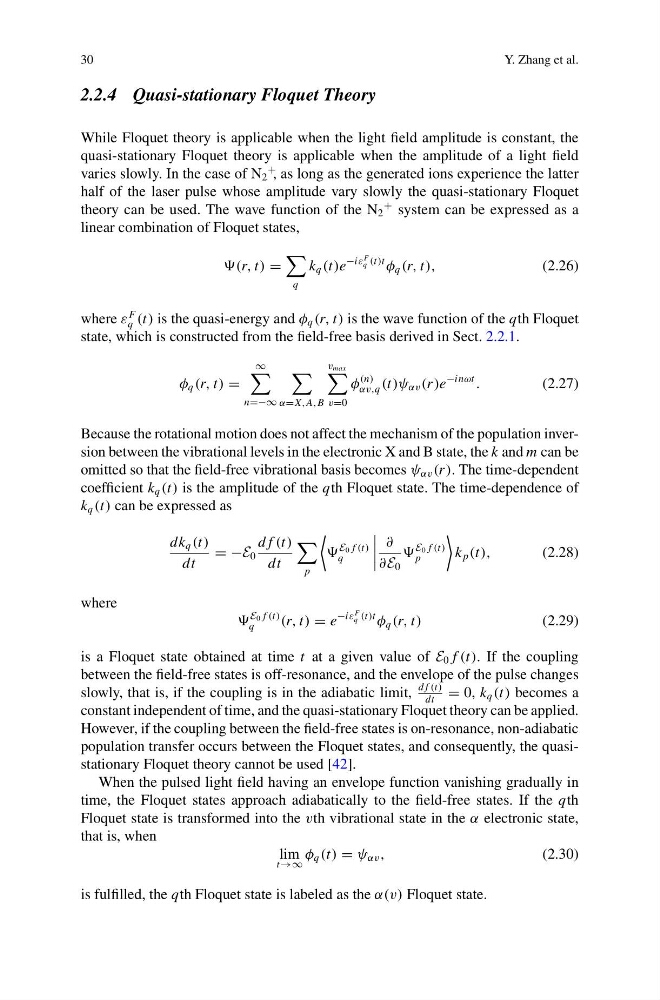
While Floquet theory is applicable when the light field amplitude is constant, the
quasi-stationary Floquet theory is applicable when the amplitude of a light field
varies slowly. In the case of N 2
+
, as long as the generated ions experience the latter
half of the laser pulse whose amplitude vary slowly the quasi-stationary Floquet
theory can be used. The wave function of the N 2
+ system can be expressed as a
linear combination of Floquet states,
(r, t) =
q
k q (t)e
−iε
F
q (t)t
φ q (r, t),
(2.26)
where ε
F
q (t) is the quasi-energy and φ q (r, t) is the wave function of the qth Floquet
state, which is constructed from the field-free basis derived in Sect. 2.2.1.
φ q (r, t) =
∞
n=−∞
α=X,A,B
v max
v=0
φ
(n)
αv,q (t)ψ αv (r )e
−inωt
.
(2.27)
Because the rotational motion does not affect the mechanism of the population inversion between the vibrational levels in the electronic X and B state, the k and m can be
omitted so that the field-free vibrational basis becomes ψ αv (r ). The time-dependent
coefficient k q (t) is the amplitude of the qth Floquet state. The time-dependence of
k q (t) can be expressed as
dk q (t)
dt
= −E 0
d f (t)
dt
p
E 0 f (t)
q
∂
∂E 0
E 0 f (t)
p
k p (t),
(2.28)
where
E 0 f (t)
q
(r, t) = e
−iε
F
q (t)t
φ q (r, t)
(2.29)
is a Floquet state obtained at time t at a given value of E 0 f (t). If the coupling
between the field-free states is off-resonance, and the envelope of the pulse changes
slowly, that is, if the coupling is in the adiabatic limit,
d f (t)
dt
= 0, k q (t) becomes a
constant independent of time, and the quasi-stationary Floquet theory can be applied.
However, if the coupling between the field-free states is on-resonance, non-adiabatic
population transfer occurs between the Floquet states, and consequently, the quasistationary Floquet theory cannot be used [42].
When the pulsed light field having an envelope function vanishing gradually in
time, the Floquet states approach adiabatically to the field-free states. If the qth
Floquet state is transformed into the vth vibrational state in the α electronic state,
that is, when
lim
t→∞
φ q (t) = ψ αv ,
(2.30)
is fulfilled, the qth Floquet state is labeled as the α(v) Floquet state.
Y. Zhang et al.
2.2.4 Quasi-stationary Floquet Theory
While Floquet theory is applicable when the light field amplitude is constant, the
quasi-stationary Floquet theory is applicable when the amplitude of a light field
varies slowly. In the case of N 2
+
, as long as the generated ions experience the latter
half of the laser pulse whose amplitude vary slowly the quasi-stationary Floquet
theory can be used. The wave function of the N 2
+ system can be expressed as a
linear combination of Floquet states,
(r, t) =
q
k q (t)e
−iε
F
q (t)t
φ q (r, t),
(2.26)
where ε
F
q (t) is the quasi-energy and φ q (r, t) is the wave function of the qth Floquet
state, which is constructed from the field-free basis derived in Sect. 2.2.1.
φ q (r, t) =
∞
n=−∞
α=X,A,B
v max
v=0
φ
(n)
αv,q (t)ψ αv (r )e
−inωt
.
(2.27)
Because the rotational motion does not affect the mechanism of the population inversion between the vibrational levels in the electronic X and B state, the k and m can be
omitted so that the field-free vibrational basis becomes ψ αv (r ). The time-dependent
coefficient k q (t) is the amplitude of the qth Floquet state. The time-dependence of
k q (t) can be expressed as
dk q (t)
dt
= −E 0
d f (t)
dt
p
E 0 f (t)
q
∂
∂E 0
E 0 f (t)
p
k p (t),
(2.28)
where
E 0 f (t)
q
(r, t) = e
−iε
F
q (t)t
φ q (r, t)
(2.29)
is a Floquet state obtained at time t at a given value of E 0 f (t). If the coupling
between the field-free states is off-resonance, and the envelope of the pulse changes
slowly, that is, if the coupling is in the adiabatic limit,
d f (t)
dt
= 0, k q (t) becomes a
constant independent of time, and the quasi-stationary Floquet theory can be applied.
However, if the coupling between the field-free states is on-resonance, non-adiabatic
population transfer occurs between the Floquet states, and consequently, the quasistationary Floquet theory cannot be used [42].
When the pulsed light field having an envelope function vanishing gradually in
time, the Floquet states approach adiabatically to the field-free states. If the qth
Floquet state is transformed into the vth vibrational state in the α electronic state,
that is, when
lim
t→∞
φ q (t) = ψ αv ,
(2.30)
is fulfilled, the qth Floquet state is labeled as the α(v) Floquet state.