

28
Y. Zhang et al.
Solutions of the eigenfunction above give the eigenvalues as {ε αvK m }, corresponding
to the rovibrational energies, and the eigenvectors as {ψ αvK m (r )}, corresponding to
the rovibrational wave function of the K th rotational level in the vth vibrational state.
2.2.2 Rotational Basis
The standard rotational basis functions are spherical harmonics [40]. We adopt here
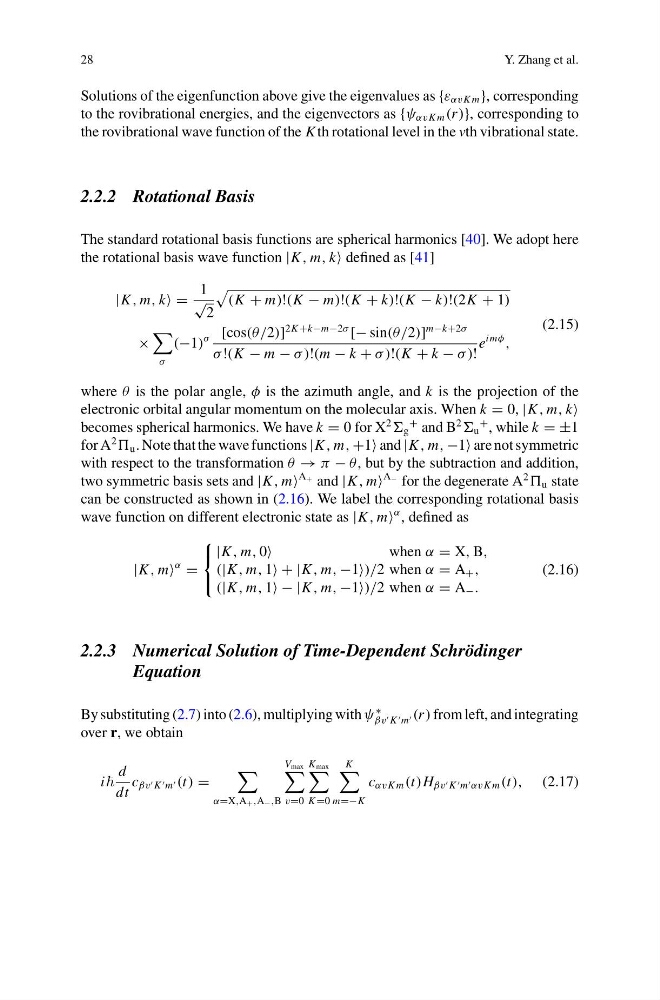
the rotational basis wave function |K , m, k defined as [41]
|K , m, k =
1
√
2
(K + m)!(K − m)!(K + k)!(K − k)!(2K + 1)
×
σ
(−1)
σ [cos(θ/2)]
2K +k−m−2σ
[− sin(θ/2)]
m−k+2σ
σ !(K − m − σ )!(m − k + σ )!(K + k − σ )!
e
imφ
,
(2.15)
where θ is the polar angle, φ is the azimuth angle, and k is the projection of the
electronic orbital angular momentum on the molecular axis. When k = 0, |K , m, k
becomes spherical harmonics. We have k = 0 for X
2
g
+ and B
2
u
+ , while k = ±1
for A
2
u . Note that the wave functions |K , m, +1 and |K , m, −1 are not symmetric
with respect to the transformation θ → π − θ , but by the subtraction and addition,
two symmetric basis sets and |K , m
A + and |K , m
A − for the degenerate A
2
u state
can be constructed as shown in (2.16). We label the corresponding rotational basis
wave function on different electronic state as |K , m
α , defined as
|K , m
α
=
⎧
⎨
⎩
|K , m, 0
when α = X, B,
(|K , m, 1 + |K , m, −1)/2 when α = A + ,
(|K , m, 1 − |K , m, −1)/2 when α = A − .
(2.16)
2.2.3 Numerical Solution of Time-Dependent Schrödinger
Equation
By substituting (2.7) into (2.6), multiplying with ψ
∗
βv K m (r ) from left, and integrating
over r, we obtain
i
d
dt
c βv K m (t) =
α=X,A + ,A − ,B
V max
v=0
K max
K =0
K
m=−K
c αvK m (t)H βv K m αvK m (t), (2.17)
Y. Zhang et al.
Solutions of the eigenfunction above give the eigenvalues as {ε αvK m }, corresponding
to the rovibrational energies, and the eigenvectors as {ψ αvK m (r )}, corresponding to
the rovibrational wave function of the K th rotational level in the vth vibrational state.
2.2.2 Rotational Basis
The standard rotational basis functions are spherical harmonics [40]. We adopt here
the rotational basis wave function |K , m, k defined as [41]
|K , m, k =
1
√
2
(K + m)!(K − m)!(K + k)!(K − k)!(2K + 1)
×
σ
(−1)
σ [cos(θ/2)]
2K +k−m−2σ
[− sin(θ/2)]
m−k+2σ
σ !(K − m − σ )!(m − k + σ )!(K + k − σ )!
e
imφ
,
(2.15)
where θ is the polar angle, φ is the azimuth angle, and k is the projection of the
electronic orbital angular momentum on the molecular axis. When k = 0, |K , m, k
becomes spherical harmonics. We have k = 0 for X
2
g
+ and B
2
u
+ , while k = ±1
for A
2
u . Note that the wave functions |K , m, +1 and |K , m, −1 are not symmetric
with respect to the transformation θ → π − θ , but by the subtraction and addition,
two symmetric basis sets and |K , m
A + and |K , m
A − for the degenerate A
2
u state
can be constructed as shown in (2.16). We label the corresponding rotational basis
wave function on different electronic state as |K , m
α , defined as
|K , m
α
=
⎧
⎨
⎩
|K , m, 0
when α = X, B,
(|K , m, 1 + |K , m, −1)/2 when α = A + ,
(|K , m, 1 − |K , m, −1)/2 when α = A − .
(2.16)
2.2.3 Numerical Solution of Time-Dependent Schrödinger
Equation
By substituting (2.7) into (2.6), multiplying with ψ
∗
βv K m (r ) from left, and integrating
over r, we obtain
i
d
dt
c βv K m (t) =
α=X,A + ,A − ,B
V max
v=0
K max
K =0
K
m=−K
c αvK m (t)H βv K m αvK m (t), (2.17)