

2 Mechanism of Population Inversion in N 2
+
23
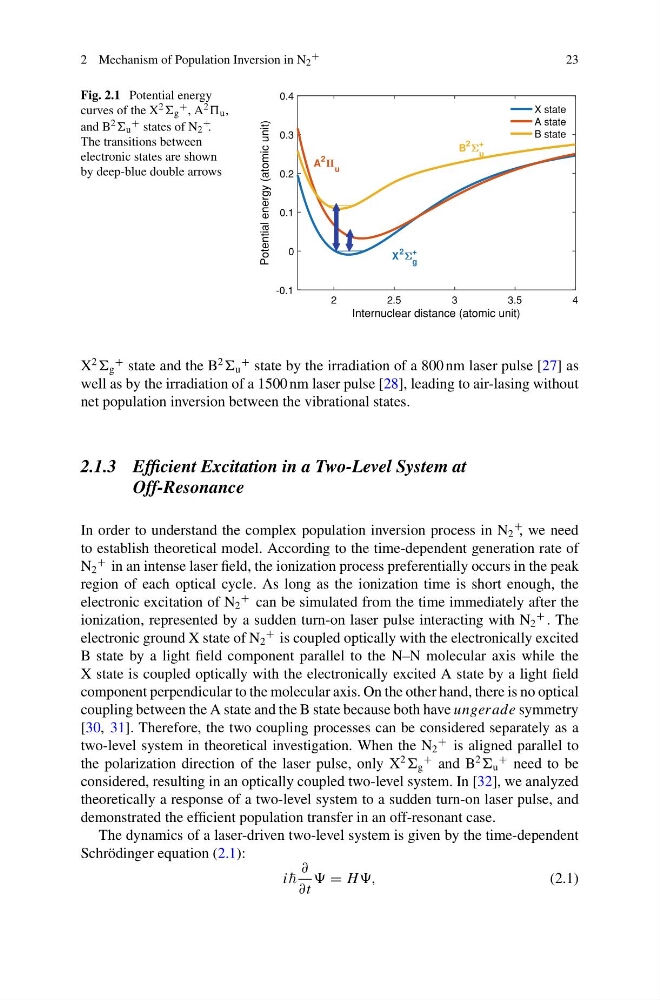
Fig. 2.1 Potential energy
curves of the X 2 g
+ , A 2 u ,
and B 2 u
+ states of N 2
+ .
The transitions between
electronic states are shown
by deep-blue double arrows
2
2.5
3
3.5
4
Internuclear distance (atomic unit)
-0.1
0
0.1
0.2
0.3
0.4
Potential energy (atomic unit)
X state
A state
B state
B
2
u
+
A
2
u
X
2
g
+
X
2
g
+ state and the B
2
u
+ state by the irradiation of a 800 nm laser pulse [27] as
well as by the irradiation of a 1500 nm laser pulse [28], leading to air-lasing without
net population inversion between the vibrational states.
2.1.3 Efficient Excitation in a Two-Level System at
Off-Resonance
In order to understand the complex population inversion process in N 2
+
, we need
to establish theoretical model. According to the time-dependent generation rate of
N 2
+ in an intense laser field, the ionization process preferentially occurs in the peak
region of each optical cycle. As long as the ionization time is short enough, the
electronic excitation of N 2
+ can be simulated from the time immediately after the
ionization, represented by a sudden turn-on laser pulse interacting with N 2
+ . The
electronic ground X state of N 2
+ is coupled optically with the electronically excited
B state by a light field component parallel to the N–N molecular axis while the
X state is coupled optically with the electronically excited A state by a light field
component perpendicular to the molecular axis. On the other hand, there is no optical
coupling between the A state and the B state because both have ungerade symmetry
[30, 31]. Therefore, the two coupling processes can be considered separately as a
two-level system in theoretical investigation. When the N 2
+ is aligned parallel to
the polarization direction of the laser pulse, only X
2
g
+ and B
2
u
+ need to be
considered, resulting in an optically coupled two-level system. In [32], we analyzed
theoretically a response of a two-level system to a sudden turn-on laser pulse, and
demonstrated the efficient population transfer in an off-resonant case.
The dynamics of a laser-driven two-level system is given by the time-dependent
Schrödinger equation (2.1):
i
∂
∂t
= H ,
(2.1)
+
23
Fig. 2.1 Potential energy
curves of the X 2 g
+ , A 2 u ,
and B 2 u
+ states of N 2
+ .
The transitions between
electronic states are shown
by deep-blue double arrows
2
2.5
3
3.5
4
Internuclear distance (atomic unit)
-0.1
0
0.1
0.2
0.3
0.4
Potential energy (atomic unit)
X state
A state
B state
B
2
u
+
A
2
u
X
2
g
+
X
2
g
+ state and the B
2
u
+ state by the irradiation of a 800 nm laser pulse [27] as
well as by the irradiation of a 1500 nm laser pulse [28], leading to air-lasing without
net population inversion between the vibrational states.
2.1.3 Efficient Excitation in a Two-Level System at
Off-Resonance
In order to understand the complex population inversion process in N 2
+
, we need
to establish theoretical model. According to the time-dependent generation rate of
N 2
+ in an intense laser field, the ionization process preferentially occurs in the peak
region of each optical cycle. As long as the ionization time is short enough, the
electronic excitation of N 2
+ can be simulated from the time immediately after the
ionization, represented by a sudden turn-on laser pulse interacting with N 2
+ . The
electronic ground X state of N 2
+ is coupled optically with the electronically excited
B state by a light field component parallel to the N–N molecular axis while the
X state is coupled optically with the electronically excited A state by a light field
component perpendicular to the molecular axis. On the other hand, there is no optical
coupling between the A state and the B state because both have ungerade symmetry
[30, 31]. Therefore, the two coupling processes can be considered separately as a
two-level system in theoretical investigation. When the N 2
+ is aligned parallel to
the polarization direction of the laser pulse, only X
2
g
+ and B
2
u
+ need to be
considered, resulting in an optically coupled two-level system. In [32], we analyzed
theoretically a response of a two-level system to a sudden turn-on laser pulse, and
demonstrated the efficient population transfer in an off-resonant case.
The dynamics of a laser-driven two-level system is given by the time-dependent
Schrödinger equation (2.1):
i
∂
∂t
= H ,
(2.1)