

8 Towards Laser Intensity Calibration Using High-Field Ionization
155
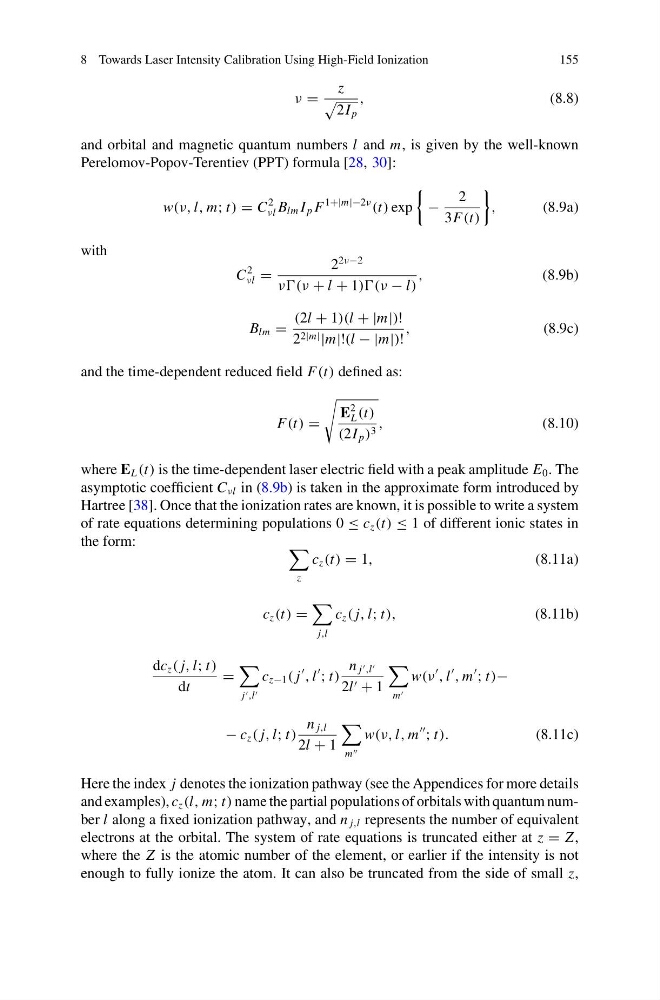
ν =
z
2I p
,
(8.8)
and orbital and magnetic quantum numbers l and m, is given by the well-known
Perelomov-Popov-Terentiev (PPT) formula [28, 30]:
w(ν, l, m; t) = C
2
νl B lm I p F
1+|m|−2ν
(t) exp
−
2
3F(t)
,
(8.9a)
with
C
2
νl =
2
2ν−2
νν(ν + l + 1))(ν − l)
,
(8.9b)
B lm =
(2l + 1)(l + |m|)!
2 2|m| |m|!(l − |m|)!
,
(8.9c)
and the time-dependent reduced field F(t) defined as:
F(t) =
E
2
L (t)
(2I p ) 3 ,
(8.10)
where E L (t) is the time-dependent laser electric field with a peak amplitude E 0 . The
asymptotic coefficient C νl in (8.9b) is taken in the approximate form introduced by
Hartree [38]. Once that the ionization rates are known, it is possible to write a system
of rate equations determining populations 0 ≤ c z (t) ≤ 1 of different ionic states in
the form:
z
c z (t) = 1,
(8.11a)
c z (t) =
j,l
c z ( j, l; t),
(8.11b)
dc z ( j, l; t)
dt
=
j ,l
c z−1 ( j
, l
; t)
n j ,l
2l + 1
m
w(ν
, l
, m
; t)−
− c z ( j, l; t)
n j,l
2l + 1
m
w(ν, l, m
; t).
(8.11c)
Here the index j denotes the ionization pathway (see the Appendices for more details
and examples), c z (l, m; t) name the partial populations of orbitals with quantum number l along a fixed ionization pathway, and n j,l represents the number of equivalent
electrons at the orbital. The system of rate equations is truncated either at z = Z ,
where the Z is the atomic number of the element, or earlier if the intensity is not
enough to fully ionize the atom. It can also be truncated from the side of small z,
155
ν =
z
2I p
,
(8.8)
and orbital and magnetic quantum numbers l and m, is given by the well-known
Perelomov-Popov-Terentiev (PPT) formula [28, 30]:
w(ν, l, m; t) = C
2
νl B lm I p F
1+|m|−2ν
(t) exp
−
2
3F(t)
,
(8.9a)
with
C
2
νl =
2
2ν−2
νν(ν + l + 1))(ν − l)
,
(8.9b)
B lm =
(2l + 1)(l + |m|)!
2 2|m| |m|!(l − |m|)!
,
(8.9c)
and the time-dependent reduced field F(t) defined as:
F(t) =
E
2
L (t)
(2I p ) 3 ,
(8.10)
where E L (t) is the time-dependent laser electric field with a peak amplitude E 0 . The
asymptotic coefficient C νl in (8.9b) is taken in the approximate form introduced by
Hartree [38]. Once that the ionization rates are known, it is possible to write a system
of rate equations determining populations 0 ≤ c z (t) ≤ 1 of different ionic states in
the form:
z
c z (t) = 1,
(8.11a)
c z (t) =
j,l
c z ( j, l; t),
(8.11b)
dc z ( j, l; t)
dt
=
j ,l
c z−1 ( j
, l
; t)
n j ,l
2l + 1
m
w(ν
, l
, m
; t)−
− c z ( j, l; t)
n j,l
2l + 1
m
w(ν, l, m
; t).
(8.11c)
Here the index j denotes the ionization pathway (see the Appendices for more details
and examples), c z (l, m; t) name the partial populations of orbitals with quantum number l along a fixed ionization pathway, and n j,l represents the number of equivalent
electrons at the orbital. The system of rate equations is truncated either at z = Z ,
where the Z is the atomic number of the element, or earlier if the intensity is not
enough to fully ionize the atom. It can also be truncated from the side of small z,