

134
M. Kanasaki et al.
a long time in laser-driven ion acceleration experiments [4–6]. This is because CR39 detectors have great advantages of being insensitive to high-energy photons and
electrons at absorbed doses less than approximately 10 kGy [7] and are capable of
detecting only ions in mixed radiation fields, such as in laser-driven ion acceleration experiments. In addition, the CR-39 detector (hereafter, referred to as CR-39)
can measure the range of each ion by using a multi-step etching technique [8–10].
Recently, this technique was applied to laser-driven ion acceleration experiments
to demonstrate a 10-fold improvement in accuracy for determining the maximum
ion energy of laser-accelerated protons with an uncertainty of E = 0.1 MeV [11].
CR-39 detectors can also measure the number of ions and spatial distribution of ions
unless the etch pit overlap. For example, CR-39 detectors were also used to calibrate
the number of ions in a Thomson parabola spectrometer [12, 13].
The present paper comments on the characteristics of SSNTDs and the method
of using CR-39 as an ion detector. In particular, an analysis of the etch pits in CR-39
detectors is described in detail to obtain the incident energy of laser-accelerated ions.
The application of CR-39 detectors to measurements of laser-accelerated ions from
cluster-gas targets is also introduced as an example based on previously published
papers by the authors’ group.
7.2 Fundamentals of the SSNTDs
7.2.1 Introduction to CR-39 Detectors
CR-39 is usually used as a SSNTD in various fields of research, such as nuclear
physics, neutron dosimetry, cosmic ray detection and laser-driven ion acceleration.
CR-39 was first developed as an optical material by the Colombia Chemical Division
in the 1940s. CR-39 is a colourless and transparent plastic of a polymerized diethylene
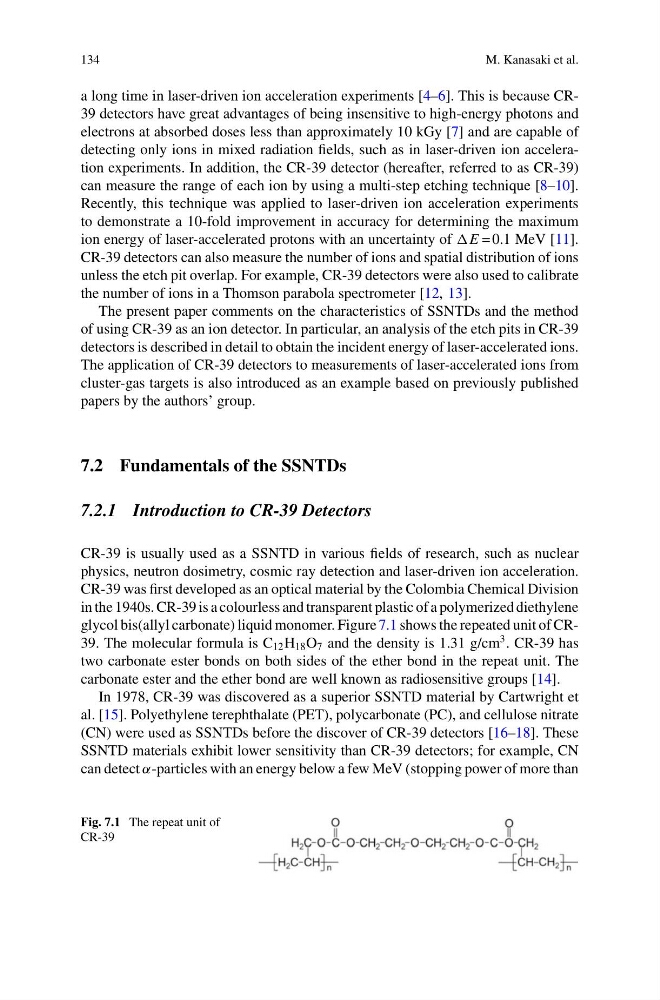
glycol bis(allyl carbonate) liquid monomer. Figure 7.1 shows the repeated unit of CR39. The molecular formula is C 12 H 18 O 7 and the density is 1.31 g/cm
3 . CR-39 has
two carbonate ester bonds on both sides of the ether bond in the repeat unit. The
carbonate ester and the ether bond are well known as radiosensitive groups [14].
In 1978, CR-39 was discovered as a superior SSNTD material by Cartwright et
al. [15]. Polyethylene terephthalate (PET), polycarbonate (PC), and cellulose nitrate
(CN) were used as SSNTDs before the discover of CR-39 detectors [16–18]. These
SSNTD materials exhibit lower sensitivity than CR-39 detectors; for example, CN
can detect α-particles with an energy below a few MeV (stopping power of more than
Fig. 7.1 The repeat unit of
CR-39
M. Kanasaki et al.
a long time in laser-driven ion acceleration experiments [4–6]. This is because CR39 detectors have great advantages of being insensitive to high-energy photons and
electrons at absorbed doses less than approximately 10 kGy [7] and are capable of
detecting only ions in mixed radiation fields, such as in laser-driven ion acceleration experiments. In addition, the CR-39 detector (hereafter, referred to as CR-39)
can measure the range of each ion by using a multi-step etching technique [8–10].
Recently, this technique was applied to laser-driven ion acceleration experiments
to demonstrate a 10-fold improvement in accuracy for determining the maximum
ion energy of laser-accelerated protons with an uncertainty of E = 0.1 MeV [11].
CR-39 detectors can also measure the number of ions and spatial distribution of ions
unless the etch pit overlap. For example, CR-39 detectors were also used to calibrate
the number of ions in a Thomson parabola spectrometer [12, 13].
The present paper comments on the characteristics of SSNTDs and the method
of using CR-39 as an ion detector. In particular, an analysis of the etch pits in CR-39
detectors is described in detail to obtain the incident energy of laser-accelerated ions.
The application of CR-39 detectors to measurements of laser-accelerated ions from
cluster-gas targets is also introduced as an example based on previously published
papers by the authors’ group.
7.2 Fundamentals of the SSNTDs
7.2.1 Introduction to CR-39 Detectors
CR-39 is usually used as a SSNTD in various fields of research, such as nuclear
physics, neutron dosimetry, cosmic ray detection and laser-driven ion acceleration.
CR-39 was first developed as an optical material by the Colombia Chemical Division
in the 1940s. CR-39 is a colourless and transparent plastic of a polymerized diethylene
glycol bis(allyl carbonate) liquid monomer. Figure 7.1 shows the repeated unit of CR39. The molecular formula is C 12 H 18 O 7 and the density is 1.31 g/cm
3 . CR-39 has
two carbonate ester bonds on both sides of the ether bond in the repeat unit. The
carbonate ester and the ether bond are well known as radiosensitive groups [14].
In 1978, CR-39 was discovered as a superior SSNTD material by Cartwright et
al. [15]. Polyethylene terephthalate (PET), polycarbonate (PC), and cellulose nitrate
(CN) were used as SSNTDs before the discover of CR-39 detectors [16–18]. These
SSNTD materials exhibit lower sensitivity than CR-39 detectors; for example, CN
can detect α-particles with an energy below a few MeV (stopping power of more than
Fig. 7.1 The repeat unit of
CR-39