

6 Coherent Control of Nonadiabatic Dynamics of Electron-Phonon …
129
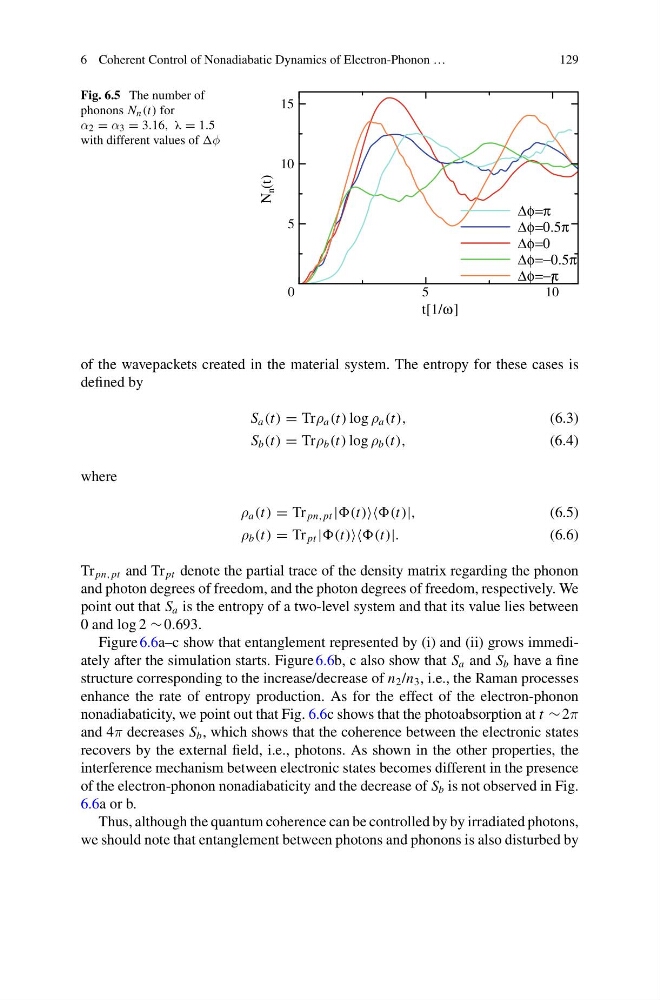
Fig. 6.5 The number of
phonons N n (t) for
α 2 = α 3 = 3.16, λ = 1.5
with different values of
t[1/ω]
N
n (t)
Δφ=π
Δφ=0.5π
Δφ=0
Δφ=−0.5π
Δφ=−π
0
5
1 0
5
10
15
of the wavepackets created in the material system. The entropy for these cases is
defined by
S a (t) = Trρ a (t) log ρ a (t),
(6.3)
S b (t) = Trρ b (t) log ρ b (t),
(6.4)
where
ρ a (t) = Tr pn, pt |
(6.5)
ρ b (t) = Tr pt |
(6.6)
Tr pn, pt and Tr pt denote the partial trace of the density matrix regarding the phonon
and photon degrees of freedom, and the photon degrees of freedom, respectively. We
point out that S a is the entropy of a two-level system and that its value lies between
0 and log 2 ∼ 0.693.
Figure 6.6a–c show that entanglement represented by (i) and (ii) grows immediately after the simulation starts. Figure 6.6b, c also show that S a and S b have a fine
structure corresponding to the increase/decrease of n 2 /n 3 , i.e., the Raman processes
enhance the rate of entropy production. As for the effect of the electron-phonon
nonadiabaticity, we point out that Fig. 6.6c shows that the photoabsorption at t ∼ 2π
and 4π decreases S b , which shows that the coherence between the electronic states
recovers by the external field, i.e., photons. As shown in the other properties, the
interference mechanism between electronic states becomes different in the presence
of the electron-phonon nonadiabaticity and the decrease of S b is not observed in Fig.
6.6a or b.
Thus, although the quantum coherence can be controlled by by irradiated photons,
we should note that entanglement between photons and phonons is also disturbed by
129
Fig. 6.5 The number of
phonons N n (t) for
α 2 = α 3 = 3.16, λ = 1.5
with different values of
t[1/ω]
N
n (t)
Δφ=π
Δφ=0.5π
Δφ=0
Δφ=−0.5π
Δφ=−π
0
5
1 0
5
10
15
of the wavepackets created in the material system. The entropy for these cases is
defined by
S a (t) = Trρ a (t) log ρ a (t),
(6.3)
S b (t) = Trρ b (t) log ρ b (t),
(6.4)
where
ρ a (t) = Tr pn, pt |
(6.5)
ρ b (t) = Tr pt |
(6.6)
Tr pn, pt and Tr pt denote the partial trace of the density matrix regarding the phonon
and photon degrees of freedom, and the photon degrees of freedom, respectively. We
point out that S a is the entropy of a two-level system and that its value lies between
0 and log 2 ∼ 0.693.
Figure 6.6a–c show that entanglement represented by (i) and (ii) grows immediately after the simulation starts. Figure 6.6b, c also show that S a and S b have a fine
structure corresponding to the increase/decrease of n 2 /n 3 , i.e., the Raman processes
enhance the rate of entropy production. As for the effect of the electron-phonon
nonadiabaticity, we point out that Fig. 6.6c shows that the photoabsorption at t ∼ 2π
and 4π decreases S b , which shows that the coherence between the electronic states
recovers by the external field, i.e., photons. As shown in the other properties, the
interference mechanism between electronic states becomes different in the presence
of the electron-phonon nonadiabaticity and the decrease of S b is not observed in Fig.
6.6a or b.
Thus, although the quantum coherence can be controlled by by irradiated photons,
we should note that entanglement between photons and phonons is also disturbed by