

116
P. Vasa
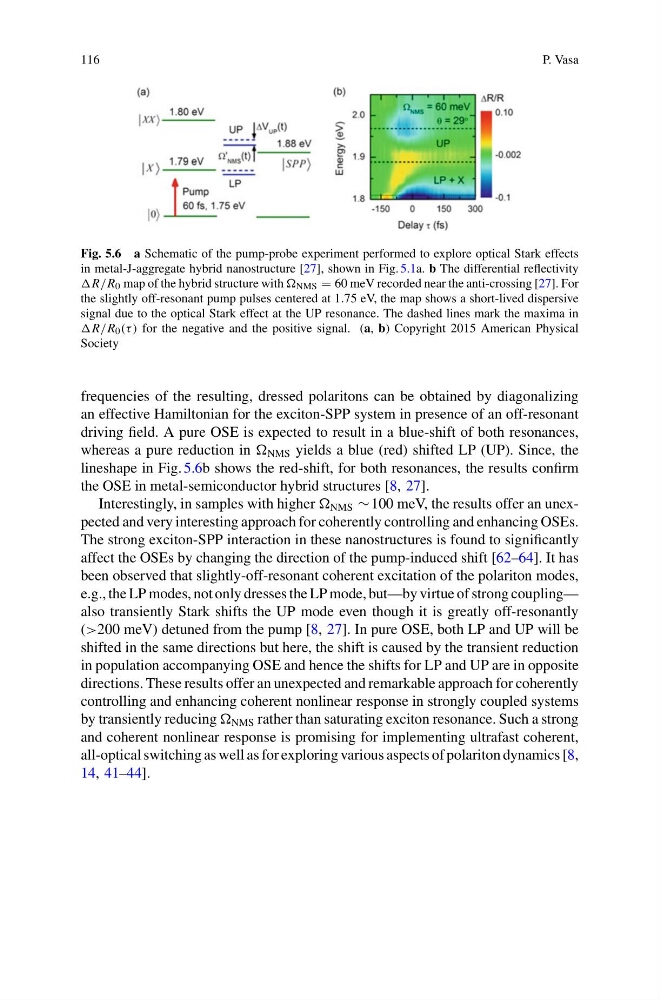
Fig. 5.6 a Schematic of the pump-probe experiment performed to explore optical Stark effects
in metal-J-aggregate hybrid nanostructure [27], shown in Fig. 5.1a. b The differential reflectivity
R/R 0 map of the hybrid structure with NMS = 60 meV recorded near the anti-crossing [27]. For
the slightly off-resonant pump pulses centered at 1.75 eV, the map shows a short-lived dispersive
signal due to the optical Stark effect at the UP resonance. The dashed lines mark the maxima in
R/R 0 (τ ) for the negative and the positive signal. (a, b) Copyright 2015 American Physical
Society
frequencies of the resulting, dressed polaritons can be obtained by diagonalizing
an effective Hamiltonian for the exciton-SPP system in presence of an off-resonant
driving field. A pure OSE is expected to result in a blue-shift of both resonances,
whereas a pure reduction in NMS yields a blue (red) shifted LP (UP). Since, the
lineshape in Fig. 5.6b shows the red-shift, for both resonances, the results confirm
the OSE in metal-semiconductor hybrid structures [8, 27].
Interestingly, in samples with higher NMS ∼ 100 meV, the results offer an unexpected and very interesting approach for coherently controlling and enhancing OSEs.
The strong exciton-SPP interaction in these nanostructures is found to significantly
affect the OSEs by changing the direction of the pump-induced shift [62–64]. It has
been observed that slightly-off-resonant coherent excitation of the polariton modes,
e.g., the LP modes, not only dresses the LP mode, but—by virtue of strong coupling—
also transiently Stark shifts the UP mode even though it is greatly off-resonantly
(>200 meV) detuned from the pump [8, 27]. In pure OSE, both LP and UP will be
shifted in the same directions but here, the shift is caused by the transient reduction
in population accompanying OSE and hence the shifts for LP and UP are in opposite
directions. These results offer an unexpected and remarkable approach for coherently
controlling and enhancing coherent nonlinear response in strongly coupled systems
by transiently reducing NMS rather than saturating exciton resonance. Such a strong
and coherent nonlinear response is promising for implementing ultrafast coherent,
all-optical switching as well as for exploring various aspects of polariton dynamics [8,
14, 41–44].
P. Vasa
Fig. 5.6 a Schematic of the pump-probe experiment performed to explore optical Stark effects
in metal-J-aggregate hybrid nanostructure [27], shown in Fig. 5.1a. b The differential reflectivity
R/R 0 map of the hybrid structure with NMS = 60 meV recorded near the anti-crossing [27]. For
the slightly off-resonant pump pulses centered at 1.75 eV, the map shows a short-lived dispersive
signal due to the optical Stark effect at the UP resonance. The dashed lines mark the maxima in
R/R 0 (τ ) for the negative and the positive signal. (a, b) Copyright 2015 American Physical
Society
frequencies of the resulting, dressed polaritons can be obtained by diagonalizing
an effective Hamiltonian for the exciton-SPP system in presence of an off-resonant
driving field. A pure OSE is expected to result in a blue-shift of both resonances,
whereas a pure reduction in NMS yields a blue (red) shifted LP (UP). Since, the
lineshape in Fig. 5.6b shows the red-shift, for both resonances, the results confirm
the OSE in metal-semiconductor hybrid structures [8, 27].
Interestingly, in samples with higher NMS ∼ 100 meV, the results offer an unexpected and very interesting approach for coherently controlling and enhancing OSEs.
The strong exciton-SPP interaction in these nanostructures is found to significantly
affect the OSEs by changing the direction of the pump-induced shift [62–64]. It has
been observed that slightly-off-resonant coherent excitation of the polariton modes,
e.g., the LP modes, not only dresses the LP mode, but—by virtue of strong coupling—
also transiently Stark shifts the UP mode even though it is greatly off-resonantly
(>200 meV) detuned from the pump [8, 27]. In pure OSE, both LP and UP will be
shifted in the same directions but here, the shift is caused by the transient reduction
in population accompanying OSE and hence the shifts for LP and UP are in opposite
directions. These results offer an unexpected and remarkable approach for coherently
controlling and enhancing coherent nonlinear response in strongly coupled systems
by transiently reducing NMS rather than saturating exciton resonance. Such a strong
and coherent nonlinear response is promising for implementing ultrafast coherent,
all-optical switching as well as for exploring various aspects of polariton dynamics [8,
14, 41–44].