

5 Coherent Nonlinear Processes in Metal-Semiconductor …
111
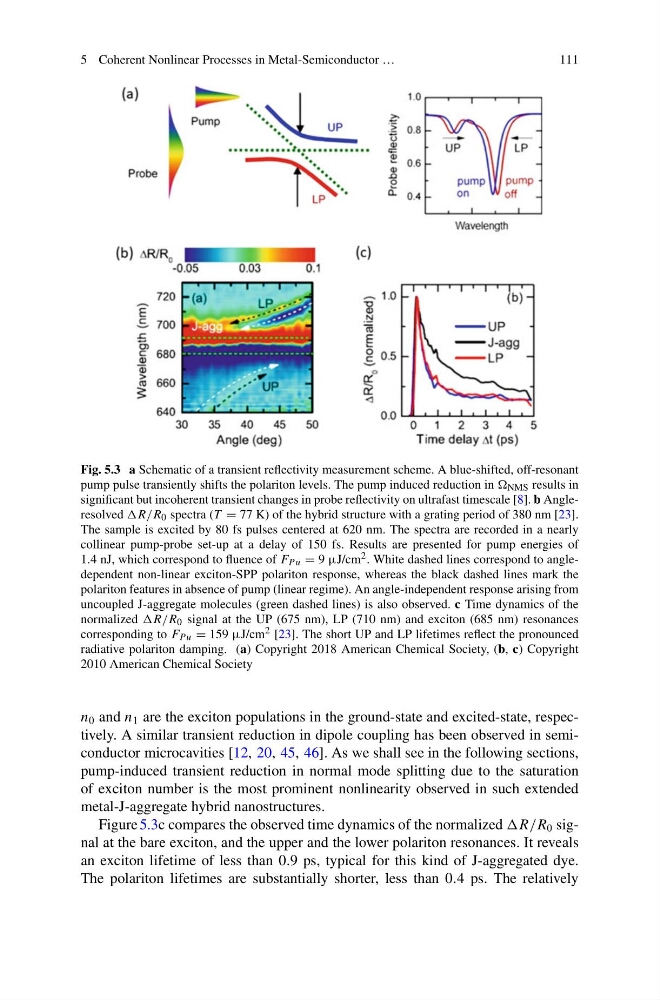
Fig. 5.3 a Schematic of a transient reflectivity measurement scheme. A blue-shifted, off-resonant
pump pulse transiently shifts the polariton levels. The pump induced reduction in NMS results in
significant but incoherent transient changes in probe reflectivity on ultrafast timescale [8]. b Angleresolved R/R 0 spectra (T = 77 K) of the hybrid structure with a grating period of 380 nm [23].
The sample is excited by 80 fs pulses centered at 620 nm. The spectra are recorded in a nearly
collinear pump-probe set-up at a delay of 150 fs. Results are presented for pump energies of
1.4 nJ, which correspond to fluence of F Pu = 9 µJ/cm 2 . White dashed lines correspond to angledependent non-linear exciton-SPP polariton response, whereas the black dashed lines mark the
polariton features in absence of pump (linear regime). An angle-independent response arising from
uncoupled J-aggregate molecules (green dashed lines) is also observed. c Time dynamics of the
normalized R/R 0 signal at the UP (675 nm), LP (710 nm) and exciton (685 nm) resonances
corresponding to F Pu = 159 µJ/cm 2 [23]. The short UP and LP lifetimes reflect the pronounced
radiative polariton damping. (a) Copyright 2018 American Chemical Society, (b, c) Copyright
2010 American Chemical Society
n 0 and n 1 are the exciton populations in the ground-state and excited-state, respectively. A similar transient reduction in dipole coupling has been observed in semiconductor microcavities [12, 20, 45, 46]. As we shall see in the following sections,
pump-induced transient reduction in normal mode splitting due to the saturation
of exciton number is the most prominent nonlinearity observed in such extended
metal-J-aggregate hybrid nanostructures.
Figure 5.3c compares the observed time dynamics of the normalized R/R 0 signal at the bare exciton, and the upper and the lower polariton resonances. It reveals
an exciton lifetime of less than 0.9 ps, typical for this kind of J-aggregated dye.
The polariton lifetimes are substantially shorter, less than 0.4 ps. The relatively
111
Fig. 5.3 a Schematic of a transient reflectivity measurement scheme. A blue-shifted, off-resonant
pump pulse transiently shifts the polariton levels. The pump induced reduction in NMS results in
significant but incoherent transient changes in probe reflectivity on ultrafast timescale [8]. b Angleresolved R/R 0 spectra (T = 77 K) of the hybrid structure with a grating period of 380 nm [23].
The sample is excited by 80 fs pulses centered at 620 nm. The spectra are recorded in a nearly
collinear pump-probe set-up at a delay of 150 fs. Results are presented for pump energies of
1.4 nJ, which correspond to fluence of F Pu = 9 µJ/cm 2 . White dashed lines correspond to angledependent non-linear exciton-SPP polariton response, whereas the black dashed lines mark the
polariton features in absence of pump (linear regime). An angle-independent response arising from
uncoupled J-aggregate molecules (green dashed lines) is also observed. c Time dynamics of the
normalized R/R 0 signal at the UP (675 nm), LP (710 nm) and exciton (685 nm) resonances
corresponding to F Pu = 159 µJ/cm 2 [23]. The short UP and LP lifetimes reflect the pronounced
radiative polariton damping. (a) Copyright 2018 American Chemical Society, (b, c) Copyright
2010 American Chemical Society
n 0 and n 1 are the exciton populations in the ground-state and excited-state, respectively. A similar transient reduction in dipole coupling has been observed in semiconductor microcavities [12, 20, 45, 46]. As we shall see in the following sections,
pump-induced transient reduction in normal mode splitting due to the saturation
of exciton number is the most prominent nonlinearity observed in such extended
metal-J-aggregate hybrid nanostructures.
Figure 5.3c compares the observed time dynamics of the normalized R/R 0 signal at the bare exciton, and the upper and the lower polariton resonances. It reveals
an exciton lifetime of less than 0.9 ps, typical for this kind of J-aggregated dye.
The polariton lifetimes are substantially shorter, less than 0.4 ps. The relatively