

108
P. Vasa
model in conjunction with the first order perturbation theory, it is possible to evaluate
the polariton dipole moments as μ U P,L P =
((±A 0 )μ exc +2 A 2 μ SPP
B U P,L P
, where μ exc and μ SPP
are the exciton and SPP dipole moments (oscillator strengths), respectively [8, 9,
25–27]. Though this phenomenological model is simple to implement and is widely
used, the major drawback is that the damping is introduced phenomenologically
using experimental data. Also, the inhomogeneous broadening has to be accounted
by convoluting the optical response with appropriate distribution function.
Modeling of nonlinear optical response and the dynamics of the strongly coupled
system is more complex as well as challenging. It at least requires the semi-classical
approach based on Liouville equation and density matrix formalism [8, 25–27].
Instead of using phenomenological approach, the damping here can be introduced
using Lindblad formalism [2, 35, 39]. As we shall see in the later sections, this
semi-classical model can satisfactorily account for the experimental observations
(such as Rabi oscillations and optical Stark effect), and make predictions about the
phenomena yet to be observed (like higher rungs of the Jaynes-Cummings ladder
and electromagnetically induced transparency).
The linear optical response of the hybrid nanostructure is investigated by recording angle resolved p-polarized broadband reflectivity (1.6–2 eV) spectra using an
ultrafast white-light source (Fianium SC-450-4) [23, 25, 26]. A complete characterization of the emitted in terms of amplitude and phase is also possible using
spectral interferometry technique. Fully characterizing the response in terms of
amplitude and phase permits better estimation of homogeneous and inhomogeneous
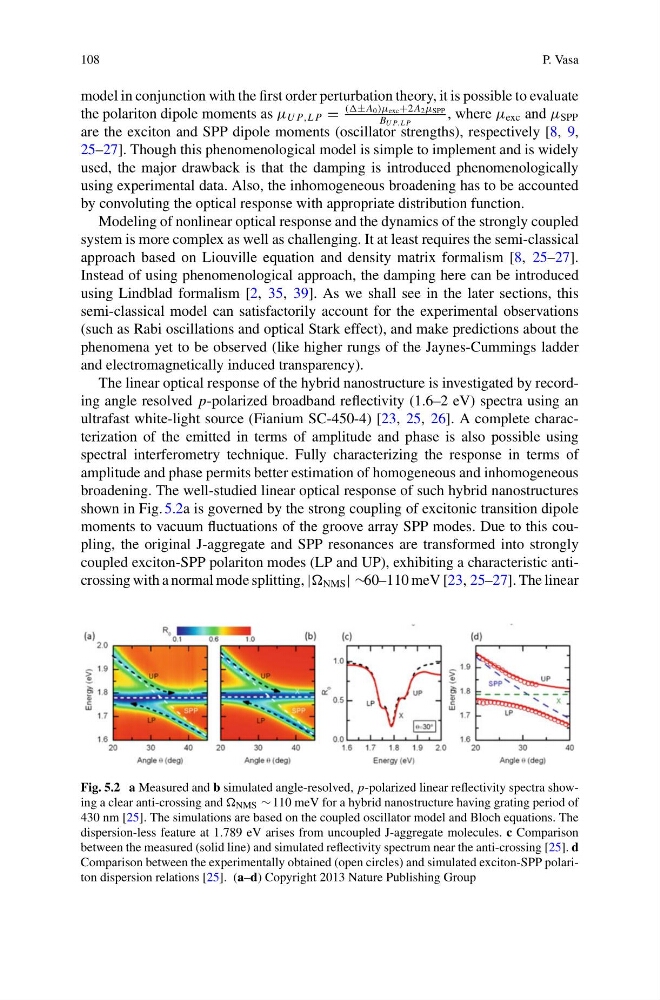
broadening. The well-studied linear optical response of such hybrid nanostructures
shown in Fig. 5.2a is governed by the strong coupling of excitonic transition dipole
moments to vacuum fluctuations of the groove array SPP modes. Due to this coupling, the original J-aggregate and SPP resonances are transformed into strongly
coupled exciton-SPP polariton modes (LP and UP), exhibiting a characteristic anticrossing with a normal mode splitting, | NMS | ∼60–110 meV [23, 25–27]. The linear
Fig. 5.2 a Measured and b simulated angle-resolved, p-polarized linear reflectivity spectra showing a clear anti-crossing and NMS ∼ 110 meV for a hybrid nanostructure having grating period of
430 nm [25]. The simulations are based on the coupled oscillator model and Bloch equations. The
dispersion-less feature at 1.789 eV arises from uncoupled J-aggregate molecules. c Comparison
between the measured (solid line) and simulated reflectivity spectrum near the anti-crossing [25]. d
Comparison between the experimentally obtained (open circles) and simulated exciton-SPP polariton dispersion relations [25]. (a–d) Copyright 2013 Nature Publishing Group
P. Vasa
model in conjunction with the first order perturbation theory, it is possible to evaluate
the polariton dipole moments as μ U P,L P =
((±A 0 )μ exc +2 A 2 μ SPP
B U P,L P
, where μ exc and μ SPP
are the exciton and SPP dipole moments (oscillator strengths), respectively [8, 9,
25–27]. Though this phenomenological model is simple to implement and is widely
used, the major drawback is that the damping is introduced phenomenologically
using experimental data. Also, the inhomogeneous broadening has to be accounted
by convoluting the optical response with appropriate distribution function.
Modeling of nonlinear optical response and the dynamics of the strongly coupled
system is more complex as well as challenging. It at least requires the semi-classical
approach based on Liouville equation and density matrix formalism [8, 25–27].
Instead of using phenomenological approach, the damping here can be introduced
using Lindblad formalism [2, 35, 39]. As we shall see in the later sections, this
semi-classical model can satisfactorily account for the experimental observations
(such as Rabi oscillations and optical Stark effect), and make predictions about the
phenomena yet to be observed (like higher rungs of the Jaynes-Cummings ladder
and electromagnetically induced transparency).
The linear optical response of the hybrid nanostructure is investigated by recording angle resolved p-polarized broadband reflectivity (1.6–2 eV) spectra using an
ultrafast white-light source (Fianium SC-450-4) [23, 25, 26]. A complete characterization of the emitted in terms of amplitude and phase is also possible using
spectral interferometry technique. Fully characterizing the response in terms of
amplitude and phase permits better estimation of homogeneous and inhomogeneous
broadening. The well-studied linear optical response of such hybrid nanostructures
shown in Fig. 5.2a is governed by the strong coupling of excitonic transition dipole
moments to vacuum fluctuations of the groove array SPP modes. Due to this coupling, the original J-aggregate and SPP resonances are transformed into strongly
coupled exciton-SPP polariton modes (LP and UP), exhibiting a characteristic anticrossing with a normal mode splitting, | NMS | ∼60–110 meV [23, 25–27]. The linear
Fig. 5.2 a Measured and b simulated angle-resolved, p-polarized linear reflectivity spectra showing a clear anti-crossing and NMS ∼ 110 meV for a hybrid nanostructure having grating period of
430 nm [25]. The simulations are based on the coupled oscillator model and Bloch equations. The
dispersion-less feature at 1.789 eV arises from uncoupled J-aggregate molecules. c Comparison
between the measured (solid line) and simulated reflectivity spectrum near the anti-crossing [25]. d
Comparison between the experimentally obtained (open circles) and simulated exciton-SPP polariton dispersion relations [25]. (a–d) Copyright 2013 Nature Publishing Group