

106
P. Vasa
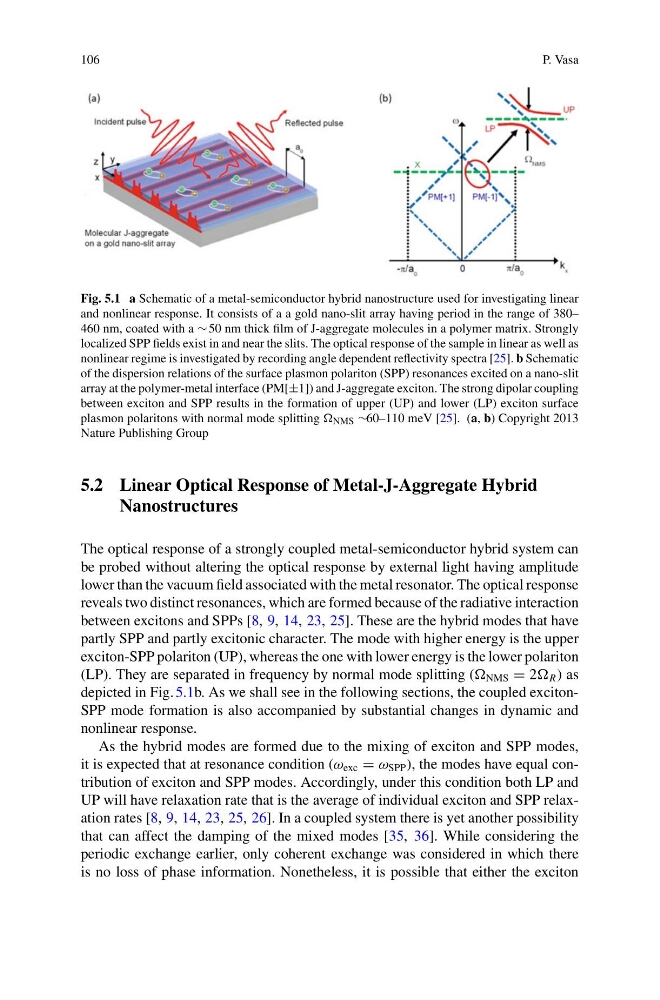
Fig. 5.1 a Schematic of a metal-semiconductor hybrid nanostructure used for investigating linear
and nonlinear response. It consists of a a gold nano-slit array having period in the range of 380–
460 nm, coated with a ∼ 50 nm thick film of J-aggregate molecules in a polymer matrix. Strongly
localized SPP fields exist in and near the slits. The optical response of the sample in linear as well as
nonlinear regime is investigated by recording angle dependent reflectivity spectra [25]. b Schematic
of the dispersion relations of the surface plasmon polariton (SPP) resonances excited on a nano-slit
array at the polymer-metal interface (PM[±1]) and J-aggregate exciton. The strong dipolar coupling
between exciton and SPP results in the formation of upper (UP) and lower (LP) exciton surface
plasmon polaritons with normal mode splitting NMS ∼60–110 meV [25]. (a, b) Copyright 2013
Nature Publishing Group
5.2 Linear Optical Response of Metal-J-Aggregate Hybrid
Nanostructures
The optical response of a strongly coupled metal-semiconductor hybrid system can
be probed without altering the optical response by external light having amplitude
lower than the vacuum field associated with the metal resonator. The optical response
reveals two distinct resonances, which are formed because of the radiative interaction
between excitons and SPPs [8, 9, 14, 23, 25]. These are the hybrid modes that have
partly SPP and partly excitonic character. The mode with higher energy is the upper
exciton-SPP polariton (UP), whereas the one with lower energy is the lower polariton
(LP). They are separated in frequency by normal mode splitting ( NMS = 2 R ) as
depicted in Fig. 5.1b. As we shall see in the following sections, the coupled excitonSPP mode formation is also accompanied by substantial changes in dynamic and
nonlinear response.
As the hybrid modes are formed due to the mixing of exciton and SPP modes,
it is expected that at resonance condition (ω exc = ω SPP ), the modes have equal contribution of exciton and SPP modes. Accordingly, under this condition both LP and
UP will have relaxation rate that is the average of individual exciton and SPP relaxation rates [8, 9, 14, 23, 25, 26]. In a coupled system there is yet another possibility
that can affect the damping of the mixed modes [35, 36]. While considering the
periodic exchange earlier, only coherent exchange was considered in which there
is no loss of phase information. Nonetheless, it is possible that either the exciton
P. Vasa
Fig. 5.1 a Schematic of a metal-semiconductor hybrid nanostructure used for investigating linear
and nonlinear response. It consists of a a gold nano-slit array having period in the range of 380–
460 nm, coated with a ∼ 50 nm thick film of J-aggregate molecules in a polymer matrix. Strongly
localized SPP fields exist in and near the slits. The optical response of the sample in linear as well as
nonlinear regime is investigated by recording angle dependent reflectivity spectra [25]. b Schematic
of the dispersion relations of the surface plasmon polariton (SPP) resonances excited on a nano-slit
array at the polymer-metal interface (PM[±1]) and J-aggregate exciton. The strong dipolar coupling
between exciton and SPP results in the formation of upper (UP) and lower (LP) exciton surface
plasmon polaritons with normal mode splitting NMS ∼60–110 meV [25]. (a, b) Copyright 2013
Nature Publishing Group
5.2 Linear Optical Response of Metal-J-Aggregate Hybrid
Nanostructures
The optical response of a strongly coupled metal-semiconductor hybrid system can
be probed without altering the optical response by external light having amplitude
lower than the vacuum field associated with the metal resonator. The optical response
reveals two distinct resonances, which are formed because of the radiative interaction
between excitons and SPPs [8, 9, 14, 23, 25]. These are the hybrid modes that have
partly SPP and partly excitonic character. The mode with higher energy is the upper
exciton-SPP polariton (UP), whereas the one with lower energy is the lower polariton
(LP). They are separated in frequency by normal mode splitting ( NMS = 2 R ) as
depicted in Fig. 5.1b. As we shall see in the following sections, the coupled excitonSPP mode formation is also accompanied by substantial changes in dynamic and
nonlinear response.
As the hybrid modes are formed due to the mixing of exciton and SPP modes,
it is expected that at resonance condition (ω exc = ω SPP ), the modes have equal contribution of exciton and SPP modes. Accordingly, under this condition both LP and
UP will have relaxation rate that is the average of individual exciton and SPP relaxation rates [8, 9, 14, 23, 25, 26]. In a coupled system there is yet another possibility
that can affect the damping of the mixed modes [35, 36]. While considering the
periodic exchange earlier, only coherent exchange was considered in which there
is no loss of phase information. Nonetheless, it is possible that either the exciton