

5 Coherent Nonlinear Processes in Metal-Semiconductor …
103
in this case the system behaves as that comprising coupled classical oscillators with
a Rabi frequency given by R =
√
N
√
MμE, where N and M correspond to the
number of emitters and field modes, respectively. Unlike in the case of the interaction
with a single mode, R is independent of the photon number, n present in a mode [6,
8–12].
The fully coherent interaction discussed above is reversible only if the emitter and
the resonator are completely isolated from the surroundings or are lossless. Since
all emitters are characterized by finite lifetime of the excited state and all resonators
have a finite photon lifetime governed by their Q-factor, the duration over which the
coherent exchange of energy is observed is limited. Beyond this duration, the energy
is released to the surrounding irreversibly. Hence, resonators having longer photon
lifetime or high Q-factors are required to observe the coherent light-matter interaction. Depending on the relative values of Rabi frequency and the relaxation rates of
the emitter and the resonator, two coupling regimes are defined. If R is lower compared to either of the relaxation rate, it is classified to be weak coupling regime [5,
6, 8, 9, 13, 14]. If R is higher or comparable to the relaxation rate, in other words
if the coupling energy is higher or comparable to the linewidths of the system, it is
said to be strong coupling regime [4–6, 8–10]. Only in strong coupling regime, the
coherence is preserved long enough to be able to observe the reversible and periodic transfer of energy between the resonator and the emitter. Apart from the energy
relaxation processes, other dephasing and line broadening processes also contribute
to the effective linewidths of the emitter and the resonator. To attain strong coupling
regime, R needs to be comparable or larger compared to the total linewidth. To a
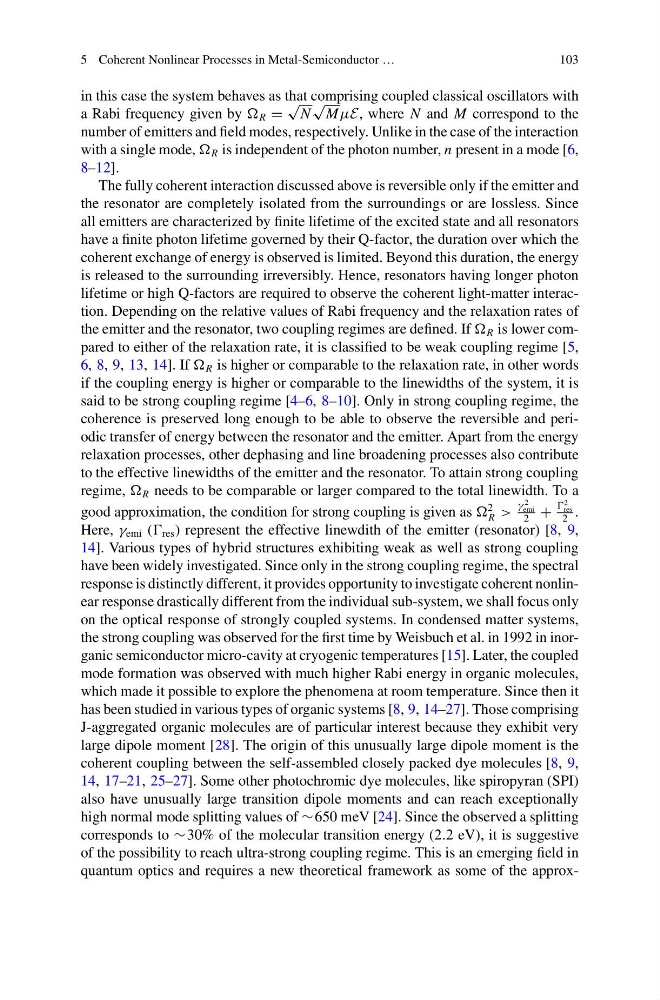
good approximation, the condition for strong coupling is given as
2
R >
γ
2
emi
2
+
2
res
2
.
Here, γ emi ( res ) represent the effective linewdith of the emitter (resonator) [8, 9,
14]. Various types of hybrid structures exhibiting weak as well as strong coupling
have been widely investigated. Since only in the strong coupling regime, the spectral
response is distinctly different, it provides opportunity to investigate coherent nonlinear response drastically different from the individual sub-system, we shall focus only
on the optical response of strongly coupled systems. In condensed matter systems,
the strong coupling was observed for the first time by Weisbuch et al. in 1992 in inorganic semiconductor micro-cavity at cryogenic temperatures [15]. Later, the coupled
mode formation was observed with much higher Rabi energy in organic molecules,
which made it possible to explore the phenomena at room temperature. Since then it
has been studied in various types of organic systems [8, 9, 14–27]. Those comprising
J-aggregated organic molecules are of particular interest because they exhibit very
large dipole moment [28]. The origin of this unusually large dipole moment is the
coherent coupling between the self-assembled closely packed dye molecules [8, 9,
14, 17–21, 25–27]. Some other photochromic dye molecules, like spiropyran (SPI)
also have unusually large transition dipole moments and can reach exceptionally
high normal mode splitting values of ∼ 650 meV [24]. Since the observed a splitting
corresponds to ∼ 30% of the molecular transition energy (2.2 eV), it is suggestive
of the possibility to reach ultra-strong coupling regime. This is an emerging field in
quantum optics and requires a new theoretical framework as some of the approx-
103
in this case the system behaves as that comprising coupled classical oscillators with
a Rabi frequency given by R =
√
N
√
MμE, where N and M correspond to the
number of emitters and field modes, respectively. Unlike in the case of the interaction
with a single mode, R is independent of the photon number, n present in a mode [6,
8–12].
The fully coherent interaction discussed above is reversible only if the emitter and
the resonator are completely isolated from the surroundings or are lossless. Since
all emitters are characterized by finite lifetime of the excited state and all resonators
have a finite photon lifetime governed by their Q-factor, the duration over which the
coherent exchange of energy is observed is limited. Beyond this duration, the energy
is released to the surrounding irreversibly. Hence, resonators having longer photon
lifetime or high Q-factors are required to observe the coherent light-matter interaction. Depending on the relative values of Rabi frequency and the relaxation rates of
the emitter and the resonator, two coupling regimes are defined. If R is lower compared to either of the relaxation rate, it is classified to be weak coupling regime [5,
6, 8, 9, 13, 14]. If R is higher or comparable to the relaxation rate, in other words
if the coupling energy is higher or comparable to the linewidths of the system, it is
said to be strong coupling regime [4–6, 8–10]. Only in strong coupling regime, the
coherence is preserved long enough to be able to observe the reversible and periodic transfer of energy between the resonator and the emitter. Apart from the energy
relaxation processes, other dephasing and line broadening processes also contribute
to the effective linewidths of the emitter and the resonator. To attain strong coupling
regime, R needs to be comparable or larger compared to the total linewidth. To a
good approximation, the condition for strong coupling is given as
2
R >
γ
2
emi
2
+
2
res
2
.
Here, γ emi ( res ) represent the effective linewdith of the emitter (resonator) [8, 9,
14]. Various types of hybrid structures exhibiting weak as well as strong coupling
have been widely investigated. Since only in the strong coupling regime, the spectral
response is distinctly different, it provides opportunity to investigate coherent nonlinear response drastically different from the individual sub-system, we shall focus only
on the optical response of strongly coupled systems. In condensed matter systems,
the strong coupling was observed for the first time by Weisbuch et al. in 1992 in inorganic semiconductor micro-cavity at cryogenic temperatures [15]. Later, the coupled
mode formation was observed with much higher Rabi energy in organic molecules,
which made it possible to explore the phenomena at room temperature. Since then it
has been studied in various types of organic systems [8, 9, 14–27]. Those comprising
J-aggregated organic molecules are of particular interest because they exhibit very
large dipole moment [28]. The origin of this unusually large dipole moment is the
coherent coupling between the self-assembled closely packed dye molecules [8, 9,
14, 17–21, 25–27]. Some other photochromic dye molecules, like spiropyran (SPI)
also have unusually large transition dipole moments and can reach exceptionally
high normal mode splitting values of ∼ 650 meV [24]. Since the observed a splitting
corresponds to ∼ 30% of the molecular transition energy (2.2 eV), it is suggestive
of the possibility to reach ultra-strong coupling regime. This is an emerging field in
quantum optics and requires a new theoretical framework as some of the approx-