

4 Light-Dressed Spectroscopy of Molecules
93
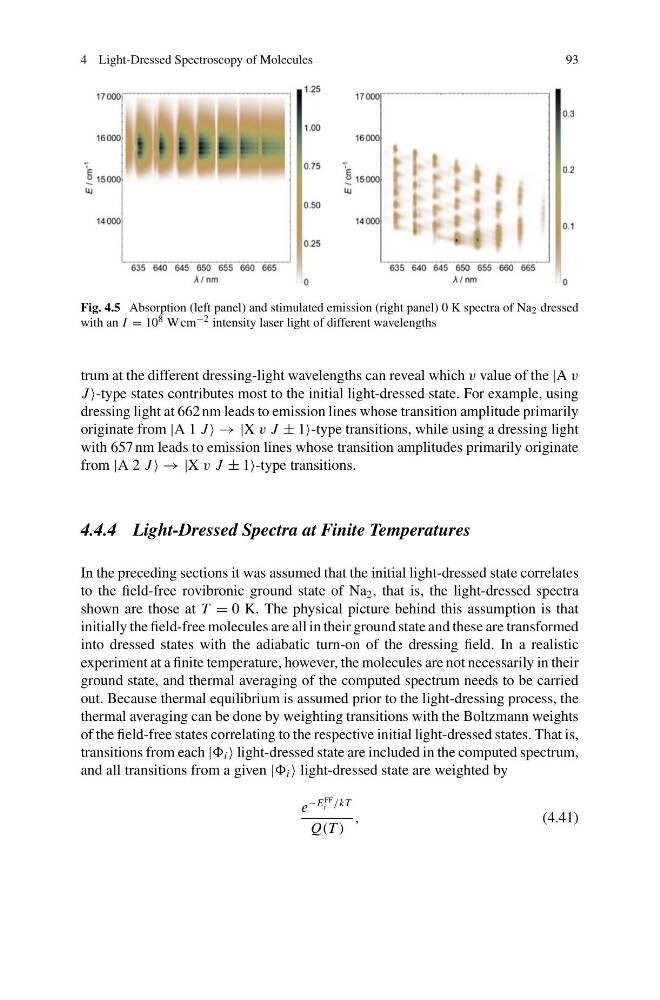
Fig. 4.5 Absorption (left panel) and stimulated emission (right panel) 0 K spectra of Na 2 dressed
with an I = 10 8 W cm −2 intensity laser light of different wavelengths
trum at the different dressing-light wavelengths can reveal which v value of the |A v
J -type states contributes most to the initial light-dressed state. For example, using
dressing light at 662 nm leads to emission lines whose transition amplitude primarily
originate from |A 1 J → |X v J ± 1-type transitions, while using a dressing light
with 657 nm leads to emission lines whose transition amplitudes primarily originate
from |A 2 J → |X v J ± 1-type transitions.
4.4.4 Light-Dressed Spectra at Finite Temperatures
In the preceding sections it was assumed that the initial light-dressed state correlates
to the field-free rovibronic ground state of Na 2 , that is, the light-dressed spectra
shown are those at T = 0 K. The physical picture behind this assumption is that
initially the field-free molecules are all in their ground state and these are transformed
into dressed states with the adiabatic turn-on of the dressing field. In a realistic
experiment at a finite temperature, however, the molecules are not necessarily in their
ground state, and thermal averaging of the computed spectrum needs to be carried
out. Because thermal equilibrium is assumed prior to the light-dressing process, the
thermal averaging can be done by weighting transitions with the Boltzmann weights
of the field-free states correlating to the respective initial light-dressed states. That is,
transitions from each | i light-dressed state are included in the computed spectrum,
and all transitions from a given | i light-dressed state are weighted by
e
−E
FF
i /kT
Q(T )
,
(4.41)
93
Fig. 4.5 Absorption (left panel) and stimulated emission (right panel) 0 K spectra of Na 2 dressed
with an I = 10 8 W cm −2 intensity laser light of different wavelengths
trum at the different dressing-light wavelengths can reveal which v value of the |A v
J -type states contributes most to the initial light-dressed state. For example, using
dressing light at 662 nm leads to emission lines whose transition amplitude primarily
originate from |A 1 J → |X v J ± 1-type transitions, while using a dressing light
with 657 nm leads to emission lines whose transition amplitudes primarily originate
from |A 2 J → |X v J ± 1-type transitions.
4.4.4 Light-Dressed Spectra at Finite Temperatures
In the preceding sections it was assumed that the initial light-dressed state correlates
to the field-free rovibronic ground state of Na 2 , that is, the light-dressed spectra
shown are those at T = 0 K. The physical picture behind this assumption is that
initially the field-free molecules are all in their ground state and these are transformed
into dressed states with the adiabatic turn-on of the dressing field. In a realistic
experiment at a finite temperature, however, the molecules are not necessarily in their
ground state, and thermal averaging of the computed spectrum needs to be carried
out. Because thermal equilibrium is assumed prior to the light-dressing process, the
thermal averaging can be done by weighting transitions with the Boltzmann weights
of the field-free states correlating to the respective initial light-dressed states. That is,
transitions from each | i light-dressed state are included in the computed spectrum,
and all transitions from a given | i light-dressed state are weighted by
e
−E
FF
i /kT
Q(T )
,
(4.41)