

2 Industrial Plant Oil Extraction
85
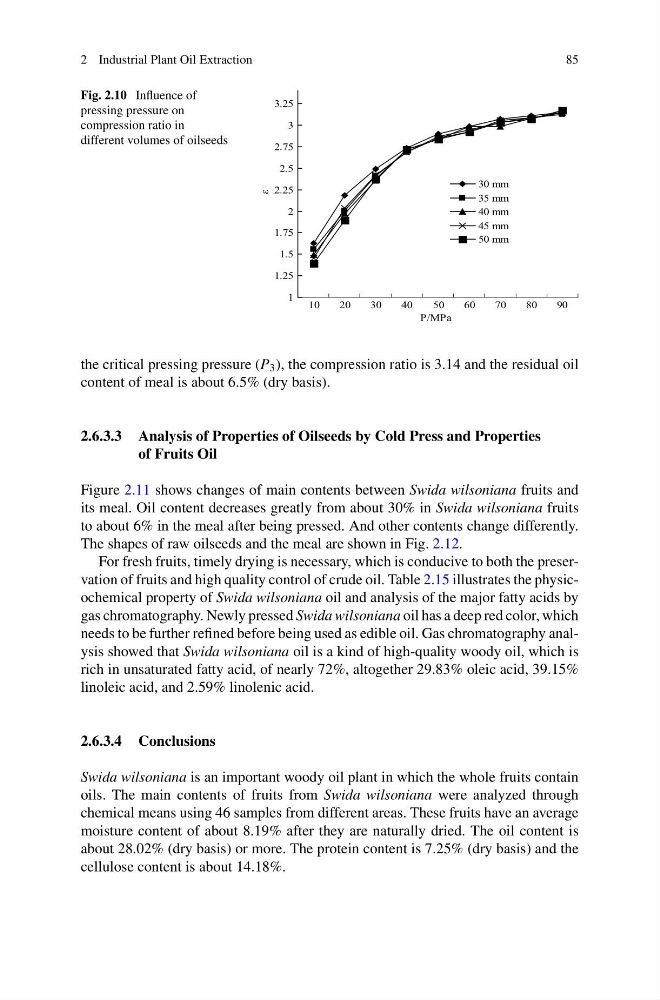
Fig. 2.10 Influence of
pressing pressure on
compression ratio in
different volumes of oilseeds
1
1.25
1.5
1.75
2
2.25
2.5
2.75
3
3.25
10
20
30
40
50
60
70
80
90
P/MPa
ε
30 mm
35 mm
40 mm
45 mm
50 mm
the critical pressing pressure (P 3 ), the compression ratio is 3.14 and the residual oil
content of meal is about 6.5% (dry basis).
2.6.3.3 Analysis of Properties of Oilseeds by Cold Press and Properties
of Fruits Oil
Figure 2.11 shows changes of main contents between Swida wilsoniana fruits and
its meal. Oil content decreases greatly from about 30% in Swida wilsoniana fruits
to about 6% in the meal after being pressed. And other contents change differently.
The shapes of raw oilseeds and the meal are shown in Fig. 2.12.
For fresh fruits, timely drying is necessary, which is conducive to both the preservation of fruits and high quality control of crude oil. Table 2.15 illustrates the physicochemical property of Swida wilsoniana oil and analysis of the major fatty acids by
gas chromatography. Newly pressed Swida wilsoniana oil has a deep red color, which
needs to be further refined before being used as edible oil. Gas chromatography analysis showed that Swida wilsoniana oil is a kind of high-quality woody oil, which is
rich in unsaturated fatty acid, of nearly 72%, altogether 29.83% oleic acid, 39.15%
linoleic acid, and 2.59% linolenic acid.
2.6.3.4 Conclusions
Swida wilsoniana is an important woody oil plant in which the whole fruits contain
oils. The main contents of fruits from Swida wilsoniana were analyzed through
chemical means using 46 samples from different areas. These fruits have an average
moisture content of about 8.19% after they are naturally dried. The oil content is
about 28.02% (dry basis) or more. The protein content is 7.25% (dry basis) and the
cellulose content is about 14.18%.
85
Fig. 2.10 Influence of
pressing pressure on
compression ratio in
different volumes of oilseeds
1
1.25
1.5
1.75
2
2.25
2.5
2.75
3
3.25
10
20
30
40
50
60
70
80
90
P/MPa
ε
30 mm
35 mm
40 mm
45 mm
50 mm
the critical pressing pressure (P 3 ), the compression ratio is 3.14 and the residual oil
content of meal is about 6.5% (dry basis).
2.6.3.3 Analysis of Properties of Oilseeds by Cold Press and Properties
of Fruits Oil
Figure 2.11 shows changes of main contents between Swida wilsoniana fruits and
its meal. Oil content decreases greatly from about 30% in Swida wilsoniana fruits
to about 6% in the meal after being pressed. And other contents change differently.
The shapes of raw oilseeds and the meal are shown in Fig. 2.12.
For fresh fruits, timely drying is necessary, which is conducive to both the preservation of fruits and high quality control of crude oil. Table 2.15 illustrates the physicochemical property of Swida wilsoniana oil and analysis of the major fatty acids by
gas chromatography. Newly pressed Swida wilsoniana oil has a deep red color, which
needs to be further refined before being used as edible oil. Gas chromatography analysis showed that Swida wilsoniana oil is a kind of high-quality woody oil, which is
rich in unsaturated fatty acid, of nearly 72%, altogether 29.83% oleic acid, 39.15%
linoleic acid, and 2.59% linolenic acid.
2.6.3.4 Conclusions
Swida wilsoniana is an important woody oil plant in which the whole fruits contain
oils. The main contents of fruits from Swida wilsoniana were analyzed through
chemical means using 46 samples from different areas. These fruits have an average
moisture content of about 8.19% after they are naturally dried. The oil content is
about 28.02% (dry basis) or more. The protein content is 7.25% (dry basis) and the
cellulose content is about 14.18%.