

78
Z. Xiao et al.
Table 2.11 Physicochemical
properties of castor seed oils
obtained by different exaction
methods
Physicochemical properties
SE
AEE
Acid value (mg KOH/g)
4.9b
10.8a
Iodine value (g/100 g)
93a
92a
Saponification value (mg KOH/g)
197a
196a
Hydroxyl value (mg KOH/g)
155b
166a
Refractive index (25 °C)
1.4841a
1.4824a
and 200 °C, respectively. Electron impact energy of mass spectrometer was 70 eV,
and scanning quality ranged from 15 to 500 amu. The fatty acid components and
relative content were identified on the basis of mass spectrometer results.
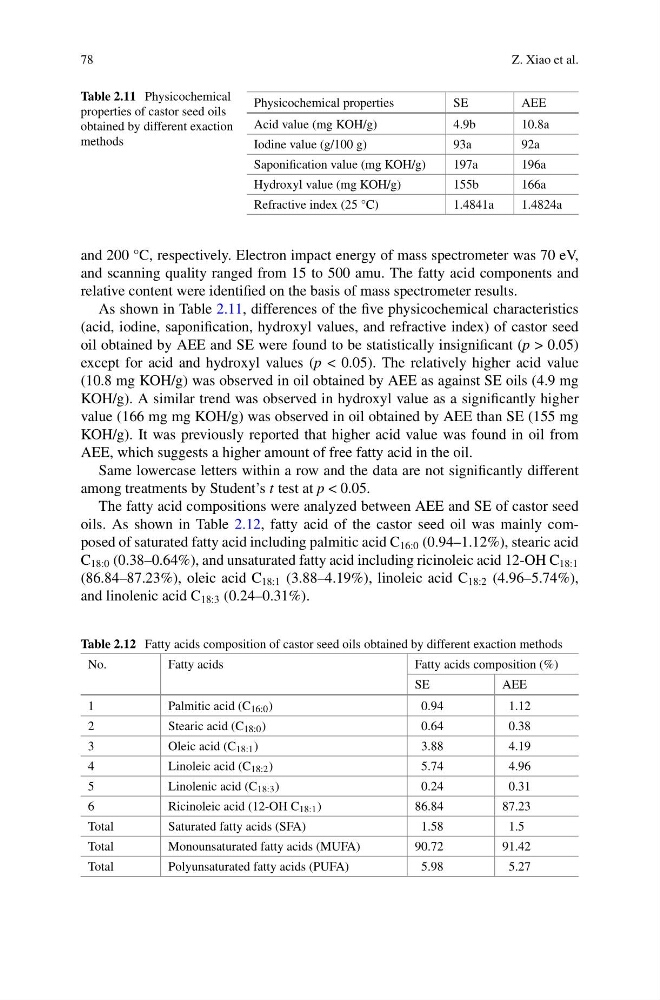
As shown in Table 2.11, differences of the five physicochemical characteristics
(acid, iodine, saponification, hydroxyl values, and refractive index) of castor seed
oil obtained by AEE and SE were found to be statistically insignificant (p > 0.05)
except for acid and hydroxyl values (p < 0.05). The relatively higher acid value
(10.8 mg KOH/g) was observed in oil obtained by AEE as against SE oils (4.9 mg
KOH/g). A similar trend was observed in hydroxyl value as a significantly higher
value (166 mg mg KOH/g) was observed in oil obtained by AEE than SE (155 mg
KOH/g). It was previously reported that higher acid value was found in oil from
AEE, which suggests a higher amount of free fatty acid in the oil.
Same lowercase letters within a row and the data are not significantly different
among treatments by Student’s t test at p < 0.05.
The fatty acid compositions were analyzed between AEE and SE of castor seed
oils. As shown in Table 2.12, fatty acid of the castor seed oil was mainly composed of saturated fatty acid including palmitic acid C 16:0 (0.94–1.12%), stearic acid
C 18:0 (0.38–0.64%), and unsaturated fatty acid including ricinoleic acid 12-OH C 18:1
(86.84–87.23%), oleic acid C 18:1 (3.88–4.19%), linoleic acid C 18:2 (4.96–5.74%),
and linolenic acid C 18:3 (0.24–0.31%).
Table 2.12 Fatty acids composition of castor seed oils obtained by different exaction methods
No.
Fatty acids
Fatty acids composition (%)
SE
AEE
1
Palmitic acid (C 16:0 )
0.94
1.12
2
Stearic acid (C 18:0 )
0.64
0.38
3
Oleic acid (C 18:1 )
3.88
4.19
4
Linoleic acid (C 18:2 )
5.74
4.96
5
Linolenic acid (C 18:3 )
0.24
0.31
6
Ricinoleic acid (12-OH C 18:1 )
86.84
87.23
Total
Saturated fatty acids (SFA)
1.58
1.5
Total
Monounsaturated fatty acids (MUFA)
90.72
91.42
Total
Polyunsaturated fatty acids (PUFA)
5.98
5.27
Z. Xiao et al.
Table 2.11 Physicochemical
properties of castor seed oils
obtained by different exaction
methods
Physicochemical properties
SE
AEE
Acid value (mg KOH/g)
4.9b
10.8a
Iodine value (g/100 g)
93a
92a
Saponification value (mg KOH/g)
197a
196a
Hydroxyl value (mg KOH/g)
155b
166a
Refractive index (25 °C)
1.4841a
1.4824a
and 200 °C, respectively. Electron impact energy of mass spectrometer was 70 eV,
and scanning quality ranged from 15 to 500 amu. The fatty acid components and
relative content were identified on the basis of mass spectrometer results.
As shown in Table 2.11, differences of the five physicochemical characteristics
(acid, iodine, saponification, hydroxyl values, and refractive index) of castor seed
oil obtained by AEE and SE were found to be statistically insignificant (p > 0.05)
except for acid and hydroxyl values (p < 0.05). The relatively higher acid value
(10.8 mg KOH/g) was observed in oil obtained by AEE as against SE oils (4.9 mg
KOH/g). A similar trend was observed in hydroxyl value as a significantly higher
value (166 mg mg KOH/g) was observed in oil obtained by AEE than SE (155 mg
KOH/g). It was previously reported that higher acid value was found in oil from
AEE, which suggests a higher amount of free fatty acid in the oil.
Same lowercase letters within a row and the data are not significantly different
among treatments by Student’s t test at p < 0.05.
The fatty acid compositions were analyzed between AEE and SE of castor seed
oils. As shown in Table 2.12, fatty acid of the castor seed oil was mainly composed of saturated fatty acid including palmitic acid C 16:0 (0.94–1.12%), stearic acid
C 18:0 (0.38–0.64%), and unsaturated fatty acid including ricinoleic acid 12-OH C 18:1
(86.84–87.23%), oleic acid C 18:1 (3.88–4.19%), linoleic acid C 18:2 (4.96–5.74%),
and linolenic acid C 18:3 (0.24–0.31%).
Table 2.12 Fatty acids composition of castor seed oils obtained by different exaction methods
No.
Fatty acids
Fatty acids composition (%)
SE
AEE
1
Palmitic acid (C 16:0 )
0.94
1.12
2
Stearic acid (C 18:0 )
0.64
0.38
3
Oleic acid (C 18:1 )
3.88
4.19
4
Linoleic acid (C 18:2 )
5.74
4.96
5
Linolenic acid (C 18:3 )
0.24
0.31
6
Ricinoleic acid (12-OH C 18:1 )
86.84
87.23
Total
Saturated fatty acids (SFA)
1.58
1.5
Total
Monounsaturated fatty acids (MUFA)
90.72
91.42
Total
Polyunsaturated fatty acids (PUFA)
5.98
5.27