

2 Industrial Plant Oil Extraction
55
to be disconnected, while the other part is connected to each other to form a channel;
it is still possible to continue to press oil. Therefore, the residual oil in the pressed
cake is composed of the oil enclosed in the pores by the closed oil circuit, the oil
combined on the inner and outer surfaces of the particles, and the residual oil in the
undamaged oil plant cells. The uneven distribution of residual oil in the cake will be
caused by the uneven distribution of pressure and the inconsistent flow rate in the
actual pressing process.
2.1.2 Principle of Solvent Extraction
Solvent extraction is according to the principle of extraction of the organic chemical separation process. And it is the use of organic solvents that can dissolve oil,
through the role of wetting, infiltration, molecular diffusion; the oil in the blank will
be extracted. The oil extraction process is a mass transfer process from the solid
phase to the liquid phase. This mass transfer process is accomplished by molecular
diffusion and convective diffusion. The miscibility between oil and organic solvents
can easily happen, with good mutual diffusion, using n-hexane as extracting agent.
Oil extraction happened between the solvent and the material under the condition
of relative motion, so in addition to the oil molecular diffusion process, there are
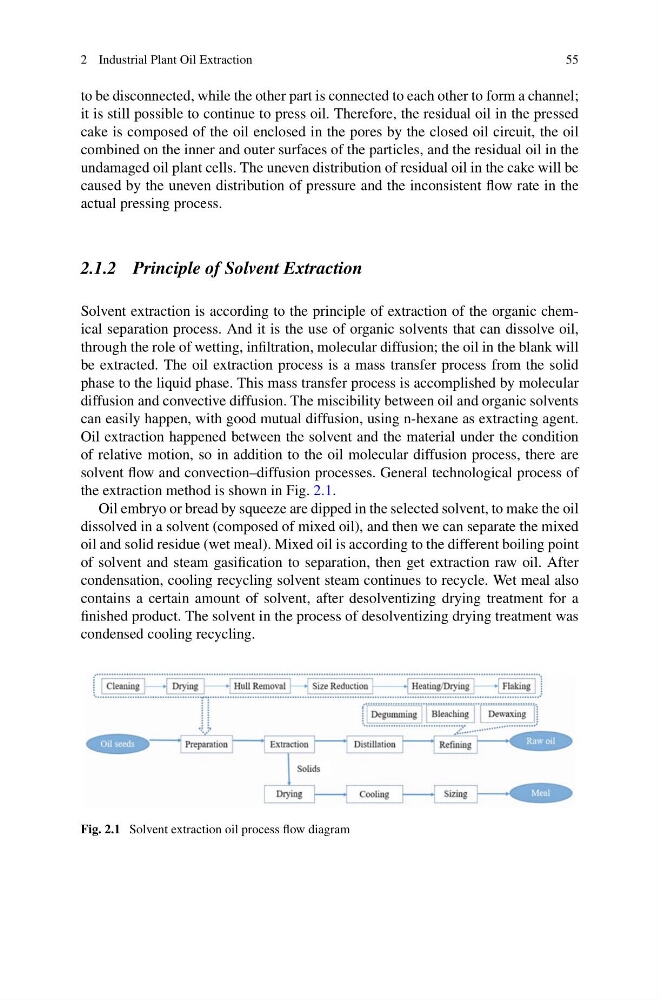
solvent flow and convection–diffusion processes. General technological process of
the extraction method is shown in Fig. 2.1.
Oil embryo or bread by squeeze are dipped in the selected solvent, to make the oil
dissolved in a solvent (composed of mixed oil), and then we can separate the mixed
oil and solid residue (wet meal). Mixed oil is according to the different boiling point
of solvent and steam gasification to separation, then get extraction raw oil. After
condensation, cooling recycling solvent steam continues to recycle. Wet meal also
contains a certain amount of solvent, after desolventizing drying treatment for a
finished product. The solvent in the process of desolventizing drying treatment was
condensed cooling recycling.
Fig. 2.1 Solvent extraction oil process flow diagram
55
to be disconnected, while the other part is connected to each other to form a channel;
it is still possible to continue to press oil. Therefore, the residual oil in the pressed
cake is composed of the oil enclosed in the pores by the closed oil circuit, the oil
combined on the inner and outer surfaces of the particles, and the residual oil in the
undamaged oil plant cells. The uneven distribution of residual oil in the cake will be
caused by the uneven distribution of pressure and the inconsistent flow rate in the
actual pressing process.
2.1.2 Principle of Solvent Extraction
Solvent extraction is according to the principle of extraction of the organic chemical separation process. And it is the use of organic solvents that can dissolve oil,
through the role of wetting, infiltration, molecular diffusion; the oil in the blank will
be extracted. The oil extraction process is a mass transfer process from the solid
phase to the liquid phase. This mass transfer process is accomplished by molecular
diffusion and convective diffusion. The miscibility between oil and organic solvents
can easily happen, with good mutual diffusion, using n-hexane as extracting agent.
Oil extraction happened between the solvent and the material under the condition
of relative motion, so in addition to the oil molecular diffusion process, there are
solvent flow and convection–diffusion processes. General technological process of
the extraction method is shown in Fig. 2.1.
Oil embryo or bread by squeeze are dipped in the selected solvent, to make the oil
dissolved in a solvent (composed of mixed oil), and then we can separate the mixed
oil and solid residue (wet meal). Mixed oil is according to the different boiling point
of solvent and steam gasification to separation, then get extraction raw oil. After
condensation, cooling recycling solvent steam continues to recycle. Wet meal also
contains a certain amount of solvent, after desolventizing drying treatment for a
finished product. The solvent in the process of desolventizing drying treatment was
condensed cooling recycling.
Fig. 2.1 Solvent extraction oil process flow diagram