

40
J. Chen et al.
were 3.4 million kiloliters/year and 142,700 tons/year, respectively. In 2010, glycerin
production was about 204,394 tons. Glycerin production was 121,640 kiloliters from
fatty acid and fatty alcohol industries and 61,694 kiloliters from the biodiesel industry.
The world demand for plant oil is increasing. In 2013, the world demand for this
oil was 162.8 million tons and was projected to reach 315.2 million tons in 2030 as
a result of the world population growth and the shift in demand from fossil fuel to
biofuel (Indonesian Palm Oil Board, 2014). Today, the fulfillment of global need of
biofuel comes from palm oil (36.1%), soybean oil (27.4%), rapeseed oil (15.2%) and
the other nine kinds of biofuel (21.4%).
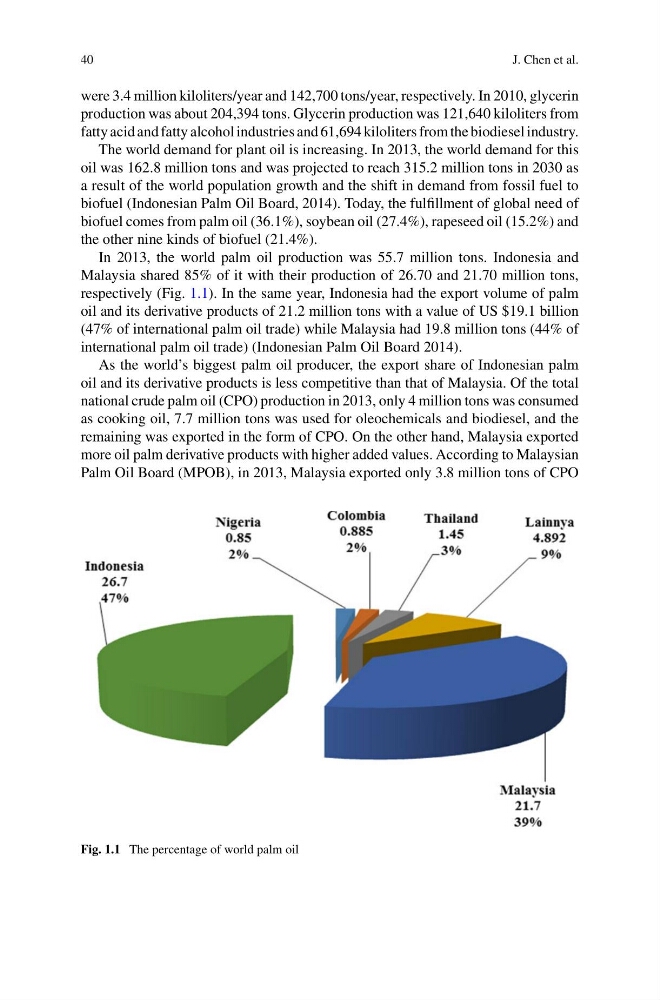
In 2013, the world palm oil production was 55.7 million tons. Indonesia and
Malaysia shared 85% of it with their production of 26.70 and 21.70 million tons,
respectively (Fig. 1.1). In the same year, Indonesia had the export volume of palm
oil and its derivative products of 21.2 million tons with a value of US $19.1 billion
(47% of international palm oil trade) while Malaysia had 19.8 million tons (44% of
international palm oil trade) (Indonesian Palm Oil Board 2014).
As the world’s biggest palm oil producer, the export share of Indonesian palm
oil and its derivative products is less competitive than that of Malaysia. Of the total
national crude palm oil (CPO) production in 2013, only 4 million tons was consumed
as cooking oil, 7.7 million tons was used for oleochemicals and biodiesel, and the
remaining was exported in the form of CPO. On the other hand, Malaysia exported
more oil palm derivative products with higher added values. According to Malaysian
Palm Oil Board (MPOB), in 2013, Malaysia exported only 3.8 million tons of CPO
Fig. 1.1 The percentage of world palm oil
J. Chen et al.
were 3.4 million kiloliters/year and 142,700 tons/year, respectively. In 2010, glycerin
production was about 204,394 tons. Glycerin production was 121,640 kiloliters from
fatty acid and fatty alcohol industries and 61,694 kiloliters from the biodiesel industry.
The world demand for plant oil is increasing. In 2013, the world demand for this
oil was 162.8 million tons and was projected to reach 315.2 million tons in 2030 as
a result of the world population growth and the shift in demand from fossil fuel to
biofuel (Indonesian Palm Oil Board, 2014). Today, the fulfillment of global need of
biofuel comes from palm oil (36.1%), soybean oil (27.4%), rapeseed oil (15.2%) and
the other nine kinds of biofuel (21.4%).
In 2013, the world palm oil production was 55.7 million tons. Indonesia and
Malaysia shared 85% of it with their production of 26.70 and 21.70 million tons,
respectively (Fig. 1.1). In the same year, Indonesia had the export volume of palm
oil and its derivative products of 21.2 million tons with a value of US $19.1 billion
(47% of international palm oil trade) while Malaysia had 19.8 million tons (44% of
international palm oil trade) (Indonesian Palm Oil Board 2014).
As the world’s biggest palm oil producer, the export share of Indonesian palm
oil and its derivative products is less competitive than that of Malaysia. Of the total
national crude palm oil (CPO) production in 2013, only 4 million tons was consumed
as cooking oil, 7.7 million tons was used for oleochemicals and biodiesel, and the
remaining was exported in the form of CPO. On the other hand, Malaysia exported
more oil palm derivative products with higher added values. According to Malaysian
Palm Oil Board (MPOB), in 2013, Malaysia exported only 3.8 million tons of CPO
Fig. 1.1 The percentage of world palm oil