

8 Oleochemistry Products
247
Lubricity
Theory
Gel
Theory
Free Volume
Theory
Plasticiser
Polymer
Secondary Forces
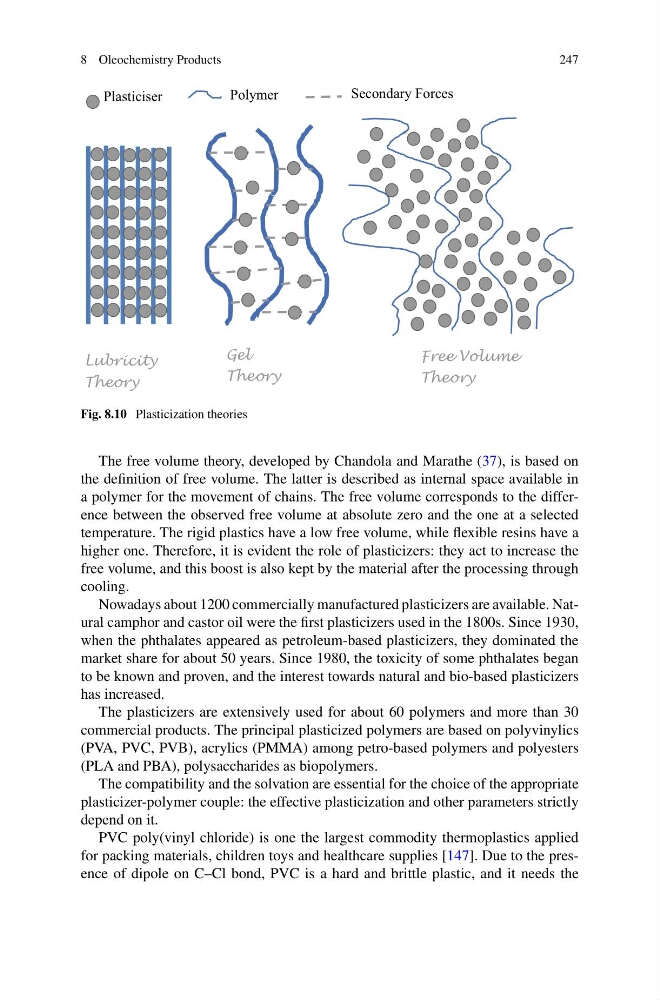
Fig. 8.10 Plasticization theories
The free volume theory, developed by Chandola and Marathe (37), is based on
the definition of free volume. The latter is described as internal space available in
a polymer for the movement of chains. The free volume corresponds to the difference between the observed free volume at absolute zero and the one at a selected
temperature. The rigid plastics have a low free volume, while flexible resins have a
higher one. Therefore, it is evident the role of plasticizers: they act to increase the
free volume, and this boost is also kept by the material after the processing through
cooling.
Nowadays about 1200 commercially manufactured plasticizers are available. Natural camphor and castor oil were the first plasticizers used in the 1800s. Since 1930,
when the phthalates appeared as petroleum-based plasticizers, they dominated the
market share for about 50 years. Since 1980, the toxicity of some phthalates began
to be known and proven, and the interest towards natural and bio-based plasticizers
has increased.
The plasticizers are extensively used for about 60 polymers and more than 30
commercial products. The principal plasticized polymers are based on polyvinylics
(PVA, PVC, PVB), acrylics (PMMA) among petro-based polymers and polyesters
(PLA and PBA), polysaccharides as biopolymers.
The compatibility and the solvation are essential for the choice of the appropriate
plasticizer-polymer couple: the effective plasticization and other parameters strictly
depend on it.
PVC poly(vinyl chloride) is one the largest commodity thermoplastics applied
for packing materials, children toys and healthcare supplies [147]. Due to the presence of dipole on C–Cl bond, PVC is a hard and brittle plastic, and it needs the
247
Lubricity
Theory
Gel
Theory
Free Volume
Theory
Plasticiser
Polymer
Secondary Forces
Fig. 8.10 Plasticization theories
The free volume theory, developed by Chandola and Marathe (37), is based on
the definition of free volume. The latter is described as internal space available in
a polymer for the movement of chains. The free volume corresponds to the difference between the observed free volume at absolute zero and the one at a selected
temperature. The rigid plastics have a low free volume, while flexible resins have a
higher one. Therefore, it is evident the role of plasticizers: they act to increase the
free volume, and this boost is also kept by the material after the processing through
cooling.
Nowadays about 1200 commercially manufactured plasticizers are available. Natural camphor and castor oil were the first plasticizers used in the 1800s. Since 1930,
when the phthalates appeared as petroleum-based plasticizers, they dominated the
market share for about 50 years. Since 1980, the toxicity of some phthalates began
to be known and proven, and the interest towards natural and bio-based plasticizers
has increased.
The plasticizers are extensively used for about 60 polymers and more than 30
commercial products. The principal plasticized polymers are based on polyvinylics
(PVA, PVC, PVB), acrylics (PMMA) among petro-based polymers and polyesters
(PLA and PBA), polysaccharides as biopolymers.
The compatibility and the solvation are essential for the choice of the appropriate
plasticizer-polymer couple: the effective plasticization and other parameters strictly
depend on it.
PVC poly(vinyl chloride) is one the largest commodity thermoplastics applied
for packing materials, children toys and healthcare supplies [147]. Due to the presence of dipole on C–Cl bond, PVC is a hard and brittle plastic, and it needs the