

8 Oleochemistry Products
229
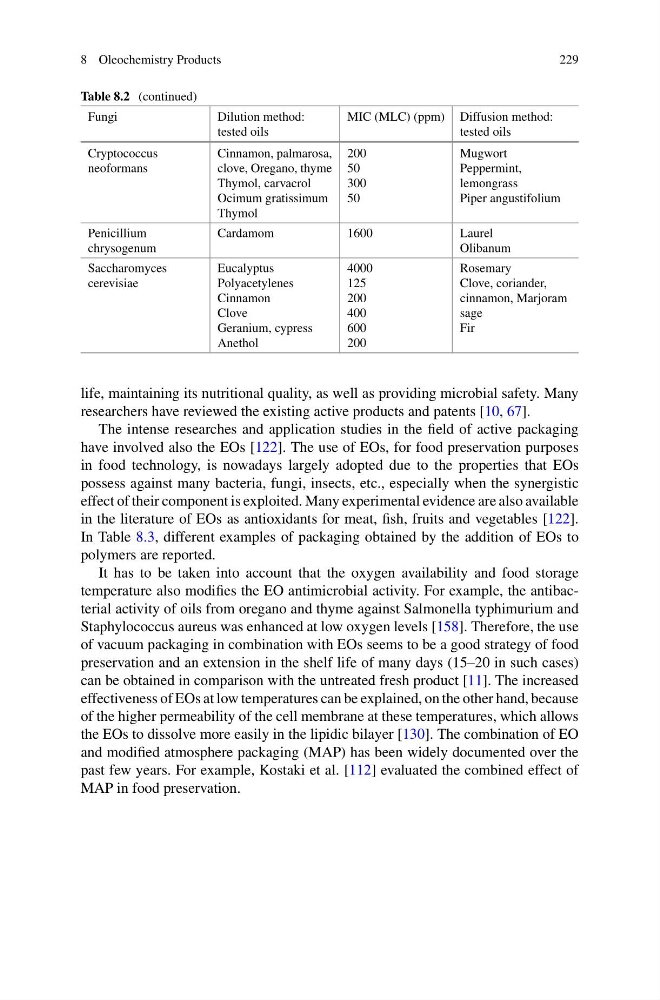
Table 8.2 (continued)
Fungi
Dilution method:
tested oils
MIC (MLC) (ppm) Diffusion method:
tested oils
Cryptococcus
neoformans
Cinnamon, palmarosa,
clove, Oregano, thyme
Thymol, carvacrol
Ocimum gratissimum
Thymol
200
50
300
50
Mugwort
Peppermint,
lemongrass
Piper angustifolium
Penicillium
chrysogenum
Cardamom
1600
Laurel
Olibanum
Saccharomyces
cerevisiae
Eucalyptus
Polyacetylenes
Cinnamon
Clove
Geranium, cypress
Anethol
4000
125
200
400
600
200
Rosemary
Clove, coriander,
cinnamon, Marjoram
sage
Fir
life, maintaining its nutritional quality, as well as providing microbial safety. Many
researchers have reviewed the existing active products and patents [10, 67].
The intense researches and application studies in the field of active packaging
have involved also the EOs [122]. The use of EOs, for food preservation purposes
in food technology, is nowadays largely adopted due to the properties that EOs
possess against many bacteria, fungi, insects, etc., especially when the synergistic
effect of their component is exploited. Many experimental evidence are also available
in the literature of EOs as antioxidants for meat, fish, fruits and vegetables [122].
In Table 8.3, different examples of packaging obtained by the addition of EOs to
polymers are reported.
It has to be taken into account that the oxygen availability and food storage
temperature also modifies the EO antimicrobial activity. For example, the antibacterial activity of oils from oregano and thyme against Salmonella typhimurium and
Staphylococcus aureus was enhanced at low oxygen levels [158]. Therefore, the use
of vacuum packaging in combination with EOs seems to be a good strategy of food
preservation and an extension in the shelf life of many days (15–20 in such cases)
can be obtained in comparison with the untreated fresh product [11]. The increased
effectiveness of EOs at low temperatures can be explained, on the other hand, because
of the higher permeability of the cell membrane at these temperatures, which allows
the EOs to dissolve more easily in the lipidic bilayer [130]. The combination of EO
and modified atmosphere packaging (MAP) has been widely documented over the
past few years. For example, Kostaki et al. [112] evaluated the combined effect of
MAP in food preservation.
229
Table 8.2 (continued)
Fungi
Dilution method:
tested oils
MIC (MLC) (ppm) Diffusion method:
tested oils
Cryptococcus
neoformans
Cinnamon, palmarosa,
clove, Oregano, thyme
Thymol, carvacrol
Ocimum gratissimum
Thymol
200
50
300
50
Mugwort
Peppermint,
lemongrass
Piper angustifolium
Penicillium
chrysogenum
Cardamom
1600
Laurel
Olibanum
Saccharomyces
cerevisiae
Eucalyptus
Polyacetylenes
Cinnamon
Clove
Geranium, cypress
Anethol
4000
125
200
400
600
200
Rosemary
Clove, coriander,
cinnamon, Marjoram
sage
Fir
life, maintaining its nutritional quality, as well as providing microbial safety. Many
researchers have reviewed the existing active products and patents [10, 67].
The intense researches and application studies in the field of active packaging
have involved also the EOs [122]. The use of EOs, for food preservation purposes
in food technology, is nowadays largely adopted due to the properties that EOs
possess against many bacteria, fungi, insects, etc., especially when the synergistic
effect of their component is exploited. Many experimental evidence are also available
in the literature of EOs as antioxidants for meat, fish, fruits and vegetables [122].
In Table 8.3, different examples of packaging obtained by the addition of EOs to
polymers are reported.
It has to be taken into account that the oxygen availability and food storage
temperature also modifies the EO antimicrobial activity. For example, the antibacterial activity of oils from oregano and thyme against Salmonella typhimurium and
Staphylococcus aureus was enhanced at low oxygen levels [158]. Therefore, the use
of vacuum packaging in combination with EOs seems to be a good strategy of food
preservation and an extension in the shelf life of many days (15–20 in such cases)
can be obtained in comparison with the untreated fresh product [11]. The increased
effectiveness of EOs at low temperatures can be explained, on the other hand, because
of the higher permeability of the cell membrane at these temperatures, which allows
the EOs to dissolve more easily in the lipidic bilayer [130]. The combination of EO
and modified atmosphere packaging (MAP) has been widely documented over the
past few years. For example, Kostaki et al. [112] evaluated the combined effect of
MAP in food preservation.