

8 Oleochemistry Products
209
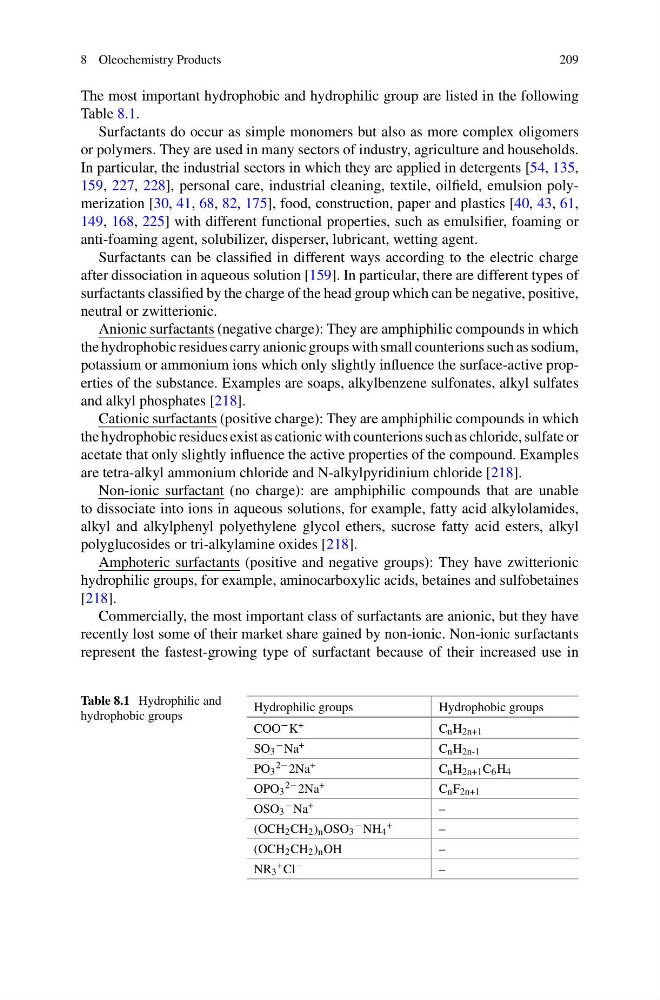
The most important hydrophobic and hydrophilic group are listed in the following
Table 8.1.
Surfactants do occur as simple monomers but also as more complex oligomers
or polymers. They are used in many sectors of industry, agriculture and households.
In particular, the industrial sectors in which they are applied in detergents [54, 135,
159, 227, 228], personal care, industrial cleaning, textile, oilfield, emulsion polymerization [30, 41, 68, 82, 175], food, construction, paper and plastics [40, 43, 61,
149, 168, 225] with different functional properties, such as emulsifier, foaming or
anti-foaming agent, solubilizer, disperser, lubricant, wetting agent.
Surfactants can be classified in different ways according to the electric charge
after dissociation in aqueous solution [159]. In particular, there are different types of
surfactants classified by the charge of the head group which can be negative, positive,
neutral or zwitterionic.
Anionic surfactants (negative charge): They are amphiphilic compounds in which
the hydrophobic residues carry anionic groups with small counterions such as sodium,
potassium or ammonium ions which only slightly influence the surface-active properties of the substance. Examples are soaps, alkylbenzene sulfonates, alkyl sulfates
and alkyl phosphates [218].
Cationic surfactants (positive charge): They are amphiphilic compounds in which
the hydrophobic residues exist as cationic with counterions such as chloride, sulfate or
acetate that only slightly influence the active properties of the compound. Examples
are tetra-alkyl ammonium chloride and N-alkylpyridinium chloride [218].
Non-ionic surfactant (no charge): are amphiphilic compounds that are unable
to dissociate into ions in aqueous solutions, for example, fatty acid alkylolamides,
alkyl and alkylphenyl polyethylene glycol ethers, sucrose fatty acid esters, alkyl
polyglucosides or tri-alkylamine oxides [218].
Amphoteric surfactants (positive and negative groups): They have zwitterionic
hydrophilic groups, for example, aminocarboxylic acids, betaines and sulfobetaines
[218].
Commercially, the most important class of surfactants are anionic, but they have
recently lost some of their market share gained by non-ionic. Non-ionic surfactants
represent the fastest-growing type of surfactant because of their increased use in
Table 8.1 Hydrophilic and
hydrophobic groups
Hydrophilic groups
Hydrophobic groups
COO − K +
C n H 2n+1
SO 3
− Na +
C n H 2n-1
PO 3
2− 2Na +
C n H 2n+1 C 6 H 4
OPO 3
2− 2Na +
C n F 2n+1
OSO 3
− Na +
–
(OCH 2 CH 2 ) n OSO 3
− NH 4
+
–
(OCH 2 CH 2 ) n OH
–
NR 3
+ Cl −
–
209
The most important hydrophobic and hydrophilic group are listed in the following
Table 8.1.
Surfactants do occur as simple monomers but also as more complex oligomers
or polymers. They are used in many sectors of industry, agriculture and households.
In particular, the industrial sectors in which they are applied in detergents [54, 135,
159, 227, 228], personal care, industrial cleaning, textile, oilfield, emulsion polymerization [30, 41, 68, 82, 175], food, construction, paper and plastics [40, 43, 61,
149, 168, 225] with different functional properties, such as emulsifier, foaming or
anti-foaming agent, solubilizer, disperser, lubricant, wetting agent.
Surfactants can be classified in different ways according to the electric charge
after dissociation in aqueous solution [159]. In particular, there are different types of
surfactants classified by the charge of the head group which can be negative, positive,
neutral or zwitterionic.
Anionic surfactants (negative charge): They are amphiphilic compounds in which
the hydrophobic residues carry anionic groups with small counterions such as sodium,
potassium or ammonium ions which only slightly influence the surface-active properties of the substance. Examples are soaps, alkylbenzene sulfonates, alkyl sulfates
and alkyl phosphates [218].
Cationic surfactants (positive charge): They are amphiphilic compounds in which
the hydrophobic residues exist as cationic with counterions such as chloride, sulfate or
acetate that only slightly influence the active properties of the compound. Examples
are tetra-alkyl ammonium chloride and N-alkylpyridinium chloride [218].
Non-ionic surfactant (no charge): are amphiphilic compounds that are unable
to dissociate into ions in aqueous solutions, for example, fatty acid alkylolamides,
alkyl and alkylphenyl polyethylene glycol ethers, sucrose fatty acid esters, alkyl
polyglucosides or tri-alkylamine oxides [218].
Amphoteric surfactants (positive and negative groups): They have zwitterionic
hydrophilic groups, for example, aminocarboxylic acids, betaines and sulfobetaines
[218].
Commercially, the most important class of surfactants are anionic, but they have
recently lost some of their market share gained by non-ionic. Non-ionic surfactants
represent the fastest-growing type of surfactant because of their increased use in
Table 8.1 Hydrophilic and
hydrophobic groups
Hydrophilic groups
Hydrophobic groups
COO − K +
C n H 2n+1
SO 3
− Na +
C n H 2n-1
PO 3
2− 2Na +
C n H 2n+1 C 6 H 4
OPO 3
2− 2Na +
C n F 2n+1
OSO 3
− Na +
–
(OCH 2 CH 2 ) n OSO 3
− NH 4
+
–
(OCH 2 CH 2 ) n OH
–
NR 3
+ Cl −
–