

7 Technologies for Conversion Bio-Lubricant …
185
+ 3 CH 3 COOOH
CH 2 O C
O
(CH 2 ) 7
CH O C
O
(CH 2 ) 7
CH 2 O C
O
(CH 2 ) 7
CH
CH
CH
CH
CH
CH
CH 2
CH 2
(CH 3 ) 7 CH 3
CH
CH
CH
CH
(CH 2 ) 4 CH 3
CH CHCH 2 CH 2 CH 3
CH 2 O C
O
(CH 2 ) 7
CH O C
O
(CH 2 ) 7
CH 2 O C
O
(CH 2 ) 7
C
H
C
H
H
C
C
H
C
H
H
C
CH 2
CH 2
(CH 3 ) 7 CH 3
CH
CH
CH
CH
(CH 2 ) 4 CH 3
CH CH(CH 2 ) 2 CH 3
O
O
O
+ 3 CH 3 COOH
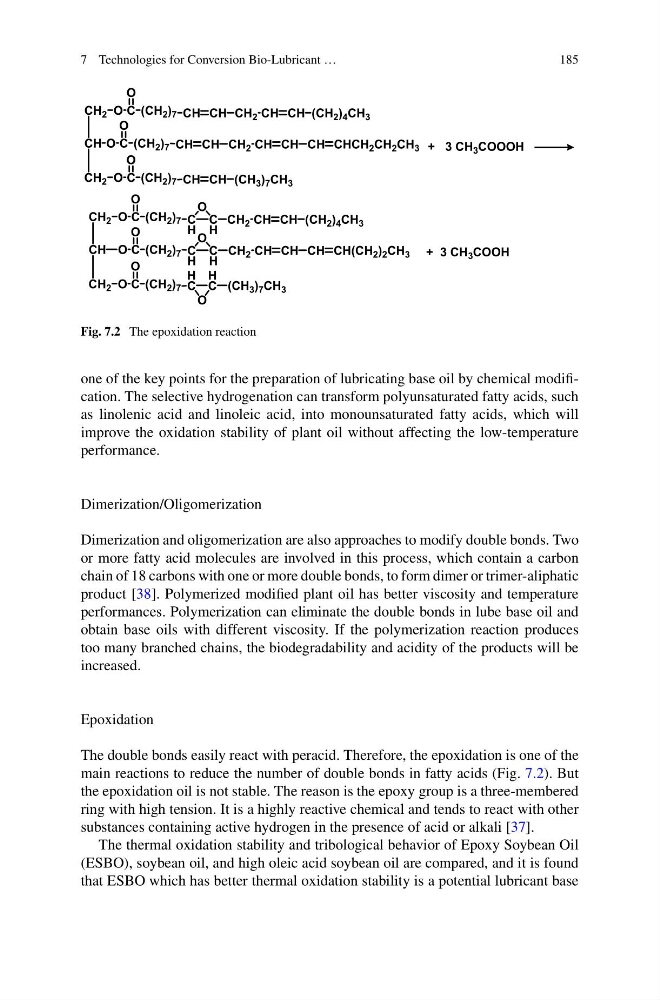
Fig. 7.2 The epoxidation reaction
one of the key points for the preparation of lubricating base oil by chemical modification. The selective hydrogenation can transform polyunsaturated fatty acids, such
as linolenic acid and linoleic acid, into monounsaturated fatty acids, which will
improve the oxidation stability of plant oil without affecting the low-temperature
performance.
Dimerization/Oligomerization
Dimerization and oligomerization are also approaches to modify double bonds. Two
or more fatty acid molecules are involved in this process, which contain a carbon
chain of 18 carbons with one or more double bonds, to form dimer or trimer-aliphatic
product [38]. Polymerized modified plant oil has better viscosity and temperature
performances. Polymerization can eliminate the double bonds in lube base oil and
obtain base oils with different viscosity. If the polymerization reaction produces
too many branched chains, the biodegradability and acidity of the products will be
increased.
Epoxidation
The double bonds easily react with peracid. Therefore, the epoxidation is one of the
main reactions to reduce the number of double bonds in fatty acids (Fig. 7.2). But
the epoxidation oil is not stable. The reason is the epoxy group is a three-membered
ring with high tension. It is a highly reactive chemical and tends to react with other
substances containing active hydrogen in the presence of acid or alkali [37].
The thermal oxidation stability and tribological behavior of Epoxy Soybean Oil
(ESBO), soybean oil, and high oleic acid soybean oil are compared, and it is found
that ESBO which has better thermal oxidation stability is a potential lubricant base
185
+ 3 CH 3 COOOH
CH 2 O C
O
(CH 2 ) 7
CH O C
O
(CH 2 ) 7
CH 2 O C
O
(CH 2 ) 7
CH
CH
CH
CH
CH
CH
CH 2
CH 2
(CH 3 ) 7 CH 3
CH
CH
CH
CH
(CH 2 ) 4 CH 3
CH CHCH 2 CH 2 CH 3
CH 2 O C
O
(CH 2 ) 7
CH O C
O
(CH 2 ) 7
CH 2 O C
O
(CH 2 ) 7
C
H
C
H
H
C
C
H
C
H
H
C
CH 2
CH 2
(CH 3 ) 7 CH 3
CH
CH
CH
CH
(CH 2 ) 4 CH 3
CH CH(CH 2 ) 2 CH 3
O
O
O
+ 3 CH 3 COOH
Fig. 7.2 The epoxidation reaction
one of the key points for the preparation of lubricating base oil by chemical modification. The selective hydrogenation can transform polyunsaturated fatty acids, such
as linolenic acid and linoleic acid, into monounsaturated fatty acids, which will
improve the oxidation stability of plant oil without affecting the low-temperature
performance.
Dimerization/Oligomerization
Dimerization and oligomerization are also approaches to modify double bonds. Two
or more fatty acid molecules are involved in this process, which contain a carbon
chain of 18 carbons with one or more double bonds, to form dimer or trimer-aliphatic
product [38]. Polymerized modified plant oil has better viscosity and temperature
performances. Polymerization can eliminate the double bonds in lube base oil and
obtain base oils with different viscosity. If the polymerization reaction produces
too many branched chains, the biodegradability and acidity of the products will be
increased.
Epoxidation
The double bonds easily react with peracid. Therefore, the epoxidation is one of the
main reactions to reduce the number of double bonds in fatty acids (Fig. 7.2). But
the epoxidation oil is not stable. The reason is the epoxy group is a three-membered
ring with high tension. It is a highly reactive chemical and tends to react with other
substances containing active hydrogen in the presence of acid or alkali [37].
The thermal oxidation stability and tribological behavior of Epoxy Soybean Oil
(ESBO), soybean oil, and high oleic acid soybean oil are compared, and it is found
that ESBO which has better thermal oxidation stability is a potential lubricant base