

6 By-Products of Biodiesel and Their Recycling
165
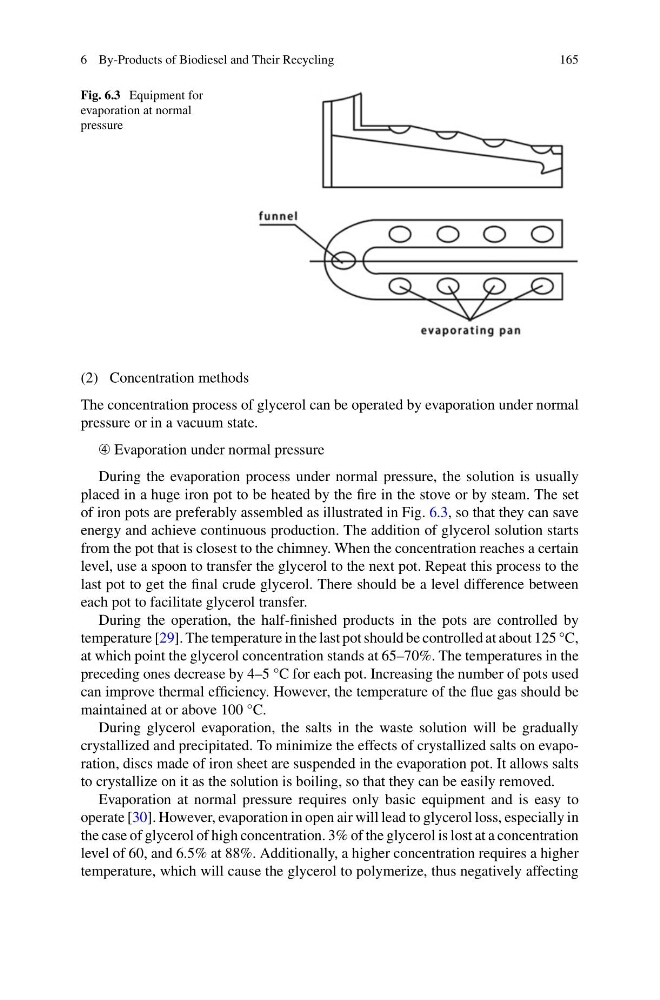
Fig. 6.3 Equipment for
evaporation at normal
pressure
(2) Concentration methods
The concentration process of glycerol can be operated by evaporation under normal
pressure or in a vacuum state.
➃ Evaporation under normal pressure
During the evaporation process under normal pressure, the solution is usually
placed in a huge iron pot to be heated by the fire in the stove or by steam. The set
of iron pots are preferably assembled as illustrated in Fig. 6.3, so that they can save
energy and achieve continuous production. The addition of glycerol solution starts
from the pot that is closest to the chimney. When the concentration reaches a certain
level, use a spoon to transfer the glycerol to the next pot. Repeat this process to the
last pot to get the final crude glycerol. There should be a level difference between
each pot to facilitate glycerol transfer.
During the operation, the half-finished products in the pots are controlled by
temperature [29]. The temperature in the last pot should be controlled at about 125 °C,
at which point the glycerol concentration stands at 65–70%. The temperatures in the
preceding ones decrease by 4–5 °C for each pot. Increasing the number of pots used
can improve thermal efficiency. However, the temperature of the flue gas should be
maintained at or above 100 °C.
During glycerol evaporation, the salts in the waste solution will be gradually
crystallized and precipitated. To minimize the effects of crystallized salts on evaporation, discs made of iron sheet are suspended in the evaporation pot. It allows salts
to crystallize on it as the solution is boiling, so that they can be easily removed.
Evaporation at normal pressure requires only basic equipment and is easy to
operate [30]. However, evaporation in open air will lead to glycerol loss, especially in
the case of glycerol of high concentration. 3% of the glycerol is lost at a concentration
level of 60, and 6.5% at 88%. Additionally, a higher concentration requires a higher
temperature, which will cause the glycerol to polymerize, thus negatively affecting
165
Fig. 6.3 Equipment for
evaporation at normal
pressure
(2) Concentration methods
The concentration process of glycerol can be operated by evaporation under normal
pressure or in a vacuum state.
➃ Evaporation under normal pressure
During the evaporation process under normal pressure, the solution is usually
placed in a huge iron pot to be heated by the fire in the stove or by steam. The set
of iron pots are preferably assembled as illustrated in Fig. 6.3, so that they can save
energy and achieve continuous production. The addition of glycerol solution starts
from the pot that is closest to the chimney. When the concentration reaches a certain
level, use a spoon to transfer the glycerol to the next pot. Repeat this process to the
last pot to get the final crude glycerol. There should be a level difference between
each pot to facilitate glycerol transfer.
During the operation, the half-finished products in the pots are controlled by
temperature [29]. The temperature in the last pot should be controlled at about 125 °C,
at which point the glycerol concentration stands at 65–70%. The temperatures in the
preceding ones decrease by 4–5 °C for each pot. Increasing the number of pots used
can improve thermal efficiency. However, the temperature of the flue gas should be
maintained at or above 100 °C.
During glycerol evaporation, the salts in the waste solution will be gradually
crystallized and precipitated. To minimize the effects of crystallized salts on evaporation, discs made of iron sheet are suspended in the evaporation pot. It allows salts
to crystallize on it as the solution is boiling, so that they can be easily removed.
Evaporation at normal pressure requires only basic equipment and is easy to
operate [30]. However, evaporation in open air will lead to glycerol loss, especially in
the case of glycerol of high concentration. 3% of the glycerol is lost at a concentration
level of 60, and 6.5% at 88%. Additionally, a higher concentration requires a higher
temperature, which will cause the glycerol to polymerize, thus negatively affecting