

5 Principle and Processing of Biodiesel Production
137
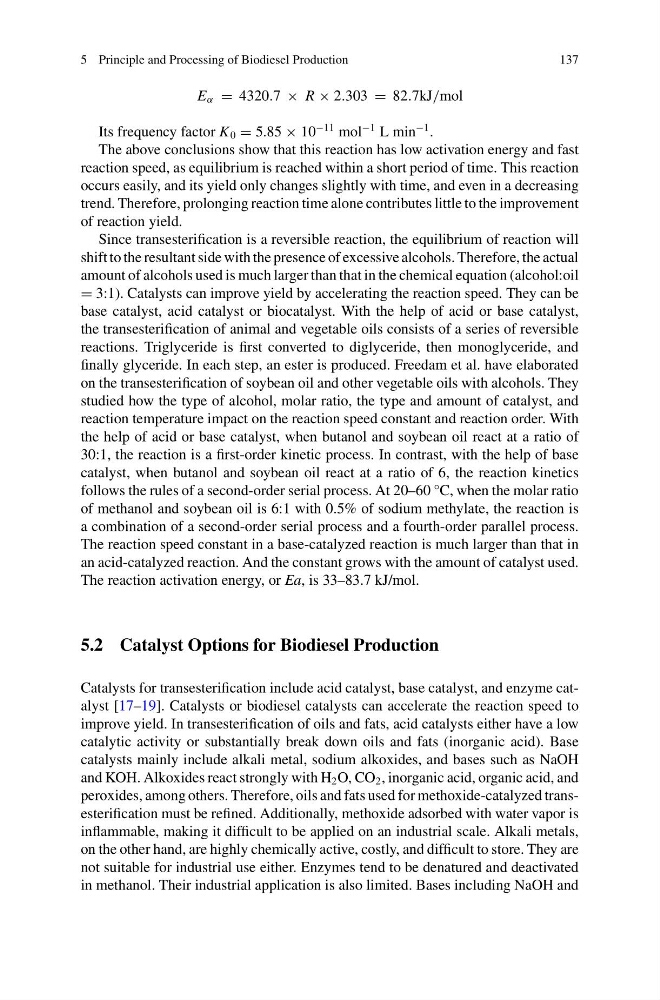
E α = 4320.7 × R × 2.303 = 82.7kJ/mol
Its frequency factor K 0 = 5.85 × 10
−11 mol
−1 L min
−1 .
The above conclusions show that this reaction has low activation energy and fast
reaction speed, as equilibrium is reached within a short period of time. This reaction
occurs easily, and its yield only changes slightly with time, and even in a decreasing
trend. Therefore, prolonging reaction time alone contributes little to the improvement
of reaction yield.
Since transesterification is a reversible reaction, the equilibrium of reaction will
shift to the resultant side with the presence of excessive alcohols. Therefore, the actual
amount of alcohols used is much larger than that in the chemical equation (alcohol:oil
= 3:1). Catalysts can improve yield by accelerating the reaction speed. They can be
base catalyst, acid catalyst or biocatalyst. With the help of acid or base catalyst,
the transesterification of animal and vegetable oils consists of a series of reversible
reactions. Triglyceride is first converted to diglyceride, then monoglyceride, and
finally glyceride. In each step, an ester is produced. Freedam et al. have elaborated
on the transesterification of soybean oil and other vegetable oils with alcohols. They
studied how the type of alcohol, molar ratio, the type and amount of catalyst, and
reaction temperature impact on the reaction speed constant and reaction order. With
the help of acid or base catalyst, when butanol and soybean oil react at a ratio of
30:1, the reaction is a first-order kinetic process. In contrast, with the help of base
catalyst, when butanol and soybean oil react at a ratio of 6, the reaction kinetics
follows the rules of a second-order serial process. At 20–60 °C, when the molar ratio
of methanol and soybean oil is 6:1 with 0.5% of sodium methylate, the reaction is
a combination of a second-order serial process and a fourth-order parallel process.
The reaction speed constant in a base-catalyzed reaction is much larger than that in
an acid-catalyzed reaction. And the constant grows with the amount of catalyst used.
The reaction activation energy, or Ea, is 33–83.7 kJ/mol.
5.2 Catalyst Options for Biodiesel Production
Catalysts for transesterification include acid catalyst, base catalyst, and enzyme catalyst [17–19]. Catalysts or biodiesel catalysts can accelerate the reaction speed to
improve yield. In transesterification of oils and fats, acid catalysts either have a low
catalytic activity or substantially break down oils and fats (inorganic acid). Base
catalysts mainly include alkali metal, sodium alkoxides, and bases such as NaOH
and KOH. Alkoxides react strongly with H 2 O, CO 2 , inorganic acid, organic acid, and
peroxides, among others. Therefore, oils and fats used for methoxide-catalyzed transesterification must be refined. Additionally, methoxide adsorbed with water vapor is
inflammable, making it difficult to be applied on an industrial scale. Alkali metals,
on the other hand, are highly chemically active, costly, and difficult to store. They are
not suitable for industrial use either. Enzymes tend to be denatured and deactivated
in methanol. Their industrial application is also limited. Bases including NaOH and
137
E α = 4320.7 × R × 2.303 = 82.7kJ/mol
Its frequency factor K 0 = 5.85 × 10
−11 mol
−1 L min
−1 .
The above conclusions show that this reaction has low activation energy and fast
reaction speed, as equilibrium is reached within a short period of time. This reaction
occurs easily, and its yield only changes slightly with time, and even in a decreasing
trend. Therefore, prolonging reaction time alone contributes little to the improvement
of reaction yield.
Since transesterification is a reversible reaction, the equilibrium of reaction will
shift to the resultant side with the presence of excessive alcohols. Therefore, the actual
amount of alcohols used is much larger than that in the chemical equation (alcohol:oil
= 3:1). Catalysts can improve yield by accelerating the reaction speed. They can be
base catalyst, acid catalyst or biocatalyst. With the help of acid or base catalyst,
the transesterification of animal and vegetable oils consists of a series of reversible
reactions. Triglyceride is first converted to diglyceride, then monoglyceride, and
finally glyceride. In each step, an ester is produced. Freedam et al. have elaborated
on the transesterification of soybean oil and other vegetable oils with alcohols. They
studied how the type of alcohol, molar ratio, the type and amount of catalyst, and
reaction temperature impact on the reaction speed constant and reaction order. With
the help of acid or base catalyst, when butanol and soybean oil react at a ratio of
30:1, the reaction is a first-order kinetic process. In contrast, with the help of base
catalyst, when butanol and soybean oil react at a ratio of 6, the reaction kinetics
follows the rules of a second-order serial process. At 20–60 °C, when the molar ratio
of methanol and soybean oil is 6:1 with 0.5% of sodium methylate, the reaction is
a combination of a second-order serial process and a fourth-order parallel process.
The reaction speed constant in a base-catalyzed reaction is much larger than that in
an acid-catalyzed reaction. And the constant grows with the amount of catalyst used.
The reaction activation energy, or Ea, is 33–83.7 kJ/mol.
5.2 Catalyst Options for Biodiesel Production
Catalysts for transesterification include acid catalyst, base catalyst, and enzyme catalyst [17–19]. Catalysts or biodiesel catalysts can accelerate the reaction speed to
improve yield. In transesterification of oils and fats, acid catalysts either have a low
catalytic activity or substantially break down oils and fats (inorganic acid). Base
catalysts mainly include alkali metal, sodium alkoxides, and bases such as NaOH
and KOH. Alkoxides react strongly with H 2 O, CO 2 , inorganic acid, organic acid, and
peroxides, among others. Therefore, oils and fats used for methoxide-catalyzed transesterification must be refined. Additionally, methoxide adsorbed with water vapor is
inflammable, making it difficult to be applied on an industrial scale. Alkali metals,
on the other hand, are highly chemically active, costly, and difficult to store. They are
not suitable for industrial use either. Enzymes tend to be denatured and deactivated
in methanol. Their industrial application is also limited. Bases including NaOH and