

132
C. Li et al.
5.1.3 Kinetics of Transesterification
Chemical kinetics is a method to describe chemical reactions by mathematical equations. Chemical kinetics researches also allow for understanding in the control of
reaction condition to increase the speed of primary reaction and improve biodiesel
output. They also provide insights into the ways to inhibit or slow side reactions
to reduce raw material consumption, lessen the burden of detach operation, and
enhance end product output [16]. Additionally, quantitative researches on reaction
speed could shed light on optimal designs of the biodiesel production process, thus
serving as a theoretical basis for optimal control.
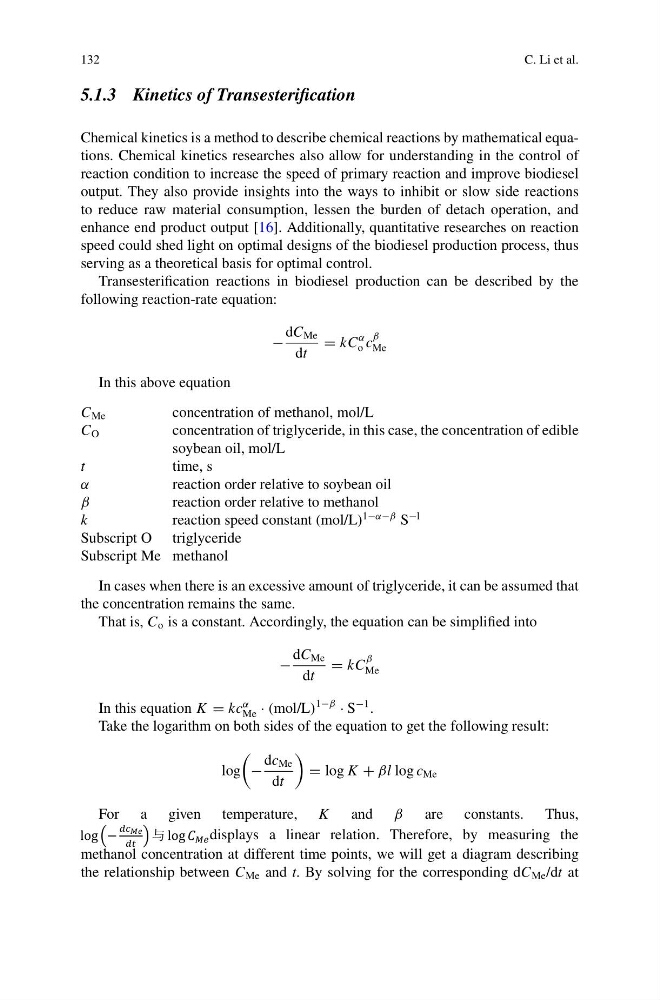
Transesterification reactions in biodiesel production can be described by the
following reaction-rate equation:
−
dC Me
dt
= kC
α
o c
β
Me
In this above equation
C Me
concentration of methanol, mol/L
C O
concentration of triglyceride, in this case, the concentration of edible
soybean oil, mol/L
t
time, s
α
reaction order relative to soybean oil
β
reaction order relative to methanol
k
reaction speed constant (mol/L)
1−α−β S
−l
Subscript O triglyceride
Subscript Me methanol
In cases when there is an excessive amount of triglyceride, it can be assumed that
the concentration remains the same.
That is, C o is a constant. Accordingly, the equation can be simplified into
−
dC Me
dt
= kC
β
Me
In this equation K = kc
α
Me · (mol/L)
1−β
· S
−1 .
Take the logarithm on both sides of the equation to get the following result:
log
−
dc Me
dt
= log K + βl log c Me
For a given temperature, K
and β are constants. Thus,
displays a linear relation. Therefore, by measuring the
methanol concentration at different time points, we will get a diagram describing
the relationship between C Me and t. By solving for the corresponding dC Me /dt at
C. Li et al.
5.1.3 Kinetics of Transesterification
Chemical kinetics is a method to describe chemical reactions by mathematical equations. Chemical kinetics researches also allow for understanding in the control of
reaction condition to increase the speed of primary reaction and improve biodiesel
output. They also provide insights into the ways to inhibit or slow side reactions
to reduce raw material consumption, lessen the burden of detach operation, and
enhance end product output [16]. Additionally, quantitative researches on reaction
speed could shed light on optimal designs of the biodiesel production process, thus
serving as a theoretical basis for optimal control.
Transesterification reactions in biodiesel production can be described by the
following reaction-rate equation:
−
dC Me
dt
= kC
α
o c
β
Me
In this above equation
C Me
concentration of methanol, mol/L
C O
concentration of triglyceride, in this case, the concentration of edible
soybean oil, mol/L
t
time, s
α
reaction order relative to soybean oil
β
reaction order relative to methanol
k
reaction speed constant (mol/L)
1−α−β S
−l
Subscript O triglyceride
Subscript Me methanol
In cases when there is an excessive amount of triglyceride, it can be assumed that
the concentration remains the same.
That is, C o is a constant. Accordingly, the equation can be simplified into
−
dC Me
dt
= kC
β
Me
In this equation K = kc
α
Me · (mol/L)
1−β
· S
−1 .
Take the logarithm on both sides of the equation to get the following result:
log
−
dc Me
dt
= log K + βl log c Me
For a given temperature, K
and β are constants. Thus,
displays a linear relation. Therefore, by measuring the
methanol concentration at different time points, we will get a diagram describing
the relationship between C Me and t. By solving for the corresponding dC Me /dt at