

3 Bio-liquid Fuels in Industrial Plant Oil
101
C 18 H 36 O 2
C 17 H 36
- C O 2
CH 2 CH
C 15 H 31
-H 2 O
-CO
+H 2
-H 2
C 18 Unsaturated fatty acids
+H 2 -H 2
-0.5H
2 O
-0.5CO 2
0.5H 35 C 17
C
O
C 17 H 35
p
y
r
o
l
y
s
i
s
Short chain fatty acids
and hydrocarbons
C 18 H 38
+
3
H
2
-
2
H
2
O
C 17 Saturated isomer
C 17 Unsaturated isomer
+H 2
-H 2
C 17 Naphthenic hydrocarbon
-H 2 open cycle
Cyclization H 2 +
C 17 Cyclic olefin
+H 2
-H 2
dipolymer
i s o m e r i z a t i o n
Cyclization
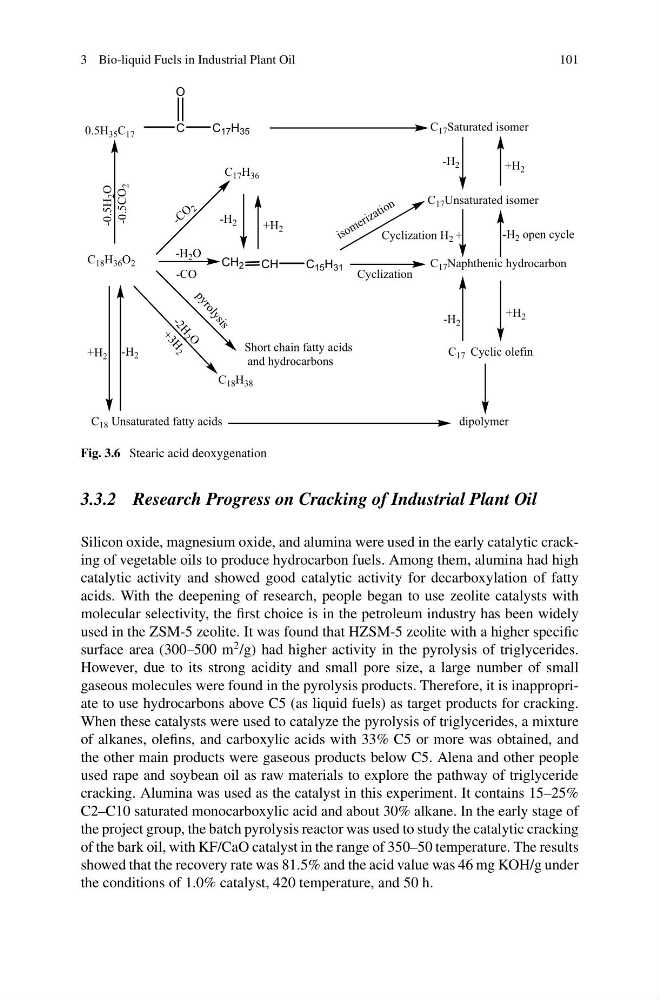
Fig. 3.6 Stearic acid deoxygenation
3.3.2 Research Progress on Cracking of Industrial Plant Oil
Silicon oxide, magnesium oxide, and alumina were used in the early catalytic cracking of vegetable oils to produce hydrocarbon fuels. Among them, alumina had high
catalytic activity and showed good catalytic activity for decarboxylation of fatty
acids. With the deepening of research, people began to use zeolite catalysts with
molecular selectivity, the first choice is in the petroleum industry has been widely
used in the ZSM-5 zeolite. It was found that HZSM-5 zeolite with a higher specific
surface area (300–500 m
2 /g) had higher activity in the pyrolysis of triglycerides.
However, due to its strong acidity and small pore size, a large number of small
gaseous molecules were found in the pyrolysis products. Therefore, it is inappropriate to use hydrocarbons above C5 (as liquid fuels) as target products for cracking.
When these catalysts were used to catalyze the pyrolysis of triglycerides, a mixture
of alkanes, olefins, and carboxylic acids with 33% C5 or more was obtained, and
the other main products were gaseous products below C5. Alena and other people
used rape and soybean oil as raw materials to explore the pathway of triglyceride
cracking. Alumina was used as the catalyst in this experiment. It contains 15–25%
C2–C10 saturated monocarboxylic acid and about 30% alkane. In the early stage of
the project group, the batch pyrolysis reactor was used to study the catalytic cracking
of the bark oil, with KF/CaO catalyst in the range of 350–50 temperature. The results
showed that the recovery rate was 81.5% and the acid value was 46 mg KOH/g under
the conditions of 1.0% catalyst, 420 temperature, and 50 h.
101
C 18 H 36 O 2
C 17 H 36
- C O 2
CH 2 CH
C 15 H 31
-H 2 O
-CO
+H 2
-H 2
C 18 Unsaturated fatty acids
+H 2 -H 2
-0.5H
2 O
-0.5CO 2
0.5H 35 C 17
C
O
C 17 H 35
p
y
r
o
l
y
s
i
s
Short chain fatty acids
and hydrocarbons
C 18 H 38
+
3
H
2
-
2
H
2
O
C 17 Saturated isomer
C 17 Unsaturated isomer
+H 2
-H 2
C 17 Naphthenic hydrocarbon
-H 2 open cycle
Cyclization H 2 +
C 17 Cyclic olefin
+H 2
-H 2
dipolymer
i s o m e r i z a t i o n
Cyclization
Fig. 3.6 Stearic acid deoxygenation
3.3.2 Research Progress on Cracking of Industrial Plant Oil
Silicon oxide, magnesium oxide, and alumina were used in the early catalytic cracking of vegetable oils to produce hydrocarbon fuels. Among them, alumina had high
catalytic activity and showed good catalytic activity for decarboxylation of fatty
acids. With the deepening of research, people began to use zeolite catalysts with
molecular selectivity, the first choice is in the petroleum industry has been widely
used in the ZSM-5 zeolite. It was found that HZSM-5 zeolite with a higher specific
surface area (300–500 m
2 /g) had higher activity in the pyrolysis of triglycerides.
However, due to its strong acidity and small pore size, a large number of small
gaseous molecules were found in the pyrolysis products. Therefore, it is inappropriate to use hydrocarbons above C5 (as liquid fuels) as target products for cracking.
When these catalysts were used to catalyze the pyrolysis of triglycerides, a mixture
of alkanes, olefins, and carboxylic acids with 33% C5 or more was obtained, and
the other main products were gaseous products below C5. Alena and other people
used rape and soybean oil as raw materials to explore the pathway of triglyceride
cracking. Alumina was used as the catalyst in this experiment. It contains 15–25%
C2–C10 saturated monocarboxylic acid and about 30% alkane. In the early stage of
the project group, the batch pyrolysis reactor was used to study the catalytic cracking
of the bark oil, with KF/CaO catalyst in the range of 350–50 temperature. The results
showed that the recovery rate was 81.5% and the acid value was 46 mg KOH/g under
the conditions of 1.0% catalyst, 420 temperature, and 50 h.