

8.2 Modern Space Weapons: Technical Possibilities and Limitations
759
jet propulsion causing corresponding movements and turns of the SBS, the compensation of which will require fuel reserves comparable to the weight of the gas mix
required for operation of such laser.
In excimer lasers, which belong to the group of pulse multiple-action lasers, the
active jet is formed by unstable excited states of chemical compounds of various
inert gases.
One of the problems here is the need to cool the fuel mixture after almost every
shot, while energy emissions corresponding to SBS tasks cannot ensure the required
rate of fire.
Moreover, excimer lasers are emitted in the ultraviolet range, for which the
atmosphere is of low transparency.
While chemical lasers require no special power system for excitation, for excimer
lasers with their low efficiency, the problem of pumping power supply is the main
reason for ensuring power of over a hundred GW with a repetition frequency of
10–100 Hz. Such requirements cannot be satisfied by space-based energy units with
their severe restrictions on dimensions and weight.
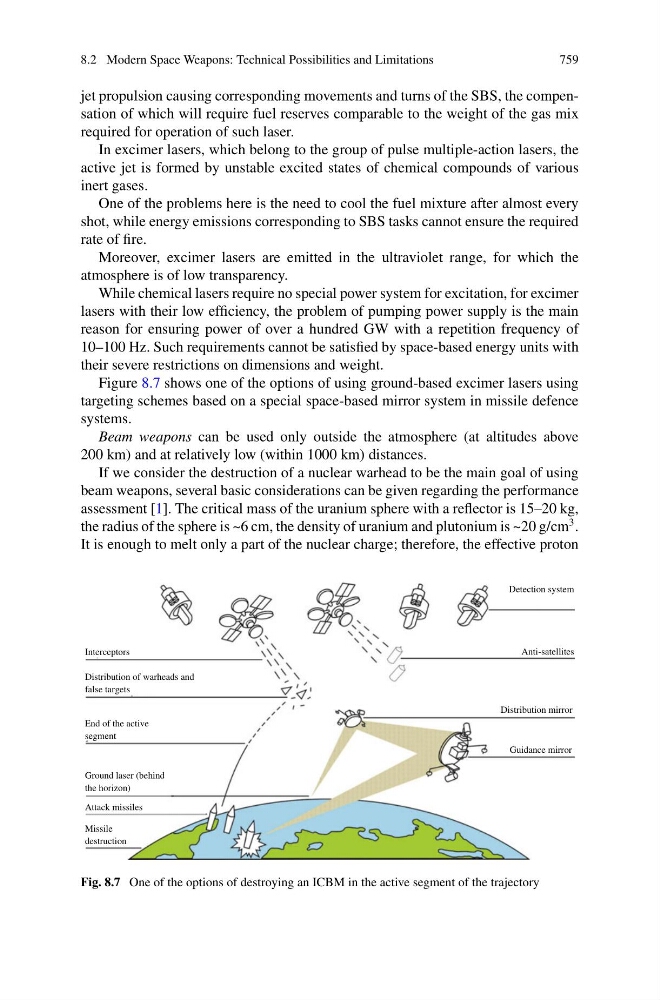
Figure 8.7 shows one of the options of using ground-based excimer lasers using
targeting schemes based on a special space-based mirror system in missile defence
systems.
Beam weapons can be used only outside the atmosphere (at altitudes above
200 km) and at relatively low (within 1000 km) distances.
If we consider the destruction of a nuclear warhead to be the main goal of using
beam weapons, several basic considerations can be given regarding the performance
assessment [1]. The critical mass of the uranium sphere with a reflector is 15–20 kg,
the radius of the sphere is ~6 cm, the density of uranium and plutonium is ~20 g/cm
3 .
It is enough to melt only a part of the nuclear charge; therefore, the effective proton
Interceptors
Distribution of warheads and
false targets
End of the active
segment
Ground laser (behind
the horizon)
Attack missiles
Missile
destruction
Detection system
Anti-satellites
Distribution mirror
Guidance mirror
Fig. 8.7 One of the options of destroying an ICBM in the active segment of the trajectory