

754
8 Modern Weapons: Possibilities and Limitations
8.2.2 Important Scientific-Technical and Military-Strategic
Aspects of Building and Using Weapons of the Space
Layer of Missile Defense
8.2.2.1 Technical Possibilities and Limitations of Potential Means
of Destruction of Ballistic Missiles
The main problem of creating any missile defense system is the creation of an
effective subsystem for destruction of intercontinental and ballistic missiles (ICBM)
and submarine-launched ballistic missiles (SLBM) in all segments of their area—
old missile defense systems were only designed to provide protection from attack
missiles at the final segment of their trajectory.
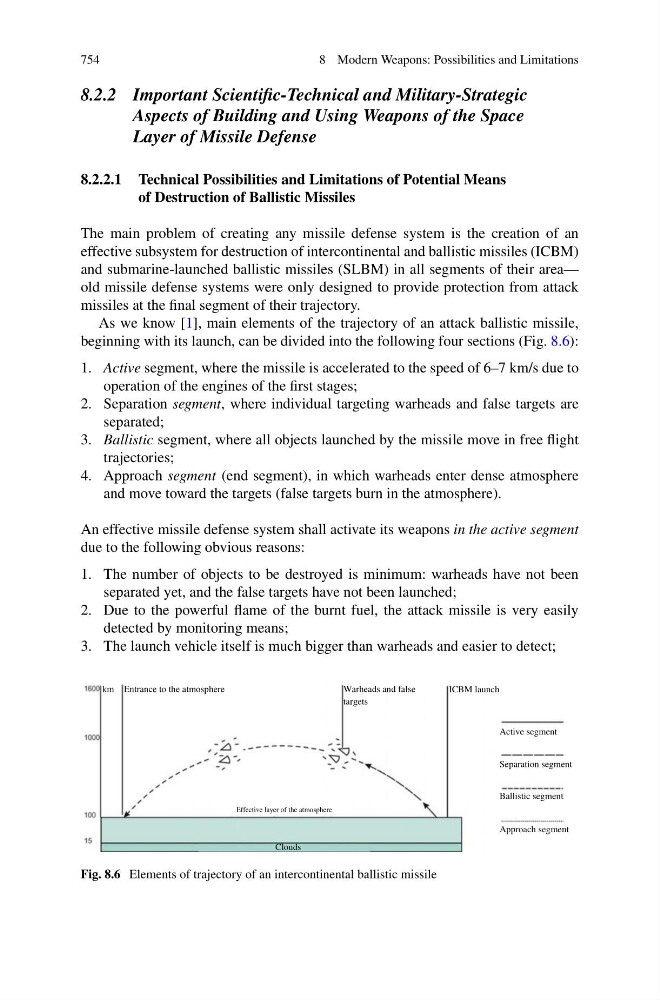
As we know [1], main elements of the trajectory of an attack ballistic missile,
beginning with its launch, can be divided into the following four sections (Fig. 8.6):
1. Active segment, where the missile is accelerated to the speed of 6–7 km/s due to
operation of the engines of the first stages;
2. Separation segment, where individual targeting warheads and false targets are
separated;
3. Ballistic segment, where all objects launched by the missile move in free flight
trajectories;
4. Approach segment (end segment), in which warheads enter dense atmosphere
and move toward the targets (false targets burn in the atmosphere).
An effective missile defense system shall activate its weapons in the active segment
due to the following obvious reasons:
1. The number of objects to be destroyed is minimum: warheads have not been
separated yet, and the false targets have not been launched;
2. Due to the powerful flame of the burnt fuel, the attack missile is very easily
detected by monitoring means;
3. The launch vehicle itself is much bigger than warheads and easier to detect;
Entrance to the atmosphere
km
Warheads and false
targets
ICBM launch
Active segment
Separation segment
Ballistic segment
Approach segment
Effective layer of the atmosphere
Clouds
Fig. 8.6 Elements of trajectory of an intercontinental ballistic missile