

50
1 Information Weapon: Concepts, Means, Methods …
area. The level of signals directed to them largely depends not only on the power of
the emitted signals, but also on the distance to IPE.
When propagating through a random antenna, the induced informative signal is
attenuated. Informative signal attenuation coefficient can be calculated or determined
experimentally. Knowing the amplification factor of a random antenna, its sensitivity
and receiver characteristics, it is easy to calculate the value of the directed informative
signal with the probability of detecting a signal using the intelligence equipment
receiver equal to some (rated) value (P 0 = Pp).
At the boundary and beyond the area around IPE, the level of the directed informative signal from IPE in focused antennas does not exceed the allowable (rated)
value (U = U n ). This is Risk Area 1 (r1) or Risk Area 1
(r1
) for distributed antennas
[21, 23].
Unlike Area R2, the size of Area r1 (r1
) depends not only on the level of IPE
stray electromagnetic radiation, but also on the length of a random antenna (the room,
where IPE is installed, up to the intelligence equipment connection point).
Areas r1 and r1
for each CE are determined by the instrumental and calculation
method, and their values are indicated in the CE operation manual.
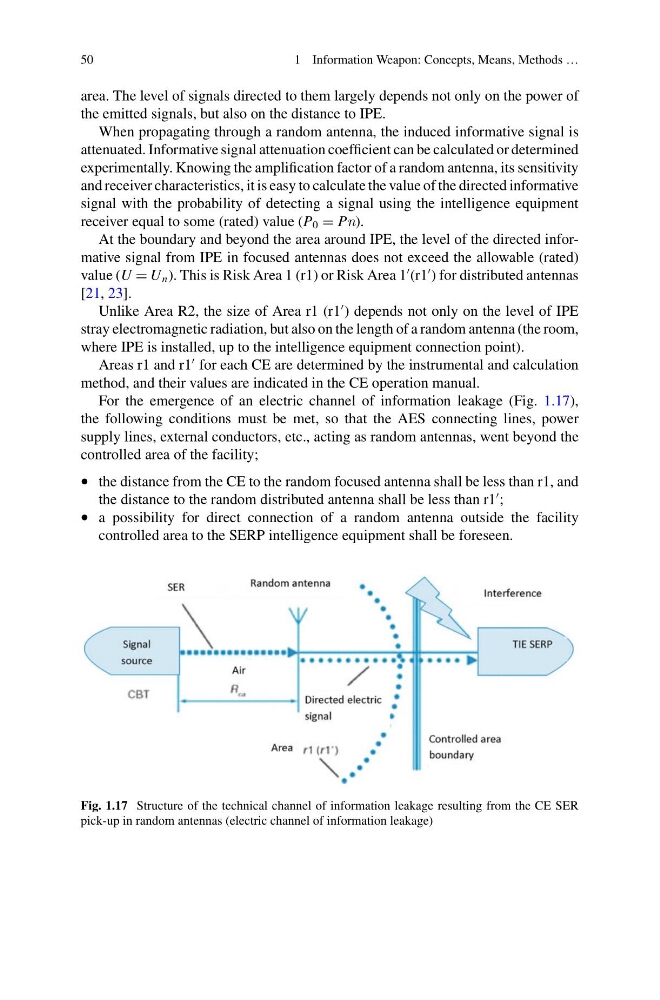
For the emergence of an electric channel of information leakage (Fig. 1.17),
the following conditions must be met, so that the AES connecting lines, power
supply lines, external conductors, etc., acting as random antennas, went beyond the
controlled area of the facility;
• the distance from the CE to the random focused antenna shall be less than r1, and
the distance to the random distributed antenna shall be less than r1
;
• a possibility for direct connection of a random antenna outside the facility
controlled area to the SERP intelligence equipment shall be foreseen.
Fig. 1.17 Structure of the technical channel of information leakage resulting from the CE SER
pick-up in random antennas (electric channel of information leakage)
1 Information Weapon: Concepts, Means, Methods …
area. The level of signals directed to them largely depends not only on the power of
the emitted signals, but also on the distance to IPE.
When propagating through a random antenna, the induced informative signal is
attenuated. Informative signal attenuation coefficient can be calculated or determined
experimentally. Knowing the amplification factor of a random antenna, its sensitivity
and receiver characteristics, it is easy to calculate the value of the directed informative
signal with the probability of detecting a signal using the intelligence equipment
receiver equal to some (rated) value (P 0 = Pp).
At the boundary and beyond the area around IPE, the level of the directed informative signal from IPE in focused antennas does not exceed the allowable (rated)
value (U = U n ). This is Risk Area 1 (r1) or Risk Area 1
(r1
) for distributed antennas
[21, 23].
Unlike Area R2, the size of Area r1 (r1
) depends not only on the level of IPE
stray electromagnetic radiation, but also on the length of a random antenna (the room,
where IPE is installed, up to the intelligence equipment connection point).
Areas r1 and r1
for each CE are determined by the instrumental and calculation
method, and their values are indicated in the CE operation manual.
For the emergence of an electric channel of information leakage (Fig. 1.17),
the following conditions must be met, so that the AES connecting lines, power
supply lines, external conductors, etc., acting as random antennas, went beyond the
controlled area of the facility;
• the distance from the CE to the random focused antenna shall be less than r1, and
the distance to the random distributed antenna shall be less than r1
;
• a possibility for direct connection of a random antenna outside the facility
controlled area to the SERP intelligence equipment shall be foreseen.
Fig. 1.17 Structure of the technical channel of information leakage resulting from the CE SER
pick-up in random antennas (electric channel of information leakage)