

7.6 Using Mathematical Instruments …
701
TRUST program dedicated to studies in the field of ensuring reliability of ICs applied
in military systems by American military.
While the world expert community designed a number of solutions and methods
of hardware-oriented protection, the number and complexity of issues created by
such implants extend far beyond the existing solutions to ensure security. Moreover,
the existing methods of detecting hardware Trojans in ICs, according to the authors
of [110], cannot solve a number of important tasks.
• Extended detection task. Does the use of remote Trojans leave traces? Can more
complex models and algorithms improve detection of Trojan programs?
• Secondary identification task. Can the traces left by Trojan programs reveal additional important information, such as identifying the specific type of a hardware
Trojan or its location on an IC chip topology?
• The task of modeling the hacking mechanism. What were the optimal strategies
of the hacker installing the circuit with a Trojan in the IC? What are the possible
optimal countermeasures?
• The task of ensuring safe design. Is it possible to develop IC design technologies
that would increase the possibility of detecting a circuit with embedded hardware
Trojan in advance?
In order to solve these tasks, the authors of [110] suggested a new set of methods
to detect hardware Trojans created in the process of solving tasks of the so-called
information forensic [110]. Algorithms of such information forensic are usually
designed for identification of multimedia information solely, such as potentially
falsified images or videos. These methods ensure reliable detection of manipulations
with information by finding the so-called statistical traces left in the digital content by
previously performed editing operations. Such information forensic is fully capable
of identifying any falsified video images and even localizing specific regions of
images or videos and determine which specific editing operations were used to create
such fake.
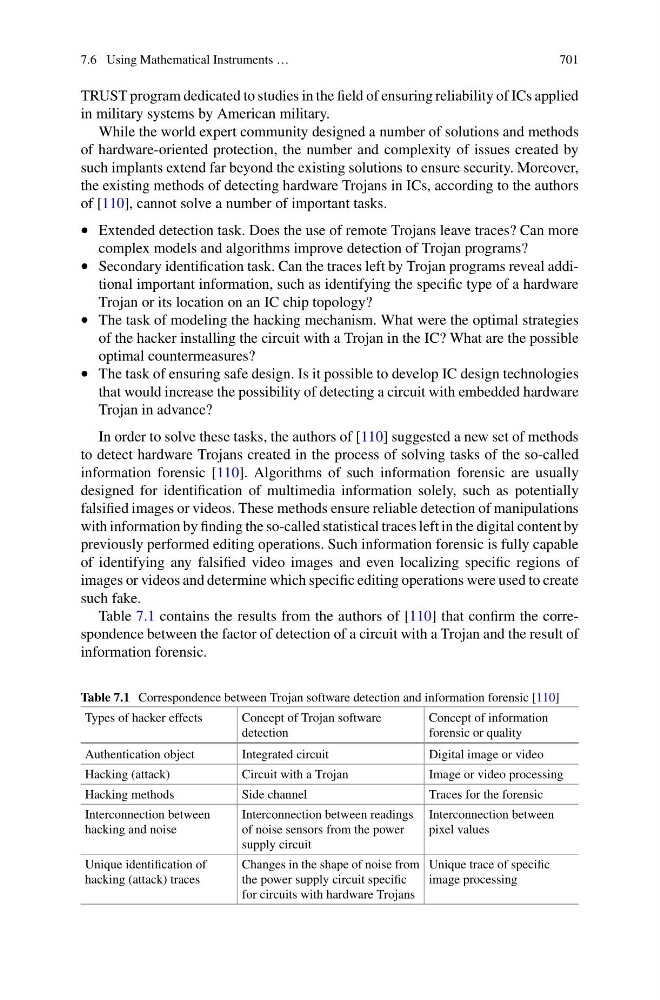
Table 7.1 contains the results from the authors of [110] that confirm the correspondence between the factor of detection of a circuit with a Trojan and the result of
information forensic.
Table 7.1 Correspondence between Trojan software detection and information forensic [110]
Types of hacker effects
Concept of Trojan software
detection
Concept of information
forensic or quality
Authentication object
Integrated circuit
Digital image or video
Hacking (attack)
Circuit with a Trojan
Image or video processing
Hacking methods
Side channel
Traces for the forensic
Interconnection between
hacking and noise
Interconnection between readings
of noise sensors from the power
supply circuit
Interconnection between
pixel values
Unique identification of
hacking (attack) traces
Changes in the shape of noise from
the power supply circuit specific
for circuits with hardware Trojans
Unique trace of specific
image processing