

1.5 Technical Channels of Information Leakage
45
Parasitic electromagnetic radiation of IPE is stray radio-frequency radiation
resulting from self-triggering of IPE generator or amplifier units due to the parasitic coupling [24]. Most often, such coupling results from random transformations
of negative feedbacks (inductive or capacitive) into parasitic positive ones, which
leads to the amplifier’s mode change from amplification to signal autogeneration.
The autogeneration (self-triggering) frequency lies within the operating frequencies
of non-linear components of amplifiers (for instance, semiconductor devices). In
some cases, stray electromagnetic radiation is modulated by an informative signal
(modulation refers to the process of changing one or several parameters of electromagnetic radiation (for instance, amplitude, frequency or phase) in accordance with
changes in the parameters of an informative signal affecting it [25]).
To intercept CE stray electromagnetic radiation, special stationary or mobile
(transportable and portable) receiving devices are used. They are referred to as the
technical intelligence equipment of stray electromagnetic radiation and pickup (TIE
SERP).
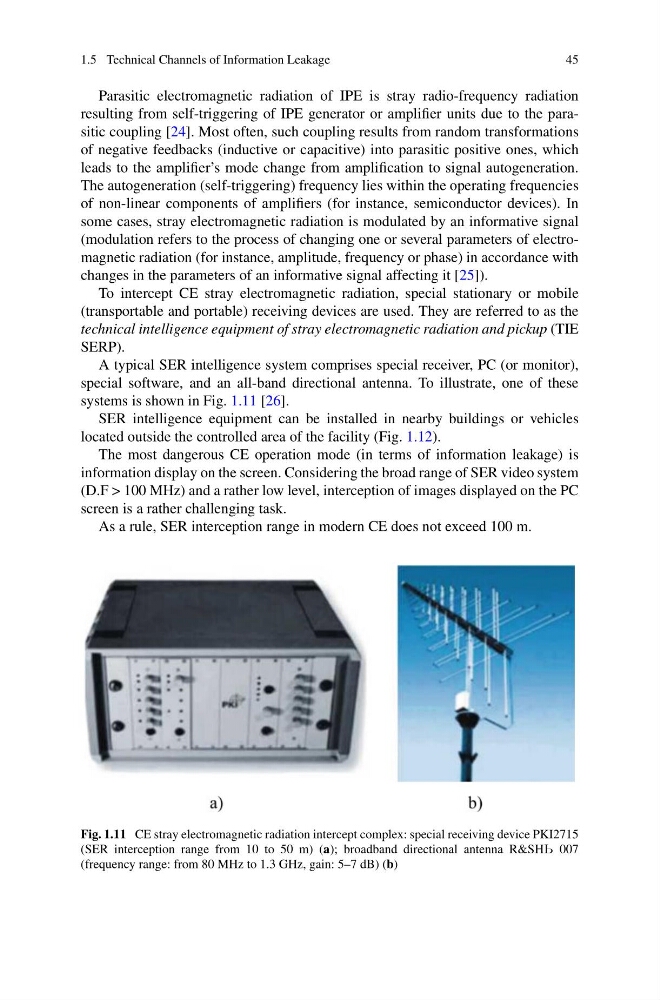
A typical SER intelligence system comprises special receiver, PC (or monitor),
special software, and an all-band directional antenna. To illustrate, one of these
systems is shown in Fig. 1.11 [26].
SER intelligence equipment can be installed in nearby buildings or vehicles
located outside the controlled area of the facility (Fig. 1.12).
The most dangerous CE operation mode (in terms of information leakage) is
information display on the screen. Considering the broad range of SER video system
(D.F > 100 MHz) and a rather low level, interception of images displayed on the PC
screen is a rather challenging task.
As a rule, SER interception range in modern CE does not exceed 100 m.
Fig. 1.11 CE stray electromagnetic radiation intercept complex: special receiving device PKI2715
(SER interception range from 10 to 50 m) (a); broadband directional antenna R&SH 007
(frequency range: from 80 MHz to 1.3 GHz, gain: 5–7 dB) (b)
45
Parasitic electromagnetic radiation of IPE is stray radio-frequency radiation
resulting from self-triggering of IPE generator or amplifier units due to the parasitic coupling [24]. Most often, such coupling results from random transformations
of negative feedbacks (inductive or capacitive) into parasitic positive ones, which
leads to the amplifier’s mode change from amplification to signal autogeneration.
The autogeneration (self-triggering) frequency lies within the operating frequencies
of non-linear components of amplifiers (for instance, semiconductor devices). In
some cases, stray electromagnetic radiation is modulated by an informative signal
(modulation refers to the process of changing one or several parameters of electromagnetic radiation (for instance, amplitude, frequency or phase) in accordance with
changes in the parameters of an informative signal affecting it [25]).
To intercept CE stray electromagnetic radiation, special stationary or mobile
(transportable and portable) receiving devices are used. They are referred to as the
technical intelligence equipment of stray electromagnetic radiation and pickup (TIE
SERP).
A typical SER intelligence system comprises special receiver, PC (or monitor),
special software, and an all-band directional antenna. To illustrate, one of these
systems is shown in Fig. 1.11 [26].
SER intelligence equipment can be installed in nearby buildings or vehicles
located outside the controlled area of the facility (Fig. 1.12).
The most dangerous CE operation mode (in terms of information leakage) is
information display on the screen. Considering the broad range of SER video system
(D.F > 100 MHz) and a rather low level, interception of images displayed on the PC
screen is a rather challenging task.
As a rule, SER interception range in modern CE does not exceed 100 m.
Fig. 1.11 CE stray electromagnetic radiation intercept complex: special receiving device PKI2715
(SER interception range from 10 to 50 m) (a); broadband directional antenna R&SH 007
(frequency range: from 80 MHz to 1.3 GHz, gain: 5–7 dB) (b)