

6.1 Introduction to the Problem of Reverse Engineering …
513
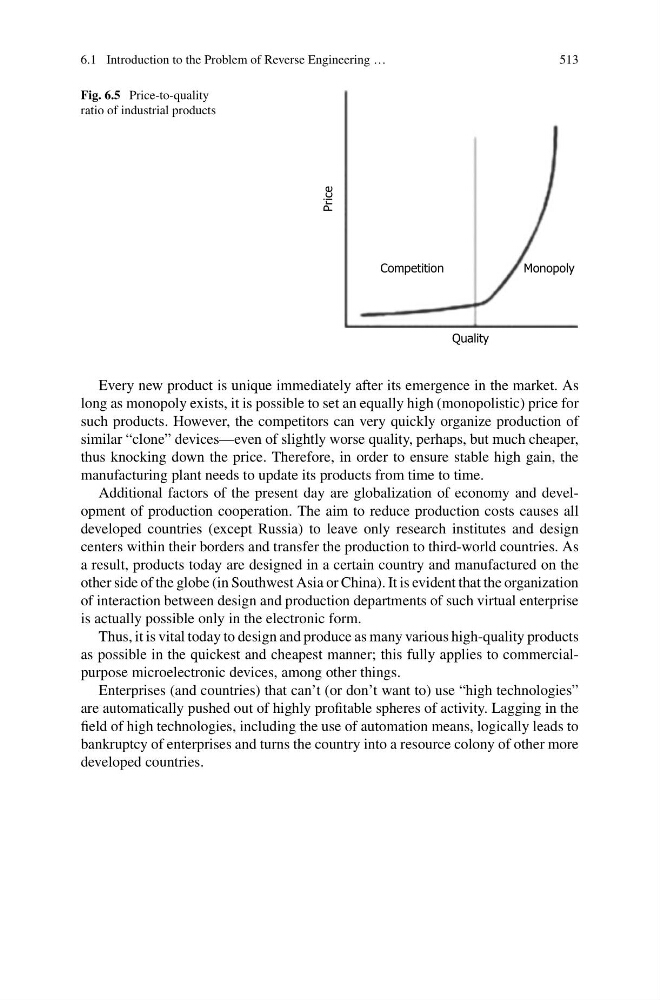
Fig. 6.5 Price-to-quality
ratio of industrial products
Monopoly
Competition
Quality
Price
Every new product is unique immediately after its emergence in the market. As
long as monopoly exists, it is possible to set an equally high (monopolistic) price for
such products. However, the competitors can very quickly organize production of
similar “clone” devices—even of slightly worse quality, perhaps, but much cheaper,
thus knocking down the price. Therefore, in order to ensure stable high gain, the
manufacturing plant needs to update its products from time to time.
Additional factors of the present day are globalization of economy and development of production cooperation. The aim to reduce production costs causes all
developed countries (except Russia) to leave only research institutes and design
centers within their borders and transfer the production to third-world countries. As
a result, products today are designed in a certain country and manufactured on the
other side of the globe (in Southwest Asia or China). It is evident that the organization
of interaction between design and production departments of such virtual enterprise
is actually possible only in the electronic form.
Thus, it is vital today to design and produce as many various high-quality products
as possible in the quickest and cheapest manner; this fully applies to commercialpurpose microelectronic devices, among other things.
Enterprises (and countries) that can’t (or don’t want to) use “high technologies”
are automatically pushed out of highly profitable spheres of activity. Lagging in the
field of high technologies, including the use of automation means, logically leads to
bankruptcy of enterprises and turns the country into a resource colony of other more
developed countries.
513
Fig. 6.5 Price-to-quality
ratio of industrial products
Monopoly
Competition
Quality
Price
Every new product is unique immediately after its emergence in the market. As
long as monopoly exists, it is possible to set an equally high (monopolistic) price for
such products. However, the competitors can very quickly organize production of
similar “clone” devices—even of slightly worse quality, perhaps, but much cheaper,
thus knocking down the price. Therefore, in order to ensure stable high gain, the
manufacturing plant needs to update its products from time to time.
Additional factors of the present day are globalization of economy and development of production cooperation. The aim to reduce production costs causes all
developed countries (except Russia) to leave only research institutes and design
centers within their borders and transfer the production to third-world countries. As
a result, products today are designed in a certain country and manufactured on the
other side of the globe (in Southwest Asia or China). It is evident that the organization
of interaction between design and production departments of such virtual enterprise
is actually possible only in the electronic form.
Thus, it is vital today to design and produce as many various high-quality products
as possible in the quickest and cheapest manner; this fully applies to commercialpurpose microelectronic devices, among other things.
Enterprises (and countries) that can’t (or don’t want to) use “high technologies”
are automatically pushed out of highly profitable spheres of activity. Lagging in the
field of high technologies, including the use of automation means, logically leads to
bankruptcy of enterprises and turns the country into a resource colony of other more
developed countries.