

504
6 Reverse Engineering of Microcircuits
including the methods of implementing hidden (masked) interconnections, means of
introducing additional conductive traces and interlayer connect, and introduction of
false transistors.
In order to ensure a deeper understanding of the methods for organizing protection
from RE, the authors provide a number of original technological solutions developed
by the authors themselves and implemented in serial microcircuits produced in the
Belarusian semiconductor holding “Integral.”
6.1 Introduction to the Problem of Reverse Engineering
of Microcircuits
6.1.1 Problem Emergence Background, Terms,
and Definitions
Since this book, according to the foreword, is intended not only for specialists in
microelectronics, but also for engineers and students of other technical specialties
related to the issues of engineering, production, and application of radioelectronic
devices, all of them shall have at least a basic understanding of the essence of the
reverse engineering of any technical object. It is necessary to take at least a very brief
look at the problem of reverse engineering of various products.
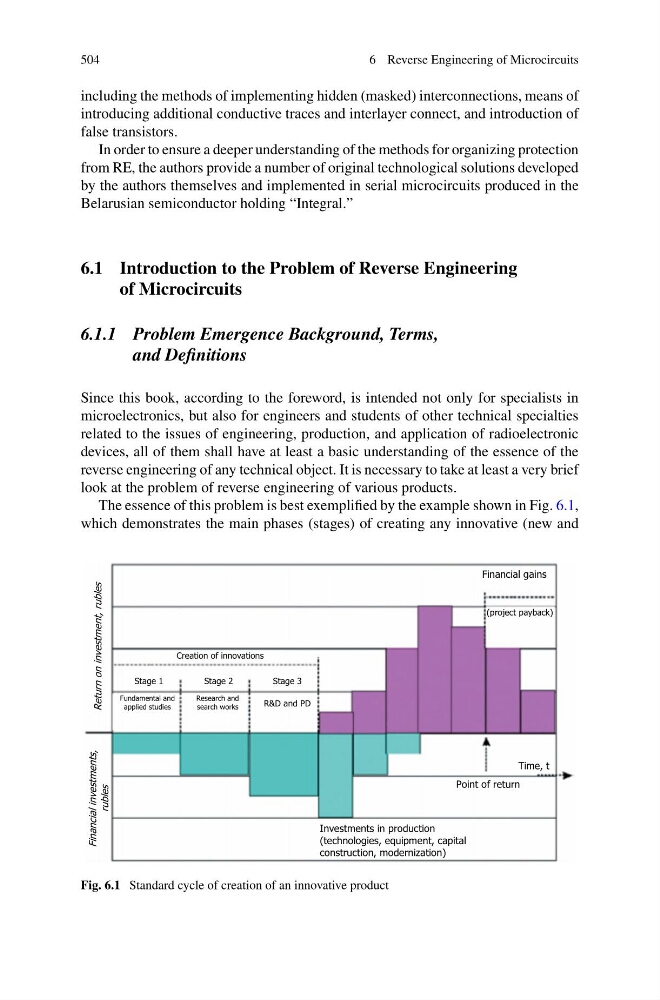
The essence of this problem is best exemplified by the example shown in Fig. 6.1,
which demonstrates the main phases (stages) of creating any innovative (new and
Creation of innovations
Stage 1
Stage 2
Stage 3
R&D and PD
Research and
search works
Fundamental and
applied studies
Financial gains
(project payback)
Point of return
Time, t
Investments in production
(technologies, equipment, capital
construction, modernization)
Financial investments,
rubles
Return on investment, rubles
Fig. 6.1 Standard cycle of creation of an innovative product
6 Reverse Engineering of Microcircuits
including the methods of implementing hidden (masked) interconnections, means of
introducing additional conductive traces and interlayer connect, and introduction of
false transistors.
In order to ensure a deeper understanding of the methods for organizing protection
from RE, the authors provide a number of original technological solutions developed
by the authors themselves and implemented in serial microcircuits produced in the
Belarusian semiconductor holding “Integral.”
6.1 Introduction to the Problem of Reverse Engineering
of Microcircuits
6.1.1 Problem Emergence Background, Terms,
and Definitions
Since this book, according to the foreword, is intended not only for specialists in
microelectronics, but also for engineers and students of other technical specialties
related to the issues of engineering, production, and application of radioelectronic
devices, all of them shall have at least a basic understanding of the essence of the
reverse engineering of any technical object. It is necessary to take at least a very brief
look at the problem of reverse engineering of various products.
The essence of this problem is best exemplified by the example shown in Fig. 6.1,
which demonstrates the main phases (stages) of creating any innovative (new and
Creation of innovations
Stage 1
Stage 2
Stage 3
R&D and PD
Research and
search works
Fundamental and
applied studies
Financial gains
(project payback)
Point of return
Time, t
Investments in production
(technologies, equipment, capital
construction, modernization)
Financial investments,
rubles
Return on investment, rubles
Fig. 6.1 Standard cycle of creation of an innovative product