

4.11 Analytical Review of Basic Techniques …
415
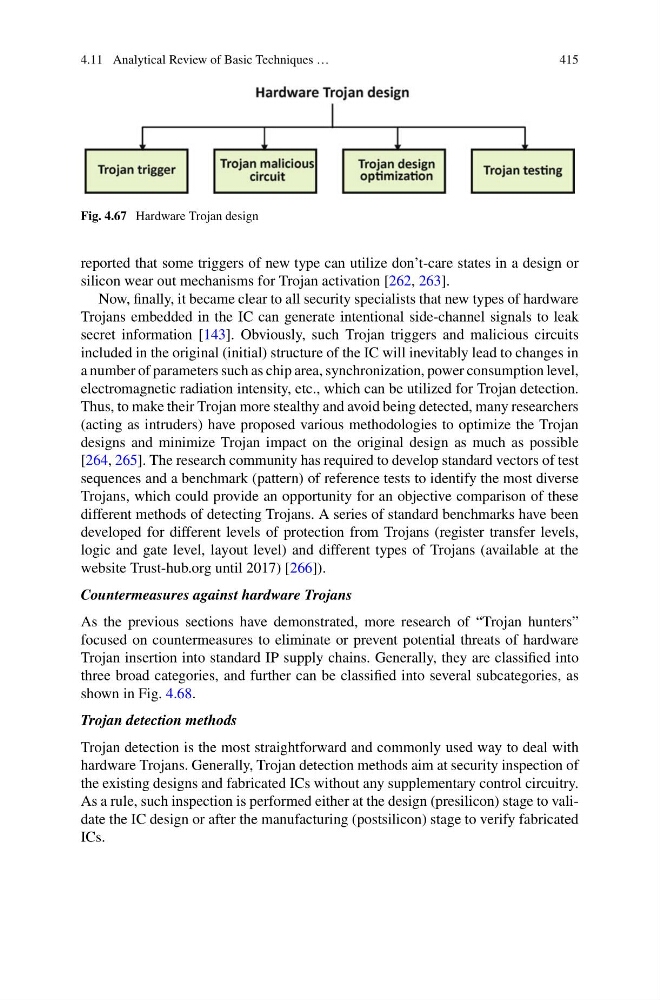
Fig. 4.67 Hardware Trojan design
reported that some triggers of new type can utilize don’t-care states in a design or
silicon wear out mechanisms for Trojan activation [262, 263].
Now, finally, it became clear to all security specialists that new types of hardware
Trojans embedded in the IC can generate intentional side-channel signals to leak
secret information [143]. Obviously, such Trojan triggers and malicious circuits
included in the original (initial) structure of the IC will inevitably lead to changes in
a number of parameters such as chip area, synchronization, power consumption level,
electromagnetic radiation intensity, etc., which can be utilized for Trojan detection.
Thus, to make their Trojan more stealthy and avoid being detected, many researchers
(acting as intruders) have proposed various methodologies to optimize the Trojan
designs and minimize Trojan impact on the original design as much as possible
[264, 265]. The research community has required to develop standard vectors of test
sequences and a benchmark (pattern) of reference tests to identify the most diverse
Trojans, which could provide an opportunity for an objective comparison of these
different methods of detecting Trojans. A series of standard benchmarks have been
developed for different levels of protection from Trojans (register transfer levels,
logic and gate level, layout level) and different types of Trojans (available at the
website Trust-hub.org until 2017) [266]).
Countermeasures against hardware Trojans
As the previous sections have demonstrated, more research of “Trojan hunters”
focused on countermeasures to eliminate or prevent potential threats of hardware
Trojan insertion into standard IP supply chains. Generally, they are classified into
three broad categories, and further can be classified into several subcategories, as
shown in Fig. 4.68.
Trojan detection methods
Trojan detection is the most straightforward and commonly used way to deal with
hardware Trojans. Generally, Trojan detection methods aim at security inspection of
the existing designs and fabricated ICs without any supplementary control circuitry.
As a rule, such inspection is performed either at the design (presilicon) stage to validate the IC design or after the manufacturing (postsilicon) stage to verify fabricated
ICs.
415
Fig. 4.67 Hardware Trojan design
reported that some triggers of new type can utilize don’t-care states in a design or
silicon wear out mechanisms for Trojan activation [262, 263].
Now, finally, it became clear to all security specialists that new types of hardware
Trojans embedded in the IC can generate intentional side-channel signals to leak
secret information [143]. Obviously, such Trojan triggers and malicious circuits
included in the original (initial) structure of the IC will inevitably lead to changes in
a number of parameters such as chip area, synchronization, power consumption level,
electromagnetic radiation intensity, etc., which can be utilized for Trojan detection.
Thus, to make their Trojan more stealthy and avoid being detected, many researchers
(acting as intruders) have proposed various methodologies to optimize the Trojan
designs and minimize Trojan impact on the original design as much as possible
[264, 265]. The research community has required to develop standard vectors of test
sequences and a benchmark (pattern) of reference tests to identify the most diverse
Trojans, which could provide an opportunity for an objective comparison of these
different methods of detecting Trojans. A series of standard benchmarks have been
developed for different levels of protection from Trojans (register transfer levels,
logic and gate level, layout level) and different types of Trojans (available at the
website Trust-hub.org until 2017) [266]).
Countermeasures against hardware Trojans
As the previous sections have demonstrated, more research of “Trojan hunters”
focused on countermeasures to eliminate or prevent potential threats of hardware
Trojan insertion into standard IP supply chains. Generally, they are classified into
three broad categories, and further can be classified into several subcategories, as
shown in Fig. 4.68.
Trojan detection methods
Trojan detection is the most straightforward and commonly used way to deal with
hardware Trojans. Generally, Trojan detection methods aim at security inspection of
the existing designs and fabricated ICs without any supplementary control circuitry.
As a rule, such inspection is performed either at the design (presilicon) stage to validate the IC design or after the manufacturing (postsilicon) stage to verify fabricated
ICs.