

408
4 Hardware Trojans in Microcircuits
Table 4.5 Assessment of
hardware overhead caused by
the hardware Trojans [244]
Design
# of LUT (overhead) # of FF (overhead)
Reference
Circuit
2791
551
with hardware
Trojan 1
2866 (+2.7%)
594 (+7.8%)
with hardware
Trojan 2
2821 (+1.1%)
594 (+7.8%)
with hardware
Trojan 3
2805 (+0.5%)
625 (+13.4%)
with hardware
Trojan 4
2879 (+3.1%)
619 (+12.3%)
with hardware
Trojan 5
2763 (−1.0%)
619 (+12.3%)
with hardware
Trojan 6
2691 (−3.6%)
594 (+7.8%)
with hardware
Trojan 7
2777 (−0.5%)
622 (+12.9%)
with hardware
Trojan 8
2816 (+0.9%)
594 (+7.8%)
with hardware
Trojan 9
2812 (+0.8%)
594 (+7.8%)
with hardware
Trojan 10
2764 (−1.0%)
594 (+7.8%)
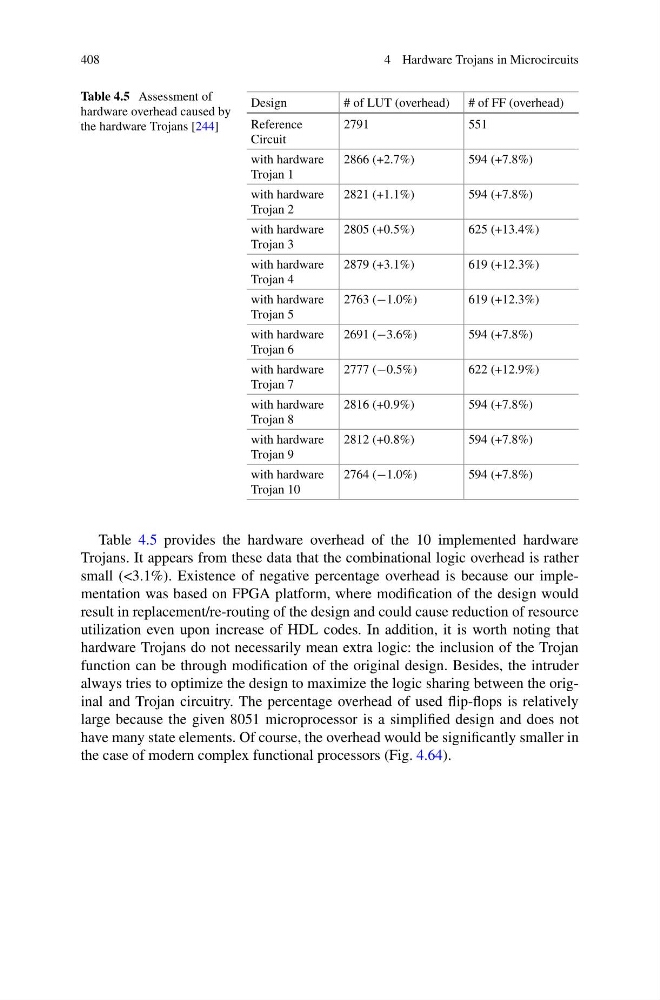
Table 4.5 provides the hardware overhead of the 10 implemented hardware
Trojans. It appears from these data that the combinational logic overhead is rather
small (<3.1%). Existence of negative percentage overhead is because our implementation was based on FPGA platform, where modification of the design would
result in replacement/re-routing of the design and could cause reduction of resource
utilization even upon increase of HDL codes. In addition, it is worth noting that
hardware Trojans do not necessarily mean extra logic: the inclusion of the Trojan
function can be through modification of the original design. Besides, the intruder
always tries to optimize the design to maximize the logic sharing between the original and Trojan circuitry. The percentage overhead of used flip-flops is relatively
large because the given 8051 microprocessor is a simplified design and does not
have many state elements. Of course, the overhead would be significantly smaller in
the case of modern complex functional processors (Fig. 4.64).
4 Hardware Trojans in Microcircuits
Table 4.5 Assessment of
hardware overhead caused by
the hardware Trojans [244]
Design
# of LUT (overhead) # of FF (overhead)
Reference
Circuit
2791
551
with hardware
Trojan 1
2866 (+2.7%)
594 (+7.8%)
with hardware
Trojan 2
2821 (+1.1%)
594 (+7.8%)
with hardware
Trojan 3
2805 (+0.5%)
625 (+13.4%)
with hardware
Trojan 4
2879 (+3.1%)
619 (+12.3%)
with hardware
Trojan 5
2763 (−1.0%)
619 (+12.3%)
with hardware
Trojan 6
2691 (−3.6%)
594 (+7.8%)
with hardware
Trojan 7
2777 (−0.5%)
622 (+12.9%)
with hardware
Trojan 8
2816 (+0.9%)
594 (+7.8%)
with hardware
Trojan 9
2812 (+0.8%)
594 (+7.8%)
with hardware
Trojan 10
2764 (−1.0%)
594 (+7.8%)
Table 4.5 provides the hardware overhead of the 10 implemented hardware
Trojans. It appears from these data that the combinational logic overhead is rather
small (<3.1%). Existence of negative percentage overhead is because our implementation was based on FPGA platform, where modification of the design would
result in replacement/re-routing of the design and could cause reduction of resource
utilization even upon increase of HDL codes. In addition, it is worth noting that
hardware Trojans do not necessarily mean extra logic: the inclusion of the Trojan
function can be through modification of the original design. Besides, the intruder
always tries to optimize the design to maximize the logic sharing between the original and Trojan circuitry. The percentage overhead of used flip-flops is relatively
large because the given 8051 microprocessor is a simplified design and does not
have many state elements. Of course, the overhead would be significantly smaller in
the case of modern complex functional processors (Fig. 4.64).