

382
4 Hardware Trojans in Microcircuits
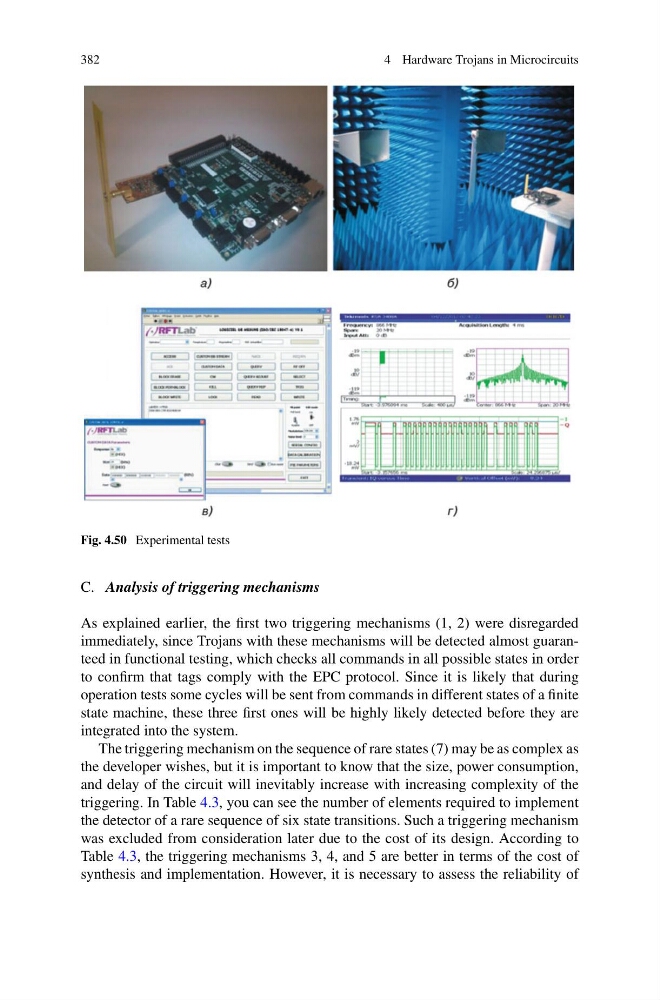
Fig. 4.50 Experimental tests
C. Analysis of triggering mechanisms
As explained earlier, the first two triggering mechanisms (1, 2) were disregarded
immediately, since Trojans with these mechanisms will be detected almost guaranteed in functional testing, which checks all commands in all possible states in order
to confirm that tags comply with the EPC protocol. Since it is likely that during
operation tests some cycles will be sent from commands in different states of a finite
state machine, these three first ones will be highly likely detected before they are
integrated into the system.
The triggering mechanism on the sequence of rare states (7) may be as complex as
the developer wishes, but it is important to know that the size, power consumption,
and delay of the circuit will inevitably increase with increasing complexity of the
triggering. In Table 4.3, you can see the number of elements required to implement
the detector of a rare sequence of six state transitions. Such a triggering mechanism
was excluded from consideration later due to the cost of its design. According to
Table 4.3, the triggering mechanisms 3, 4, and 5 are better in terms of the cost of
synthesis and implementation. However, it is necessary to assess the reliability of
4 Hardware Trojans in Microcircuits
Fig. 4.50 Experimental tests
C. Analysis of triggering mechanisms
As explained earlier, the first two triggering mechanisms (1, 2) were disregarded
immediately, since Trojans with these mechanisms will be detected almost guaranteed in functional testing, which checks all commands in all possible states in order
to confirm that tags comply with the EPC protocol. Since it is likely that during
operation tests some cycles will be sent from commands in different states of a finite
state machine, these three first ones will be highly likely detected before they are
integrated into the system.
The triggering mechanism on the sequence of rare states (7) may be as complex as
the developer wishes, but it is important to know that the size, power consumption,
and delay of the circuit will inevitably increase with increasing complexity of the
triggering. In Table 4.3, you can see the number of elements required to implement
the detector of a rare sequence of six state transitions. Such a triggering mechanism
was excluded from consideration later due to the cost of its design. According to
Table 4.3, the triggering mechanisms 3, 4, and 5 are better in terms of the cost of
synthesis and implementation. However, it is necessary to assess the reliability of