

4.7 Case Study of the Development …
361
bytes, the system being described should necessarily send more than 5 bytes of 0xFF
but less than 14 bytes of 0xFF that are sent to the reference system. When reporting a
variable length within a block of 8 bytes, there are eight possible places from which
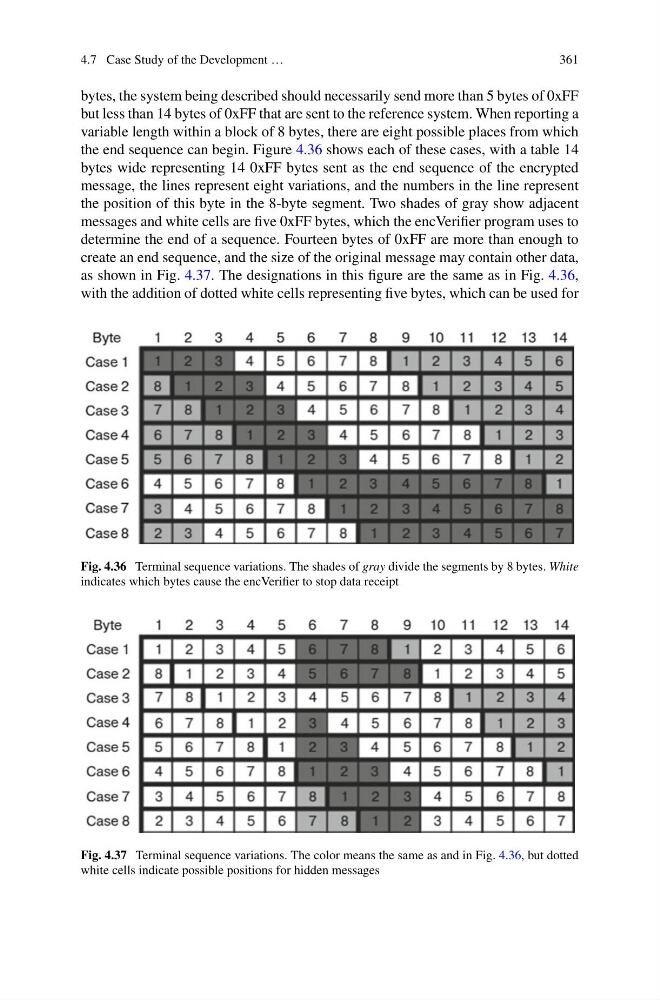
the end sequence can begin. Figure 4.36 shows each of these cases, with a table 14
bytes wide representing 14 0xFF bytes sent as the end sequence of the encrypted
message, the lines represent eight variations, and the numbers in the line represent
the position of this byte in the 8-byte segment. Two shades of gray show adjacent
messages and white cells are five 0xFF bytes, which the encVerifier program uses to
determine the end of a sequence. Fourteen bytes of 0xFF are more than enough to
create an end sequence, and the size of the original message may contain other data,
as shown in Fig. 4.37. The designations in this figure are the same as in Fig. 4.36,
with the addition of dotted white cells representing five bytes, which can be used for
Fig. 4.36 Terminal sequence variations. The shades of gray divide the segments by 8 bytes. White
indicates which bytes cause the encVerifier to stop data receipt
Fig. 4.37 Terminal sequence variations. The color means the same as and in Fig. 4.36, but dotted
white cells indicate possible positions for hidden messages
361
bytes, the system being described should necessarily send more than 5 bytes of 0xFF
but less than 14 bytes of 0xFF that are sent to the reference system. When reporting a
variable length within a block of 8 bytes, there are eight possible places from which
the end sequence can begin. Figure 4.36 shows each of these cases, with a table 14
bytes wide representing 14 0xFF bytes sent as the end sequence of the encrypted
message, the lines represent eight variations, and the numbers in the line represent
the position of this byte in the 8-byte segment. Two shades of gray show adjacent
messages and white cells are five 0xFF bytes, which the encVerifier program uses to
determine the end of a sequence. Fourteen bytes of 0xFF are more than enough to
create an end sequence, and the size of the original message may contain other data,
as shown in Fig. 4.37. The designations in this figure are the same as in Fig. 4.36,
with the addition of dotted white cells representing five bytes, which can be used for
Fig. 4.36 Terminal sequence variations. The shades of gray divide the segments by 8 bytes. White
indicates which bytes cause the encVerifier to stop data receipt
Fig. 4.37 Terminal sequence variations. The color means the same as and in Fig. 4.36, but dotted
white cells indicate possible positions for hidden messages