

354
4 Hardware Trojans in Microcircuits
for the presence of such transitions that can be used. Other works, such as [219, 220],
use NP-complete design space from algorithms controlling CAD systems to provide
flexibility for the installation of watermarks.
4.7.2 Hierarchical Classification of Attackers
Attackers can be classified by their location in the supply chain, as well as by their
level of access. Below in this section, a list of what an attacker can get in relation
to his predetermined goals and a list of possible protections to stop the attacker or
create appropriate obstacles for him are given. In each of these cases, the attacker
can be a “mole,” a disgruntled worker, an agent of a rival company, a hacker, or
even a terrorist. Therefore, when setting a task, the participants of this competition
were told that the attacker has significant resources, but they are limited, and that
the benefits of an attack on the IC supply chain should outweigh the resources spent.
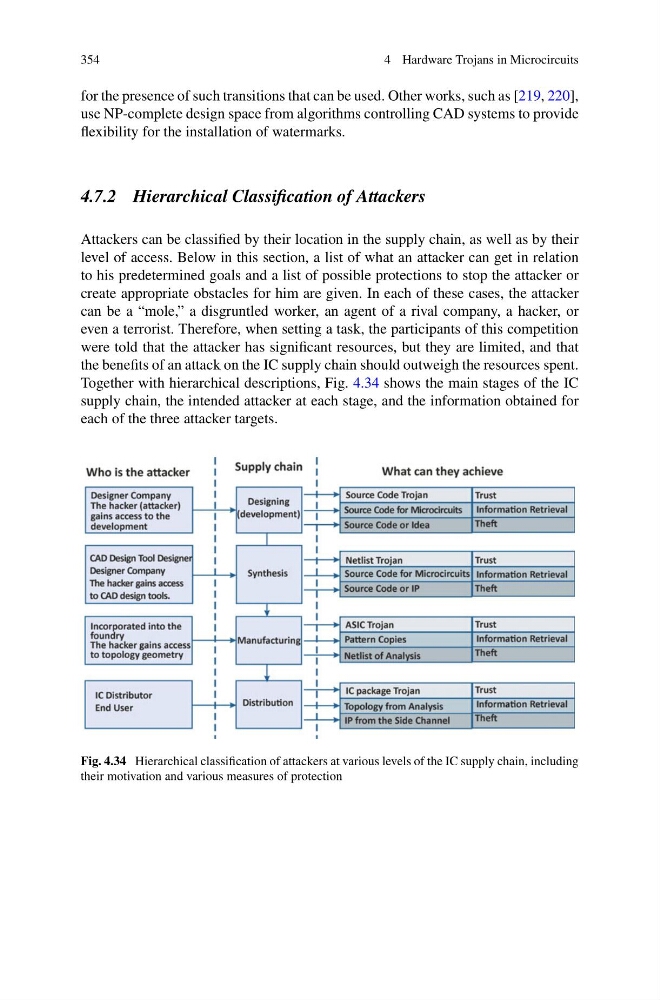
Together with hierarchical descriptions, Fig. 4.34 shows the main stages of the IC
supply chain, the intended attacker at each stage, and the information obtained for
each of the three attacker targets.
Fig. 4.34 Hierarchical classification of attackers at various levels of the IC supply chain, including
their motivation and various measures of protection
4 Hardware Trojans in Microcircuits
for the presence of such transitions that can be used. Other works, such as [219, 220],
use NP-complete design space from algorithms controlling CAD systems to provide
flexibility for the installation of watermarks.
4.7.2 Hierarchical Classification of Attackers
Attackers can be classified by their location in the supply chain, as well as by their
level of access. Below in this section, a list of what an attacker can get in relation
to his predetermined goals and a list of possible protections to stop the attacker or
create appropriate obstacles for him are given. In each of these cases, the attacker
can be a “mole,” a disgruntled worker, an agent of a rival company, a hacker, or
even a terrorist. Therefore, when setting a task, the participants of this competition
were told that the attacker has significant resources, but they are limited, and that
the benefits of an attack on the IC supply chain should outweigh the resources spent.
Together with hierarchical descriptions, Fig. 4.34 shows the main stages of the IC
supply chain, the intended attacker at each stage, and the information obtained for
each of the three attacker targets.
Fig. 4.34 Hierarchical classification of attackers at various levels of the IC supply chain, including
their motivation and various measures of protection