

332
4 Hardware Trojans in Microcircuits
certification and functional testing of integrated circuits or in the study of the socalled space for analyzing the dynamic behavior of a project, including I/O and
internal logic statuses. Activating a hardware Trojan during a competent test can
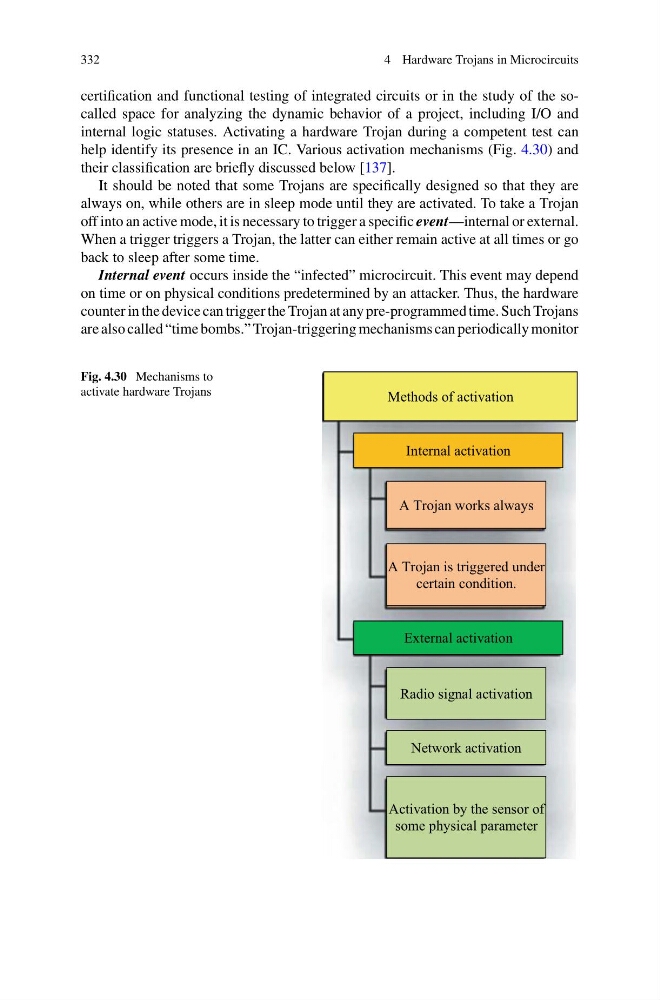
help identify its presence in an IC. Various activation mechanisms (Fig. 4.30) and
their classification are briefly discussed below [137].
It should be noted that some Trojans are specifically designed so that they are
always on, while others are in sleep mode until they are activated. To take a Trojan
off into an active mode, it is necessary to trigger a specific event—internal or external.
When a trigger triggers a Trojan, the latter can either remain active at all times or go
back to sleep after some time.
Internal event occurs inside the “infected” microcircuit. This event may depend
on time or on physical conditions predetermined by an attacker. Thus, the hardware
counter in the device can trigger the Trojan at any pre-programmed time. Such Trojans
are also called “time bombs.” Trojan-triggering mechanisms can periodically monitor
Fig. 4.30 Mechanisms to
activate hardware Trojans
Methods of activation
Internal activation
A Trojan works always
A Trojan is triggered under
certain condition.
External activation
Radio signal activation
Network activation
Activation by the sensor of
some physical parameter
4 Hardware Trojans in Microcircuits
certification and functional testing of integrated circuits or in the study of the socalled space for analyzing the dynamic behavior of a project, including I/O and
internal logic statuses. Activating a hardware Trojan during a competent test can
help identify its presence in an IC. Various activation mechanisms (Fig. 4.30) and
their classification are briefly discussed below [137].
It should be noted that some Trojans are specifically designed so that they are
always on, while others are in sleep mode until they are activated. To take a Trojan
off into an active mode, it is necessary to trigger a specific event—internal or external.
When a trigger triggers a Trojan, the latter can either remain active at all times or go
back to sleep after some time.
Internal event occurs inside the “infected” microcircuit. This event may depend
on time or on physical conditions predetermined by an attacker. Thus, the hardware
counter in the device can trigger the Trojan at any pre-programmed time. Such Trojans
are also called “time bombs.” Trojan-triggering mechanisms can periodically monitor
Fig. 4.30 Mechanisms to
activate hardware Trojans
Methods of activation
Internal activation
A Trojan works always
A Trojan is triggered under
certain condition.
External activation
Radio signal activation
Network activation
Activation by the sensor of
some physical parameter