

4.3 Classification of Hardware Trojans in Chips
321
System level
Transmission registration
level
Gate level
Transistor level
Physical level
Change protocol
Change parameters
Additional gates
Change topology
Change the selection of the
wiring diagram
Change logic
Change parameters
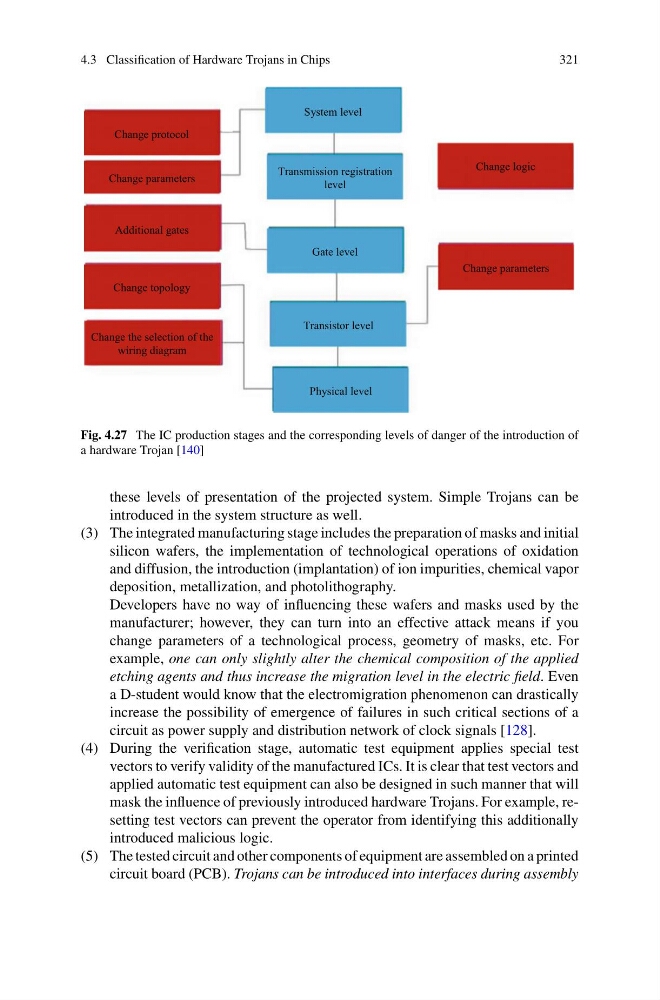
Fig. 4.27 The IC production stages and the corresponding levels of danger of the introduction of
a hardware Trojan [140]
these levels of presentation of the projected system. Simple Trojans can be
introduced in the system structure as well.
(3) The integrated manufacturing stage includes the preparation of masks and initial
silicon wafers, the implementation of technological operations of oxidation
and diffusion, the introduction (implantation) of ion impurities, chemical vapor
deposition, metallization, and photolithography.
Developers have no way of influencing these wafers and masks used by the
manufacturer; however, they can turn into an effective attack means if you
change parameters of a technological process, geometry of masks, etc. For
example, one can only slightly alter the chemical composition of the applied
etching agents and thus increase the migration level in the electric field. Even
a D-student would know that the electromigration phenomenon can drastically
increase the possibility of emergence of failures in such critical sections of a
circuit as power supply and distribution network of clock signals [128].
(4) During the verification stage, automatic test equipment applies special test
vectors to verify validity of the manufactured ICs. It is clear that test vectors and
applied automatic test equipment can also be designed in such manner that will
mask the influence of previously introduced hardware Trojans. For example, resetting test vectors can prevent the operator from identifying this additionally
introduced malicious logic.
(5) The tested circuit and other components of equipment are assembled on a printed
circuit board (PCB). Trojans can be introduced into interfaces during assembly
321
System level
Transmission registration
level
Gate level
Transistor level
Physical level
Change protocol
Change parameters
Additional gates
Change topology
Change the selection of the
wiring diagram
Change logic
Change parameters
Fig. 4.27 The IC production stages and the corresponding levels of danger of the introduction of
a hardware Trojan [140]
these levels of presentation of the projected system. Simple Trojans can be
introduced in the system structure as well.
(3) The integrated manufacturing stage includes the preparation of masks and initial
silicon wafers, the implementation of technological operations of oxidation
and diffusion, the introduction (implantation) of ion impurities, chemical vapor
deposition, metallization, and photolithography.
Developers have no way of influencing these wafers and masks used by the
manufacturer; however, they can turn into an effective attack means if you
change parameters of a technological process, geometry of masks, etc. For
example, one can only slightly alter the chemical composition of the applied
etching agents and thus increase the migration level in the electric field. Even
a D-student would know that the electromigration phenomenon can drastically
increase the possibility of emergence of failures in such critical sections of a
circuit as power supply and distribution network of clock signals [128].
(4) During the verification stage, automatic test equipment applies special test
vectors to verify validity of the manufactured ICs. It is clear that test vectors and
applied automatic test equipment can also be designed in such manner that will
mask the influence of previously introduced hardware Trojans. For example, resetting test vectors can prevent the operator from identifying this additionally
introduced malicious logic.
(5) The tested circuit and other components of equipment are assembled on a printed
circuit board (PCB). Trojans can be introduced into interfaces during assembly