

4.3 Classification of Hardware Trojans in Chips
317
4.3 Classification of Hardware Trojans in Chips
4.3.1 Problem Description
In order to develop system approaches to detection of hardware Trojans, specialists
had to understand: what are they? Otherwise, identification of every such Trojan
embedded in your system would require development of a relevant method to detect
and block it. Already existing detection methods were purely theoretical; however,
they were not properly experimentally checked by specialists using all the necessary
criteria; therefore, most researchers of this problem tried to offer their various types
of classification of hardware Trojans based on five underlying principles.
If we assume that a hardware Trojan in a microcircuit is any malicious change
in the structure of the integrated circuit (IC), which can cause adverse effects, this
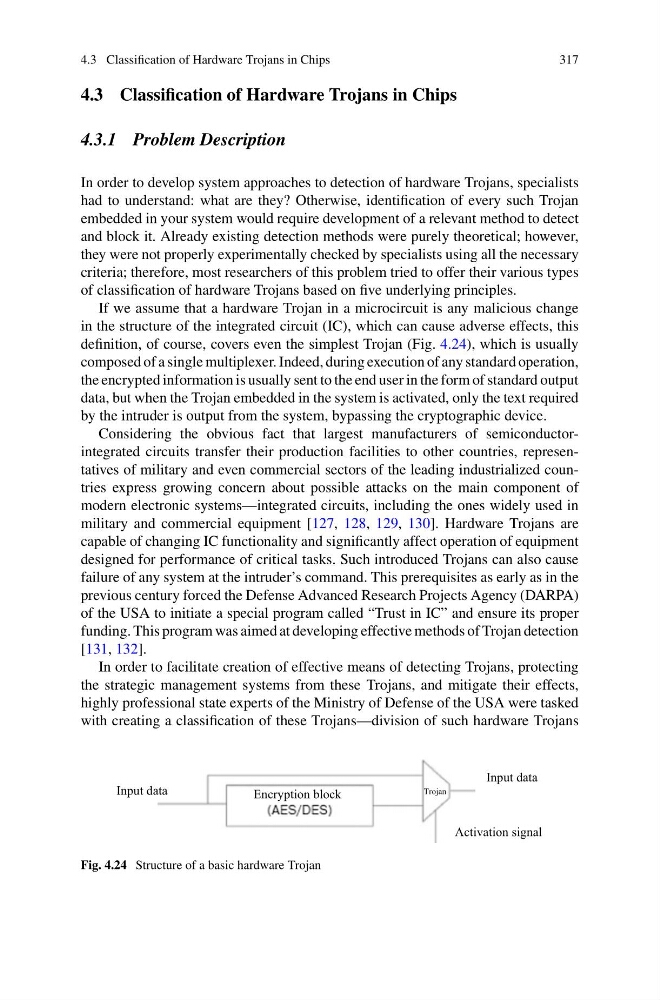
definition, of course, covers even the simplest Trojan (Fig. 4.24), which is usually
composed of a single multiplexer. Indeed, during execution of any standard operation,
the encrypted information is usually sent to the end user in the form of standard output
data, but when the Trojan embedded in the system is activated, only the text required
by the intruder is output from the system, bypassing the cryptographic device.
Considering the obvious fact that largest manufacturers of semiconductorintegrated circuits transfer their production facilities to other countries, representatives of military and even commercial sectors of the leading industrialized countries express growing concern about possible attacks on the main component of
modern electronic systems—integrated circuits, including the ones widely used in
military and commercial equipment [127, 128, 129, 130]. Hardware Trojans are
capable of changing IC functionality and significantly affect operation of equipment
designed for performance of critical tasks. Such introduced Trojans can also cause
failure of any system at the intruder’s command. This prerequisites as early as in the
previous century forced the Defense Advanced Research Projects Agency (DARPA)
of the USA to initiate a special program called “Trust in IC” and ensure its proper
funding. This program was aimed at developing effective methods of Trojan detection
[131, 132].
In order to facilitate creation of effective means of detecting Trojans, protecting
the strategic management systems from these Trojans, and mitigate their effects,
highly professional state experts of the Ministry of Defense of the USA were tasked
with creating a classification of these Trojans—division of such hardware Trojans
Input data
Encryption block
Trojan
Input data
Activation signal
Fig. 4.24 Structure of a basic hardware Trojan
317
4.3 Classification of Hardware Trojans in Chips
4.3.1 Problem Description
In order to develop system approaches to detection of hardware Trojans, specialists
had to understand: what are they? Otherwise, identification of every such Trojan
embedded in your system would require development of a relevant method to detect
and block it. Already existing detection methods were purely theoretical; however,
they were not properly experimentally checked by specialists using all the necessary
criteria; therefore, most researchers of this problem tried to offer their various types
of classification of hardware Trojans based on five underlying principles.
If we assume that a hardware Trojan in a microcircuit is any malicious change
in the structure of the integrated circuit (IC), which can cause adverse effects, this
definition, of course, covers even the simplest Trojan (Fig. 4.24), which is usually
composed of a single multiplexer. Indeed, during execution of any standard operation,
the encrypted information is usually sent to the end user in the form of standard output
data, but when the Trojan embedded in the system is activated, only the text required
by the intruder is output from the system, bypassing the cryptographic device.
Considering the obvious fact that largest manufacturers of semiconductorintegrated circuits transfer their production facilities to other countries, representatives of military and even commercial sectors of the leading industrialized countries express growing concern about possible attacks on the main component of
modern electronic systems—integrated circuits, including the ones widely used in
military and commercial equipment [127, 128, 129, 130]. Hardware Trojans are
capable of changing IC functionality and significantly affect operation of equipment
designed for performance of critical tasks. Such introduced Trojans can also cause
failure of any system at the intruder’s command. This prerequisites as early as in the
previous century forced the Defense Advanced Research Projects Agency (DARPA)
of the USA to initiate a special program called “Trust in IC” and ensure its proper
funding. This program was aimed at developing effective methods of Trojan detection
[131, 132].
In order to facilitate creation of effective means of detecting Trojans, protecting
the strategic management systems from these Trojans, and mitigate their effects,
highly professional state experts of the Ministry of Defense of the USA were tasked
with creating a classification of these Trojans—division of such hardware Trojans
Input data
Encryption block
Trojan
Input data
Activation signal
Fig. 4.24 Structure of a basic hardware Trojan