

280
4 Hardware Trojans in Microcircuits
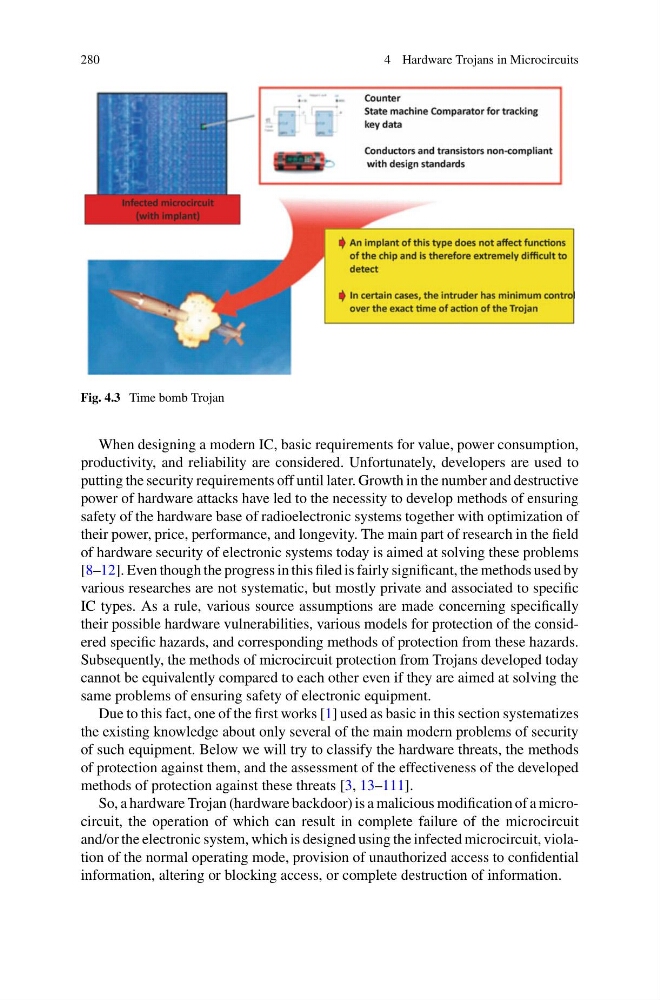
Fig. 4.3 Time bomb Trojan
When designing a modern IC, basic requirements for value, power consumption,
productivity, and reliability are considered. Unfortunately, developers are used to
putting the security requirements off until later. Growth in the number and destructive
power of hardware attacks have led to the necessity to develop methods of ensuring
safety of the hardware base of radioelectronic systems together with optimization of
their power, price, performance, and longevity. The main part of research in the field
of hardware security of electronic systems today is aimed at solving these problems
[8–12]. Even though the progress in this filed is fairly significant, the methods used by
various researches are not systematic, but mostly private and associated to specific
IC types. As a rule, various source assumptions are made concerning specifically
their possible hardware vulnerabilities, various models for protection of the considered specific hazards, and corresponding methods of protection from these hazards.
Subsequently, the methods of microcircuit protection from Trojans developed today
cannot be equivalently compared to each other even if they are aimed at solving the
same problems of ensuring safety of electronic equipment.
Due to this fact, one of the first works [1] used as basic in this section systematizes
the existing knowledge about only several of the main modern problems of security
of such equipment. Below we will try to classify the hardware threats, the methods
of protection against them, and the assessment of the effectiveness of the developed
methods of protection against these threats [3, 13–111].
So, a hardware Trojan (hardware backdoor) is a malicious modification of a microcircuit, the operation of which can result in complete failure of the microcircuit
and/or the electronic system, which is designed using the infected microcircuit, violation of the normal operating mode, provision of unauthorized access to confidential
information, altering or blocking access, or complete destruction of information.
4 Hardware Trojans in Microcircuits
Fig. 4.3 Time bomb Trojan
When designing a modern IC, basic requirements for value, power consumption,
productivity, and reliability are considered. Unfortunately, developers are used to
putting the security requirements off until later. Growth in the number and destructive
power of hardware attacks have led to the necessity to develop methods of ensuring
safety of the hardware base of radioelectronic systems together with optimization of
their power, price, performance, and longevity. The main part of research in the field
of hardware security of electronic systems today is aimed at solving these problems
[8–12]. Even though the progress in this filed is fairly significant, the methods used by
various researches are not systematic, but mostly private and associated to specific
IC types. As a rule, various source assumptions are made concerning specifically
their possible hardware vulnerabilities, various models for protection of the considered specific hazards, and corresponding methods of protection from these hazards.
Subsequently, the methods of microcircuit protection from Trojans developed today
cannot be equivalently compared to each other even if they are aimed at solving the
same problems of ensuring safety of electronic equipment.
Due to this fact, one of the first works [1] used as basic in this section systematizes
the existing knowledge about only several of the main modern problems of security
of such equipment. Below we will try to classify the hardware threats, the methods
of protection against them, and the assessment of the effectiveness of the developed
methods of protection against these threats [3, 13–111].
So, a hardware Trojan (hardware backdoor) is a malicious modification of a microcircuit, the operation of which can result in complete failure of the microcircuit
and/or the electronic system, which is designed using the infected microcircuit, violation of the normal operating mode, provision of unauthorized access to confidential
information, altering or blocking access, or complete destruction of information.