

238
3 Hardware Trojans in Electronic Devices
Mobile station transmit frequency band
Base station transmit frequency band
MHz
MHz
MHz
MHz
Duplex interval 45 MHz
Frequency band
Bandwidth per channel – 200 KHz
Bandwidth per channel – 200 KHz
Channels 1 … 124
Channels 1 … 124
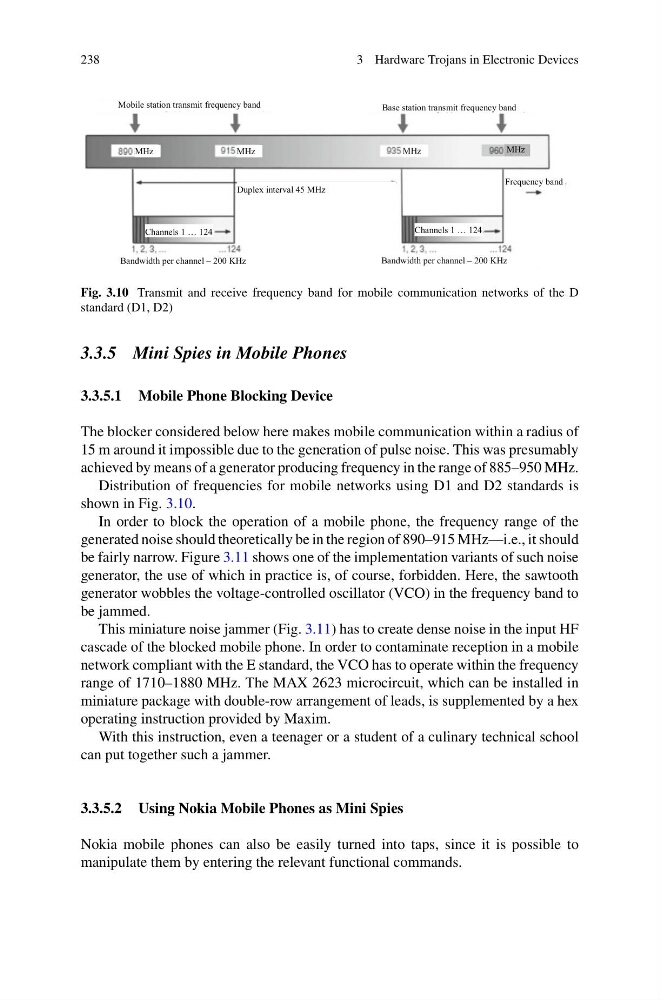
Fig. 3.10 Transmit and receive frequency band for mobile communication networks of the D
standard (D1, D2)
3.3.5 Mini Spies in Mobile Phones
3.3.5.1 Mobile Phone Blocking Device
The blocker considered below here makes mobile communication within a radius of
15 m around it impossible due to the generation of pulse noise. This was presumably
achieved by means of a generator producing frequency in the range of 885–950 MHz.
Distribution of frequencies for mobile networks using D1 and D2 standards is
shown in Fig. 3.10.
In order to block the operation of a mobile phone, the frequency range of the
generated noise should theoretically be in the region of 890–915 MHz—i.e., it should
be fairly narrow. Figure 3.11 shows one of the implementation variants of such noise
generator, the use of which in practice is, of course, forbidden. Here, the sawtooth
generator wobbles the voltage-controlled oscillator (VCO) in the frequency band to
be jammed.
This miniature noise jammer (Fig. 3.11) has to create dense noise in the input HF
cascade of the blocked mobile phone. In order to contaminate reception in a mobile
network compliant with the E standard, the VCO has to operate within the frequency
range of 1710–1880 MHz. The MAX 2623 microcircuit, which can be installed in
miniature package with double-row arrangement of leads, is supplemented by a hex
operating instruction provided by Maxim.
With this instruction, even a teenager or a student of a culinary technical school
can put together such a jammer.
3.3.5.2 Using Nokia Mobile Phones as Mini Spies
Nokia mobile phones can also be easily turned into taps, since it is possible to
manipulate them by entering the relevant functional commands.
3 Hardware Trojans in Electronic Devices
Mobile station transmit frequency band
Base station transmit frequency band
MHz
MHz
MHz
MHz
Duplex interval 45 MHz
Frequency band
Bandwidth per channel – 200 KHz
Bandwidth per channel – 200 KHz
Channels 1 … 124
Channels 1 … 124
Fig. 3.10 Transmit and receive frequency band for mobile communication networks of the D
standard (D1, D2)
3.3.5 Mini Spies in Mobile Phones
3.3.5.1 Mobile Phone Blocking Device
The blocker considered below here makes mobile communication within a radius of
15 m around it impossible due to the generation of pulse noise. This was presumably
achieved by means of a generator producing frequency in the range of 885–950 MHz.
Distribution of frequencies for mobile networks using D1 and D2 standards is
shown in Fig. 3.10.
In order to block the operation of a mobile phone, the frequency range of the
generated noise should theoretically be in the region of 890–915 MHz—i.e., it should
be fairly narrow. Figure 3.11 shows one of the implementation variants of such noise
generator, the use of which in practice is, of course, forbidden. Here, the sawtooth
generator wobbles the voltage-controlled oscillator (VCO) in the frequency band to
be jammed.
This miniature noise jammer (Fig. 3.11) has to create dense noise in the input HF
cascade of the blocked mobile phone. In order to contaminate reception in a mobile
network compliant with the E standard, the VCO has to operate within the frequency
range of 1710–1880 MHz. The MAX 2623 microcircuit, which can be installed in
miniature package with double-row arrangement of leads, is supplemented by a hex
operating instruction provided by Maxim.
With this instruction, even a teenager or a student of a culinary technical school
can put together such a jammer.
3.3.5.2 Using Nokia Mobile Phones as Mini Spies
Nokia mobile phones can also be easily turned into taps, since it is possible to
manipulate them by entering the relevant functional commands.