

3.1 Hardware Trojan Programs in Telecommunication Systems
211
Server
Router
Firewall
Wireless network
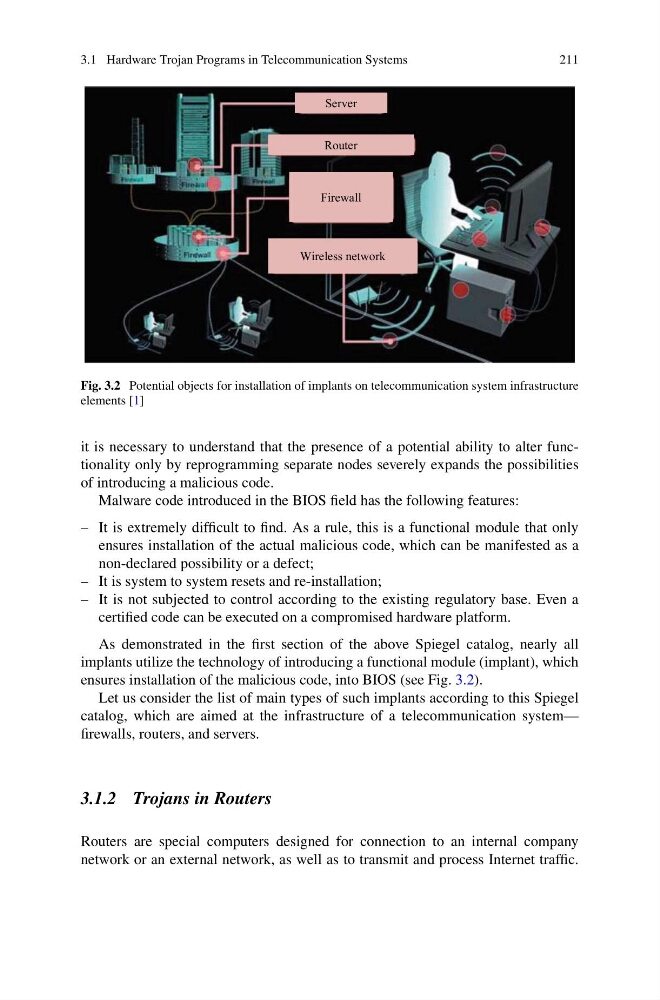
Fig. 3.2 Potential objects for installation of implants on telecommunication system infrastructure
elements [1]
it is necessary to understand that the presence of a potential ability to alter functionality only by reprogramming separate nodes severely expands the possibilities
of introducing a malicious code.
Malware code introduced in the BIOS field has the following features:
– It is extremely difficult to find. As a rule, this is a functional module that only
ensures installation of the actual malicious code, which can be manifested as a
non-declared possibility or a defect;
– It is system to system resets and re-installation;
– It is not subjected to control according to the existing regulatory base. Even a
certified code can be executed on a compromised hardware platform.
As demonstrated in the first section of the above Spiegel catalog, nearly all
implants utilize the technology of introducing a functional module (implant), which
ensures installation of the malicious code, into BIOS (see Fig. 3.2).
Let us consider the list of main types of such implants according to this Spiegel
catalog, which are aimed at the infrastructure of a telecommunication system—
firewalls, routers, and servers.
3.1.2 Trojans in Routers
Routers are special computers designed for connection to an internal company
network or an external network, as well as to transmit and process Internet traffic.
211
Server
Router
Firewall
Wireless network
Fig. 3.2 Potential objects for installation of implants on telecommunication system infrastructure
elements [1]
it is necessary to understand that the presence of a potential ability to alter functionality only by reprogramming separate nodes severely expands the possibilities
of introducing a malicious code.
Malware code introduced in the BIOS field has the following features:
– It is extremely difficult to find. As a rule, this is a functional module that only
ensures installation of the actual malicious code, which can be manifested as a
non-declared possibility or a defect;
– It is system to system resets and re-installation;
– It is not subjected to control according to the existing regulatory base. Even a
certified code can be executed on a compromised hardware platform.
As demonstrated in the first section of the above Spiegel catalog, nearly all
implants utilize the technology of introducing a functional module (implant), which
ensures installation of the malicious code, into BIOS (see Fig. 3.2).
Let us consider the list of main types of such implants according to this Spiegel
catalog, which are aimed at the infrastructure of a telecommunication system—
firewalls, routers, and servers.
3.1.2 Trojans in Routers
Routers are special computers designed for connection to an internal company
network or an external network, as well as to transmit and process Internet traffic.